

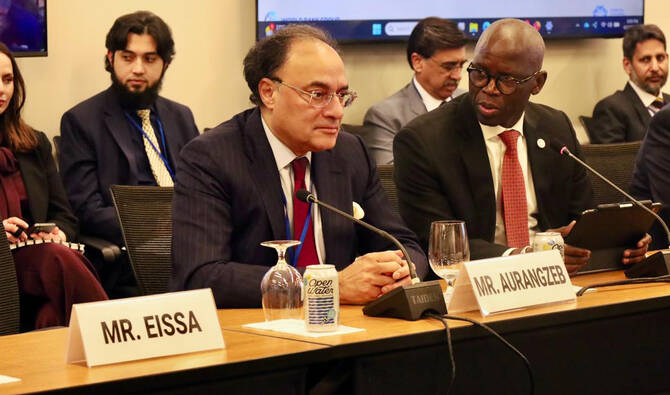

KARACHI: Finance Minister Muhammad Aurangzeb has concluded the final day of engagements on the sidelines of the International Monetary Fund-World Bank spring meetings in Washington and held a series of high-level meetings with officials of the United States, United Kingdom, global institutions and development partners to advance Pakistan’s economic interests, his ministry said on Friday.
Aurangzeb arrived in Washington this week to represent his country at the annual International Monetary Fund-World Bank spring meetings on Apr. 13-18, which brought together central bankers, finance ministers and private sector leaders to discuss the global economy and financial stability.
During his meeting with US Treasury Department Deputy Secretary Francis Brooke, the finance minister shared Pakistan’s progress on macroeconomic stabilization, re-entry into international capital markets, and prudent external debt management.
Pakistan has raised $500 million through a three-year Eurobond, marking its return to international capital markets after a four-year gap, a government adviser said on Friday, in a sign of improving investor sentiment toward the country’s economy.
“He highlighted investment opportunities in Pakistan’s minerals and energy sectors and briefed the US side on ongoing efforts related to digital and virtual asset regulation,” the Pakistani finance minister said.
“Both sides also discussed avenues for cooperation in energy, mineral development, and strengthening anti-money laundering and counter-financing of terrorism frameworks.”
The finance minister met UK Minister of State for Development Jennifer Chapman and highlighted that Pakistan has recorded a current account surplus during the first nine months of the fiscal year and remains firmly committed to meeting all fiscal targets by the end of this fiscal year in June.
“He also outlined the government’s response to the recent energy price shock through expenditure restraint, full price transmission, targeted subsidies, and direct support through digital wallets,” the finance ministry said.
“On climate resilience, he noted that recent flood-related relief was financed entirely through Pakistan’s own fiscal resources, supported by stronger buffers. He further highlighted the establishment of a forward-looking National Disaster Management Center equipped with AI and satellite technology. The Finance Minister appreciated the contribution of the Foreign, Commonwealth & Development Office.”
Separately, Aurangzeb held a meeting with Dr. Kalpana Kochhar, president for Global Policy and Advocacy at the Bill & Melinda Gates Foundation. Recalling his earlier engagement with Bill Gates on the sidelines of the World Economic Forum annual meeting, the finance minister stressed that polio eradication remains a national priority requiring sustained support, according to a Pakistani finance ministry statement.
The finance minister briefed Dr. Kochhar on Pakistan’s ongoing reforms, including digital compliance risk management systems and AI-led production monitoring. He emphasized that the government’s objective is to institutionalize durable reforms rather than pursue temporary fixes.
On vaccine financing, he noted the need for additional support beyond June-July and assured efforts to leverage strong bilateral ties with the Islamic Development Bank. Both sides agreed on the importance of continued learning and knowledge exchange.
In an interaction with President of the Asian Infrastructure Investment Bank Zou Jiayi, the finance minister appreciated AIIB’s robust engagement in Pakistan, with an ongoing portfolio of $1.7 billion and an additional $1 billion in the pipeline.
“He highlighted Pakistan’s planned inaugural Panda Bond issuance and recent Eurobond transaction as validations of macroeconomic stabilization. He invited AIIB to align future engagement with Pakistan’s infrastructure priorities under the World Bank Group Country Partnership Framework and the Asian Development Bank Country Partnership Strategy,” the statement read.
“Both sides also discussed measures to improve project implementation and accelerate disbursements.”
The finance minister held constructive meetings with S&P Global Ratings and Citibank officials as well as participated in a high-level roundtable titled “Delivering Social Protection Digitally: Lessons and Innovations from Pakistan, Middle East and North Africa,” organized by the World Bank Group.
The event showcased Pakistan’s Digital Public Infrastructure journey and transformation. In his remarks, the finance minister drew parallels between the COVID-19 demand shock and the current Middle East supply shock, emphasizing that countries investing early in governance and technology were better positioned to respond.
Aurangzeb stressed that digital social protection is not merely a payment mechanism but a powerful tool for financial inclusion and economic empowerment, particularly for women entering the formal financial system for the first time.
“The Finance Minister’s wide-ranging engagements on the final day of the Spring Meetings reflected Pakistan’s growing international economic confidence, commitment to reform, and determination to build strong partnerships for sustainable and inclusive growth,” the finance ministry added.


