

Pakistan’s anti-graft body to reopen corruption cases against former public office holders

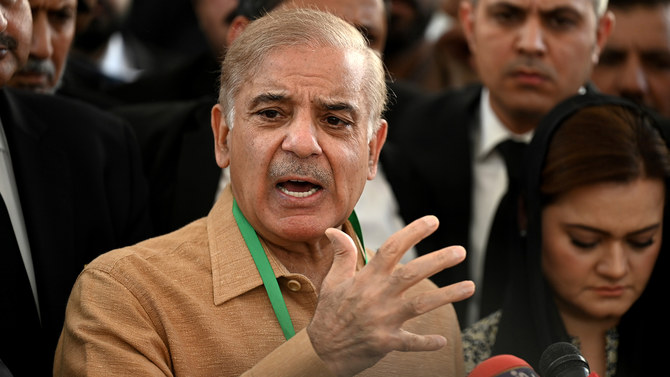
In this file photo, taken on April 5, 2022, Pakistan's former prime minister Shehbaz Sharif (C) addresses the members of the media before attending a hearing outside the Supreme Court building in Islamabad. (AFP/File)
Short Url
Updated 21 September 2023
Follow

Pakistan’s anti-graft body to reopen corruption cases against former public office holders

  • The country’s top court ordered the reinstatement of cases against suspects who embezzled less than Rs500 million
  • Corruption cases against public officials were dismissed following amendments to the legal accountability framework

ISLAMABAD: Pakistan’s anti-graft body is seeking to reopen cases involving former government officials accused of embezzling less than Rs500 million, said the local media on Thursday, as the South Asian nation gears up for general elections in January next year.

The Supreme Court of Pakistan gave a verdict last week to reinstate corruption references against public office holders that were dismissed after the administration of former prime minister Shehbaz Sharif made amendments to the country’s accountability laws. These amendments specified that the National Accountability Bureau (NAB) would not investigate corruption cases that involved less than Rs500 million.

According to local media reports, NAB has asked various authorities, including the Federal Investigation Agency (FIA), provincial anti-corruption units, banking courts, and the police, to return the corruption references that had been transferred to them as a result of the amendments.

Some of these cases involve high-profile individuals, such as former prime ministers Nawaz Sharif, Imran Khan, Shehbaz Sharif, Yousuf Raza Gilani, Raja Pervez Ashraf, Shahid Khaqan Abbasi, and Shaukat Aziz.

“The NAB headquarters has submitted an application before the registrar [of] accountability court Islamabad for [the] reopening of closed cases,” Pakistan’s Dawn newspaper said, citing a NAB source.

The exact count of the cases that are expected to be reopened following the top court’s verdict is still not clear, though an estimate suggests they are likely to be between 1,600 to 1,800 cases.

Aside from the former premiers, other prominent politicians whose cases are expected to be reopened include former president Asif Ali Zardari, former federal ministers Khawaja Saad Rafiq, Khawaja Asif, and Rana Sanaullah, among others.

The development comes at a time when Pakistan is gearing up for the next general elections which will be held in January amid heightened political, economic, and security crises in the country.


OIC’s COMSTECH stresses academic collaborations across Muslim world in Islamabad meeting

Updated 4 sec ago
Follow

OIC’s COMSTECH stresses academic collaborations across Muslim world in Islamabad meeting

  • COMSTECH holds annual meeting in Islamabad featuring 30 delegates from Iran, Somalia, Palestine, Indonesia and other OIC states
  • Limited pool of skilled professionals one of the foremost challenges facing Muslim world, notes COMSTECH secretary general 

ISLAMABAD: The OIC Standing Committee on Scientific and Technological Cooperation (COMSTECH) called for stronger academic collaboration across Islamic states to secure the future of higher education in the Muslim world, state-run media reported on Saturday. 

COMSTECH’s Coordinator General Prof. Dr. Muhammad Iqbal Choudhary was speaking at the Annual Meeting of the COMSTECH Consortium of Excellence at the organization’s Secretariat in Islamabad. The event brought together vice chancellors, rectors, and senior representatives from leading universities across OIC member and observer states. 

Nearly 30 international delegates representing universities from Iran, Somalia, Palestine, Indonesia, Malaysia, Thailand, Uganda, Bangladesh, Benin, Cameroon, Gabon, Côte d’Ivoire, and Senegal joined their counterparts from several Pakistani institutions at the meeting. Participants attempted to chart a collective path forward for tertiary education in OIC countries.

“Collaborations, knowledge sharing, best practices, exchange of scholars, technology transfer and joint academic programs are vital for overcoming the educational challenges faced across the OIC region,” Choudhary said, according to the state-run Associated Press of Pakistan (APP).

The COMSTECH secretary general noted that one of the foremost developmental challenges facing OIC nations remains the limited pool of skilled professionals and workforce. 

He said this gap can only be bridged through strengthened tertiary education systems and expanded opportunities for knowledge transfer.

Discussions at the event highlighted the urgent need for competency-driven education, modern pedagogical tools, university–industry partnerships and collaborative training programs designed to equip graduates with the skills necessary to address emerging global challenges.

“The Annual Meeting served as a vital platform for reviewing progress achieved over the past year, identifying future priorities, and deepening academic cooperation to promote scientific excellence and sustainable development across the OIC region,” the APP said.