Pakistan earmarks 10 state entities for possible privatization

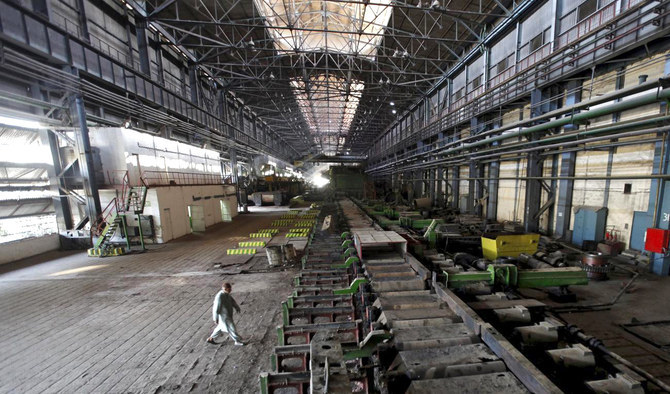
In this file photo, a man walks past machines at the hot strip mill department of the Pakistan Steel Mills (PSM) on the outskirts of Karachi on Feb. 8, 2016. (REUTERS/File)
Short Url
Updated 21 September 2023
Follow

Pakistan earmarks 10 state entities for possible privatization

  • Caretaker finance minister says the accumulated losses for state-owned entities amount to $1.74 billion
  • According to interim privatization minister, only one bidder is left for money-guzzling Pakistan Steel Mills

KARACHI: Pakistan’s caretaker government moved on Thursday to improve governance at state-owned companies and earmarked 10 for privatization or turnaround efforts, as it strives to deliver reforms under its International Monetary Fund (IMF) bailout.

Under the $3 billion bailout package from the IMF, that was critical in averting a sovereign debt default, state-owned entities (SOEs), whose losses are burning a hole in government finances, will need stronger governance.

As of 2020, the accumulated losses for SOEs amounted to 500 billion rupees ($1.74 billion), said caretaker finance minister Shamshad Akhtar at a press conference.

She said under the government’s draft policy on SOEs, the appointment of independent directors will be through a nomination process, adding that no ministry would be able to issue directives to SOEs in order to improve governance.

Later on Thursday, Pakistan’s caretaker privatization minister Fawad Hasan Fawad said there was only one bidder left for Pakistan Steel Mills (PSM).

He said that prior to COVID-19, there were four companies that were interested and qualified to bid for PSM, but three of them have backed out for a variety of reasons including global demand for steel.

Fawad added that the caretaker government was in talks with the financial planner appointed for the transaction; and that only PSM’s operational assets were up for sale.

Pakistan has also been discussing outsourcing operations of several of its state-owned assets to outside companies.

In March, it kicked off outsourcing of operations and land assets at three major airports to be run under a public-private partnership, a move to generate foreign exchange reserves for its ailing economy.

The government has budgeted only about 15 billion Pakistani rupees ($52.42 million) in receipts from a stalled privatization process in its budget for the fiscal year 2024.


Pakistan’s top military commander hails Saudi defense pact as ‘historic’ at scholars’ conference

Updated 10 December 2025
Follow

Pakistan’s top military commander hails Saudi defense pact as ‘historic’ at scholars’ conference

  • Asim Munir says Pakistan has a unique bond with the Kingdom, citing the ‘honor’ of helping safeguard the holy sites
  • He says only the state can declare jihad, urging religious scholars to counter extremist narratives and promote unity

ISLAMABAD: Chief of Defense Staff Field Marshal Asim Munir on Wednesday described the country’s joint security pact with Saudi Arabia as a “historic” milestone, telling a gathering of religious scholars that Pakistan and the kingdom share a deep strategic relationship.

Signed in September, the Strategic Mutual Defense Agreement has solidified decades of Saudi–Pakistan defense cooperation, covering intelligence-sharing, counterterrorism and regional stability.

The two nations have long coordinated on defense matters, with Pakistani military personnel deployed in the Kingdom.

“The defense agreement [with Saudi Arabia] is historic,” he said in an address to the conference in the federal capital.

The top military commander said Pakistan regarded its connection with the Kingdom as unique.

“Among all Muslim countries, Allah has given Pakistan the honor of helping safeguard the Haramain,” he continued, referring to the two holiest sites of Islam in Makkah and Madinah.

Munir used his speech to warn against extremism, saying that under the Islamic framework, only the state could declare jihad, a pointed reference to groups such as the Tehreek-e-Taliban Pakistan (TTP), which claims to act in the name of religion while carrying out attacks on civilians and security forces.

“When nations abandon knowledge and the pen, disorder takes hold,” he said, urging the religious scholars to help keep society unified and to “broaden the nation’s vision.”

Munir also criticized India, describing “terrorism” as “India’s habit, not Pakistan’s.”

His remarks came months after a four-day military confrontation in May, during which the two nuclear-armed neighbors exchanged artillery and missile fire and deployed drones and fighter jets.

India blamed Pakistan for a militant attack in Indian-administered Kashmir before launching a missile attack. Islamabad denied involvement and called for an international probe.

Pakistan claimed it had shot down six Indian fighter jets before a US-brokered ceasefire took effect.

“We do not hide when confronting the enemy,” Munir said. “We challenge openly.”