Lebanon ‘doesn’t need to be economic basket case,’ says US energy security tsar

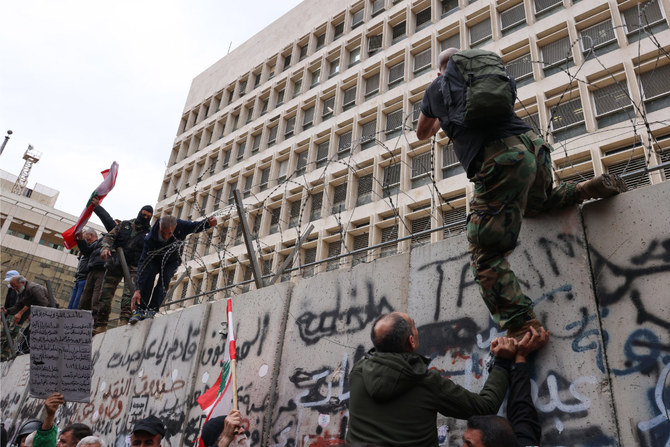
Retired servicemen try to remove the barbed wire barricade outside Lebanon's central bank during a demonstration demanding inflation-adjustments to their pensions in Beirut on March 30, 2023. (AFP/File photo)
Short Url
Updated 21 September 2023
Follow

Lebanon ‘doesn’t need to be economic basket case,’ says US energy security tsar

  • Amos Hochstein: ‘If the reform agenda is addressed, then I think for Lebanon the sky is the limit’
  • He visited the country in August to understand the potential for further negotiations with Israel

NEW YORK: Lebanon “doesn’t need to be the economic basket case that it is,” with the crisis-hit country’s business culture offering a path forward, the US president’s energy security tsar said on Wednesday.

“Lebanese run businesses in every country on the planet,” said Amos Hochstein. “Wherever you go there are Lebanese entrepreneurs, doctors, CEOs and financiers. But they have to leave Lebanon to do it.”

Hochstein, deputy assistant and senior adviser to the president for energy and investment, was addressing the inaugural Middle East Global Summit in New York, attended by Arab News.

Lt. Gen. Douglas Lute, former US permanent representative to NATO, served as moderator for the fireside-style discussion with Hochstein.

The energy security tsar served as lead negotiator of a maritime deal between Lebanon and Israel in late 2022, which saw a resolution that divided the disputed Qana and Karish gas fields between the two countries.

Lute asked Hochstein if that deal could serve as a catalyst for further negotiations and closer ties.

“Everybody told me that it wasn’t possible. I really credit both countries with walking away from the naysayers to do it,” Hochstein said.

“We should always be creating precedents. It (the deal) should be a precedent for other things that we can do.”

Hochstein visited Lebanon in late August to “take the temperature” and understand the potential for further negotiations with Israel, which the US has encouraged across the region.

He also visited Saudi Arabia in June as part of a US bid to encourage normalization with Israel.

He said it is “imperative” for Lebanon to “have civility” so that international businesses can operate securely in the country.

“After 10 years of talking about why Lebanon is the only Mediterranean country without (gas) exploration — and everybody sounds like a broken record: ‘It’s because multibillion-dollar companies don’t invest in areas that could go to war’.”

But Hochstein said: “We can settle the conflict. Now it’s secure. There are already other interests, there’s already job creation, and there are already investments in Lebanon.

“That’s the message. Lebanon doesn’t need to be the economic basket case that it is. And I’m using harsh words but somebody’s got to wake up, and a lot of people in Lebanon need to wake up and say, ‘This is a disaster.’ If the reform agenda is addressed, then I think for Lebanon the sky is the limit.”

Hochstein was asked about the recent signing of a deal between the US, the EU and other countries, including Saudi Arabia, to commit to the creation of an economic and digital corridor from the Indo-Pacific region to Europe.

He said: “Ports from India … will connect to the UAE, and connect north via Saudi, and then via rail to Greece.”

Hochstein praised the proposal as highly efficient and as making it possible to “move goods in a much faster way” around the world.


Israel objects to US announcement of leaders who will play a role in overseeing next steps in Gaza

Updated 55 min 44 sec ago
Follow

Israel objects to US announcement of leaders who will play a role in overseeing next steps in Gaza

  • Trump administration earlier in the week said the US-drafted ceasefire plan for Gaza was now moving into its challenging second phase

JERUSALEM: Israel’s government is objecting to the White House announcement of leaders who will play a role in overseeing next steps in Gaza.

The rare criticism from Israel of its close ally in Washington says the Gaza executive committee “was not coordinated with Israel and is contrary to its policy,” without details.

Saturday’s statement also said Prime Minister Benjamin Netanyahu has told the foreign ministry to contact Secretary of State Marco Rubio.

The committee announced by the White House on Friday includes no Israeli official but has an Israeli businessman. Other members announced so far include two of US President Donald Trump’s closest confidants, a former British prime minister, an American general and a collection of top officials from Middle Eastern governments.

The White House has said the executive committee will carry out the vision of a Trump-led “Board of Peace,” whose members have not yet been named. The White House also announced the members of a new Palestinian committee to run Gaza’s day to day affairs, with oversight from the executive committee.

The committee’s members include US Secretary of State Marco Rubio, Trump envoy Steve Witkoff, Trump’s son-in-law Jared Kushner, former British Prime Minister Tony Blair, Apollo Global Management CEO Marc Rowan, World Bank President Ajay Banga and Trump’s deputy national security adviser Robert Gabriel.

The Trump administration earlier in the week said the US-drafted ceasefire plan for Gaza was now moving into its challenging second phase, which includes the new Palestinian committee in Gaza, deployment of an international security force, disarmament of Hamas and reconstruction of the war-battered territory.

The ceasefire took effect on Oct. 10, with the first phase focusing on the return of all remaining hostages in exchange for the release of hundreds of Palestinian detainees, along with a surge in humanitarian aid and a partial withdrawal of Israeli forces in Gaza.