

UN should support Bosnia and Herzegovina to maintain peace in Western Balkans, says leader

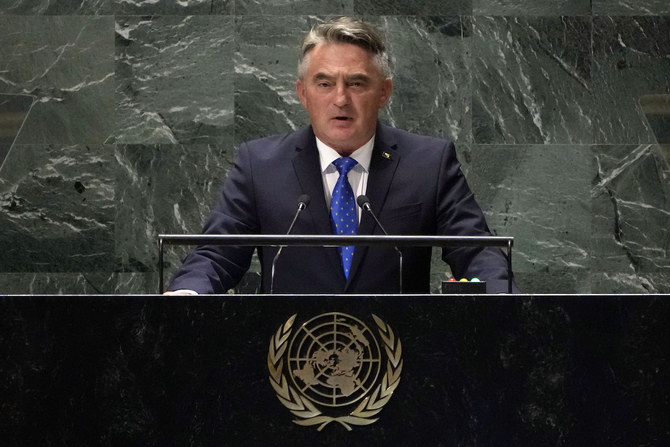
Chairman of the Presidency of Bosnia and Herzegovina Zeljko Komsic addresses the 78th session of the UNGA, Wednesday, Sept. 20, 2023. (AP)
Short Url
Updated 21 September 2023
Follow

UN should support Bosnia and Herzegovina to maintain peace in Western Balkans, says leader

  • Zeljko Komsic: Neighbors cannot divide his country ‘among themselves without entering into mutual conflict’
  • Migration of highly educated, skilled workers in search of better opportunities abroad causing ‘brain drain’

LONDON: The UN should support Bosnia and Herzegovina and its institutions to help maintain peace in the Western Balkans, Zeljko Komsic, the chairman of the country’s tripartite presidency, said on Wednesday.

Addressing the UN General Assembly in New York, he said: “If the United Nations wishes to preserve peace in the Western Balkans, then it should support those who have not violated democratic and civilization norms, who have not committed genocide, who are not part of joint criminal enterprises, did not destroy people’s lives because of their ethnicity, did not destroy other people’s temples or shrines, and did not advocate revenge.”

Komsic warned that Bosnia and Herzegovina’s neighbors cannot divide the country “among themselves without entering into mutual conflict.”

He added that “there are many, both in the East and the West, who believe that their barely hidden support for those who want to completely control, and ultimately divide, Bosnia and Herzegovina will bring stability to the Western Balkans.”

But he said any attempt to divide the country will not bring stability or progress to the region.

“We will certainly not allow the division and disappearance of our 1,000-year-old state at any cost, no matter what anyone thinks about it,” Komsic said.

He also highlighted the problem his nation faces with regard to the number of people who migrate to other countries in search of better lives.

“In my country, there is a significant outflow of population going to larger and more-developed countries, mostly to countries we view as Western democratic countries,” he said.

This “brain drain” of educated professionals, such as doctors, engineers and scientists who leave in search of better opportunities, affects a number of smaller countries, he added.

“The current form of migration management has reached such a stage where large and powerful countries, for their own benefit, carry out a certain type of selection of migrants in such a way as to select the best and most educated among them … ushering them to larger countries where their knowledge and abilities are exploited exclusively for the benefit of these larger systems,” said Komsic.

This means “the potentials and capacities of smaller countries from which the migrants come are being weakened” as they lose “their best-quality personnel” and the “investments made in creating these highly qualified profiles.”


The last US-Russia nuclear pact expires, prompting fears of a new arms race

Updated 2 sec ago
Follow

The last US-Russia nuclear pact expires, prompting fears of a new arms race

MOSCOW: The last remaining nuclear arms pact between Russia and the United States expired Thursday, removing any caps on the two largest atomic arsenals for the first time in more than a half-century.
The termination of the New START Treaty could set the stage for what many fear could be an unconstrained nuclear arms race.
Russian President Vladimir Putin last year declared readiness to stick to the treaty’s limits for another year if Washington follows suit, but US President Donald Trump has been noncommittal about extending it.
Putin discussed the pact’s expiration with Chinese leader Xi Jinping on Wednesday, Kremlin adviser Yuri Ushakov said, noting Washington hasn’t responded to his proposed extension.
Russia “will act in a balanced and responsible manner based on thorough analysis of the security situation,” Ushakov said.
Russia’s Foreign Ministry on Wednesday night said in a statement that “under the current circumstances, we assume that the parties to the New START Treaty are no longer bound by any obligations or symmetrical declarations within the context of the Treaty, including its core provisions, and are fundamentally free to choose their next steps.”
New START, signed in 2010 by then-President Barack Obama and his Russian counterpart, Dmitry Medvedev, restricted each side to no more than 1,550 nuclear warheads on no more than 700 missiles and bombers — deployed and ready for use. It was originally supposed to expire in 2021 but was extended for five more years.
The pact envisioned sweeping on-site inspections to verify compliance, although they stopped in 2020 because of the COVID-19 pandemic and never resumed.
In February 2023, Putin suspended Moscow’s participation, saying Russia couldn’t allow US inspections of its nuclear sites at a time when Washington and its NATO allies have openly declared Moscow’s defeat in Ukraine as their goal. At the same time, the Kremlin emphasized it wasn’t withdrawing from the pact altogether, pledging to respect its caps on nuclear weapons.
In offering in September to abide by New START’s limits for a year to buy time for both sides to negotiate a successor agreement, Putin said the pact’s expiration would be destabilizing and could fuel nuclear proliferation.
New START followed a long succession of US-Russian nuclear arms reduction pacts. Those have been terminated, as well.