

Tunisian president’s remarks on Storm Daniel have been denounced as antisemitic and prompt an uproar

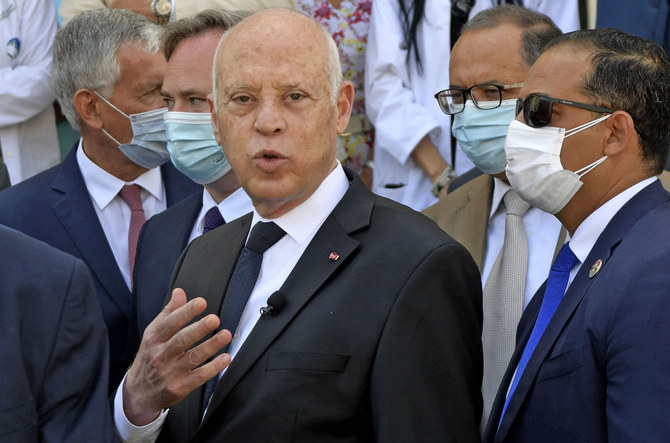
Saied suggested that US-sponsored talks to issue normalization agreements between Israel and some Arab states were connected to “Zionists abroad. (AFP)
Short Url
Updated 20 September 2023
Follow

Tunisian president’s remarks on Storm Daniel have been denounced as antisemitic and prompt an uproar

  • The storm destroyed entire neighborhoods in the Libyan city of Derna, killing thousands of people

TUNIS, Tunisia: Tunisian President Kais Saied ‘s remarks about Storm Daniel have been denounced as antisemitic, prompting an uproar on Tuesday on social media platforms across the world following floods that devastated a Libyan city.
Speaking during a government meeting on Monday, Saied pointed to the name Daniel, which was chosen for the storm, making the link with the name of a Hebrew prophet, in a video broadcast overnight on the Tunisian presidency’s social media.
“Didn’t anyone wonder why the name Daniel was chosen?” Saied asked, adding: “Because the Zionist movement has infiltrated minds and thinking, we’ve fallen into a cognitive coma.”
The storm destroyed entire neighborhoods in the Libyan city of Derna, killing thousands of people.
Names of storms are chosen by meteorological authorities through a alphabetical list alternating female and male easy-to-remember names. Daniel is a very common name across the world.
Many scholars and human rights advocates denounced the remarks on social media.
The US-based Anti-Defamation League, a Jewish civil rights organization, “strongly” condemned Saied’s words as antisemitic comments that “resonate with some of the worst conspiracy theories of Jewish control of the weather,” according to a post on X, formerly known as Twitter.
The Union of French Jewish Students tweeted that Saied “reiterated intolerable anti-Semitic comments.”
Saied also suggested that US-sponsored talks to issue normalization agreements between Israel and some Arab states were connected to “Zionists abroad.”
“Normalization for me is a major betrayal. The rights of the Palestinian people must be exercised throughout the entire Palestinian territory,” he said.
In 2021, Saied denied accusations that he made antisemitic remarks while trying to calm youths after days of unrest.
Saied’s statement was in response to allegations by the Conference of European Rabbis that he accused Jews of being responsible “for the instability of the country.” The statement, relayed by some Israeli media, caused an uproar, forcing Saied to address the allegations, which his office firmly denied.


UN must ‘carefully’ heed Lebanese views as it weighs post-UNIFIL options, peacekeeping chief says

Updated 14 sec ago
Follow

UN must ‘carefully’ heed Lebanese views as it weighs post-UNIFIL options, peacekeeping chief says

  • Jean Pierre Lacroix tells Arab News he heard nothing while visiting the country that cast doubt on the political will of authorities to disarm Hezbollah and implement UN resolution
  • Frequency of Israeli attacks ‘has been quite high and has been increasing,’ he says, warning that some of them could have had ‘very tragic consequences’

NEW YORK CITY: The UN must take its lead from authorities in Lebanon as it weighs its options for international support after the UN’s peacekeeping mission in the country ends, the head of UN peace operations said on Friday.
The views of Beirut must be central to any future arrangement, he stressed.
“We have to listen carefully to the Lebanese authorities,” Jean-Pierre Lacroix, the UN under-secretary-general for peace operations, told Arab News during a virtual press conference from Saudi Arabia, in reference to discussions about what UN support for the country might look like when the UN Interim Force in Lebanon’s peacekeeping mandate ends.
He was speaking during a regional tour that has taken him to Lebanon, Syria, Jordan and Israel, during which he met senior political and military officials as well as members of the UN peacekeeping force on the ground.
UNIFIL will continue to operate in Lebanon until its current mandate expires on Dec. 31 this year, with all forces remaining in place until then, Lacroix said. “There is no predrawdown mandate,” he added.
The UN Security Council voted in August last year to grant one final extension to the UNIFIL mandate through the end of 2026, despite Lebanon’s objections. It came as Israel and the US pressed for an end to the decades-old peacekeeping mission, established in 1978, and amid a renewed push to enforce Resolution 1701.
The resolution ended the 2006 war between Israel and Hezbollah. It also underpins their current truce, and calls for the Lebanese state to assert exclusive control over security in the south of the country and to disarm all non-state armed groups.
Lacroix said the relationship between UNIFIL and Lebanese authorities was “excellent,” and cooperation with the Lebanese Armed Forces remained strong. He praised what he described as the political will in Beirut to advance the full implementation of Resolution 1701, citing in particular the recent announcement by Lebanese authorities outlining the first phase of their efforts to establish operational control south of the Litani River. He also acknowledged that significant work remains to be done.
Asked about the disarmament of Hezbollah, Lacroix told Arab News he had heard nothing during his visit that casts doubt on the political will of Lebanese authorities to achieve this, while acknowledging that there are differing assessments among interlocutors about the pace of progress and the risk of rearmament.
“The bottom line for us is that there is momentum,” he said, adding that the UN’s role was to support Lebanese efforts through both its peacekeeping mission and political engagement.
The Security Council has asked UN Secretary-General Antonio Guterres to present options for post-UNIFIL support for Resolution 1701 by June 1. Work on that is ongoing, he said, and includes consultations with Lebanese and Israeli authorities, as well as members of the Security Council.
While Lebanese leaders have expressed concern about the end of UNIFIL’s mission and interest in maintaining some form of UN presence in the country, Lacroix said any successor arrangement would be decided by the Security Council.
He declined to speculate about the form or size of any future force. Several factors would need to be assessed, he said, including the security environment and the level of international support for the Lebanese Armed Forces.
However, he repeatedly emphasized the need for greater backing of the Lebanese army from international partners, describing such support as “more important than ever.”
Lacroix described the “appalling” widespread destruction he had witnessed during his visit to southern Lebanon along the Blue Line that separates the country from Israel. Many villages had been heavily damaged and Lebanese civilians were still unable to return to their homes, he said, warning that this complicates the prospects for rehabilitation and reconstruction.
He also raised concerns about the safety of UN peacekeepers as their operating environment had become increasingly dangerous. While relations with local communities were generally good, he said UNIFIL had faced a growing number of hostile incidents involving the Israeli army.
“The frequency of (Israeli attacks) has been quite high and has been increasing,” he said, warning that some of them could have had “very tragic consequences.”
He said he had raised this issue directly with Israeli officials, and called for action to be taken to prevent further incidents, stressing that all parties have a responsibility to ensure the safety of peacekeepers.
Turning to Syria, Lacroix said the Israeli military presence in the UN-monitored area of separation has become the main challenge for peacekeepers, as Israeli forces occupy 10 positions in a zone reserved under a 1974 agreement for UN troops only. Daily liaison with Israeli forces had helped limit the effects on civilians, he added.
“Our objective remains a return to full implementation of the 1974 agreement,” Lacroix said, and he welcomed US-mediated talks between Israel and Syria.
He also addressed the effects of budget cuts on UN peacekeeping missions. Financial shortfalls had forced missions, including UNIFIL, to reduce patrols and prioritize certain areas, he said, limiting their ability to support national forces and protect civilians.
Jordanian officials have expressed support for Lebanon’s efforts and are providing assistance, he added, including training for members of the Lebanese Armed Forces.
Lacroix said he had yet to meet Saudi officials but expected to discuss Lebanon with them during upcoming talks. He also noted Saudi Arabia’s role in discussions about a possible international conference to support the Lebanese army.