

UN chief calls for Security Council reform

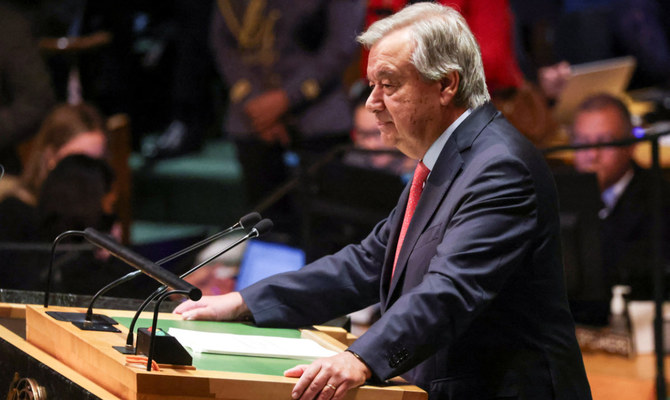
United Nations Secretary-General Antonio Guterres addresses the 78th Session of the U.N. General Assembly in New York City, US, September 19, 2023. (Reuters)
Short Url
Updated 19 September 2023
Follow

UN chief calls for Security Council reform

  • Antonio Guterres: ‘The world has changed. Our institutions have not’
  • Secretary-general highlights crises in Libya, Sudan, Palestine, Syria

NEW YORK: The UN Security Council must be reformed to meet the demands of the modern world amid an “unhinging” of the global system, Secretary-General Antonio Guterres told the UN General Assembly on Tuesday.

He began his speech by highlighting the tragedy in Libya, where thousands have died as a result of flooding.

Those living in the coastal city of Derna and surrounding areas were “victims many times over,” Guterres said.

They were “victims of years of conflict, victims of climate chaos and victims of leaders near and far.”

Derna is a “sad snapshot of the state of our world — the flood of inequity, of injustice, of inability to confront the challenges in our midst,” Guterres said.

And amid a world that is “becoming unhinged,” where “geopolitical tensions are rising” and “global challenges are mounting,” it is “high time to renew multilateral institutions based on 21st-century political and economic realities.”

He noted the transition of the global system toward multipolarity — where different power centers maintain influence — but warned that the new reality requires “strong and effective multilateral institutions” to operate peacefully and effectively.

Guterres described the UN as reflecting the world of 1945, “when many countries in this Assembly Hall were still under colonial domination.”

He added: “The world has changed. Our institutions have not. We cannot effectively address problems as they are if institutions don’t reflect the world as it is.”

As a result of the outdated system, “divides are deepening,” Guterres warned, highlighting “divides among economic and military powers,” and “divides between north and south, east and west.”

The world is “inching ever closer to a great fracture in economic and financial systems and trade relations, one that threatens a single, open internet, with diverging strategies on technology and artificial intelligence, and potentially clashing security frameworks.”

Guterres called for the UNSC and global financial system to be reformed in line with the demands of the modern world. But reforms are “a question of power,” he said. “I have no illusions.”

Statesmanship should serve as the target instead of gamesmanship and gridlock, he said, adding: “It is time for a global compromise. Politics is compromise. Diplomacy is compromise. Effective leadership is compromise.”

Guterres also noted crises affecting the Arab world and Africa, including in the Sahel, where a “series of coups is further destabilizing the region as terrorism is gaining ground.”

He added: “Sudan is descending into full-scale civil war; millions have fled and the country risks splitting apart.”

And the “escalating violence and bloodshed” in Palestine is “taking a terrible toll on civilians,” he said, adding that the two-state solution is “the only pathway to lasting peace and security.”

Syria, meanwhile, “remains in ruins while peace remains remote,” said Guterres, who concluded by calling for climate action, noting that COP28, hosted by the UAE, is “around the corner.”

He added: “To all those working, marching and championing real climate action, I want you to know you are on the right side of history. I’m with you. I won’t give up this fight of our lives.”


Bondi Beach shooting suspect conducted firearms training with his father, Australian police say

Updated 11 sec ago
Follow

Bondi Beach shooting suspect conducted firearms training with his father, Australian police say

MELBOURNE, Australia: A man accused of killing 15 people at Sydney’s Bondi Beach conducted firearms training in an area of New South Wales state outside of Sydney with his father, according to Australian police documents released on Monday.
The documents, made public following Naveed Akram’s video court appearance from a Sydney hospital where he has been treated for an abdominal injury, said the two men recorded footage justifying the meticulously planned attack.
Officers wounded Akram at the scene of the Dec. 14 shooting and killed his father, 50-year-old Sajid Akram.
The state government confirmed Naveed Akram was transferred Monday from a hospital to a prison. Authorities identified neither facility.
The 24-year-old and his father began their attack by throwing four improvised explosive devices toward a crowd celebrating an annual Jewish event at Bondi Beach, but the devices failed to explode, the documents said.
Police described the devices as three aluminum pipe bombs and a tennis ball bomb containing an explosive, gunpowder and steel ball bearings. None detonated, but police described them as “viable” IEDs.
The pair had rented a room in the Sydney suburb of Campsie for three weeks before they left at 2:16 a.m. on the day of the attack. CCTV recorded them carrying what police allege were two shotguns, a rifle, five IEDs and two homemade Daesh group flags wrapped in blankets.
Police also released images of the gunmen shooting from a footbridge, providing them with an elevated vantage point and the protection of waist-high concrete walls.
The largest IED was found after the gunbattle near the footbridge in the trunk of the son’s car, which had been left draped with the flags.
Authorities have charged Akram with 59 offenses, including 15 counts of murder, 40 counts of causing harm with intent to murder in relation to the wounded survivors and one count of committing a terrorist act.
The antisemitic attack at the start of the eight-day Hanukkah celebration was Australia’s worst mass shooting since a lone gunman killed 35 people in Tasmania state in 1996.
The New South Wales government introduced draft laws to Parliament on Monday that Premier Chris Minns said would become the toughest in Australia.
The new restrictions would include making Australian citizenship a condition of qualifying for a firearms license. That would have excluded Sajid Akram, who was an Indian citizen with a permanent resident visa.
Sajid Akram also legally owned six rifles and shotguns. A new legal limit for recreational shooters would be a maximum of four guns.
Police said a video found on Naveed Akram’s phone shows him with his father expressing “their political and religious views and appear to summarise their justification for the Bondi terrorist attack.”
The men are seen in the video “condemning the acts of Zionists” while they also “adhere to a religiously motivated ideology linked to Islamic State,” police said, using another term for the Daesh Group.
Video shot in October shows them “firing shotguns and moving in a tactical manner” on grassland surrounded by trees, police said.
“There is evidence that the Accused and his father meticulously planned this terrorist attack for many months,” police allege.
An impromptu memorial that grew near the Bondi Pavilion after the massacre, as thousands of mourners brought flowers and heartfelt cards, was removed Monday as the beachfront returned to more normal activity. The Sydney Jewish Museum will preserve part of the memorial.
Victims’ funerals continued Monday with French national Dan Elkayam’s service held in the nearby suburb of Woollahra, at the heart of Sydney’s Jewish life. The 27-year-old moved from Paris to Sydney a year ago.
The health department said 12 people wounded in the attack remained in hospitals on Monday.