Yale graduates stage pro-Palestinian walkout of commencement

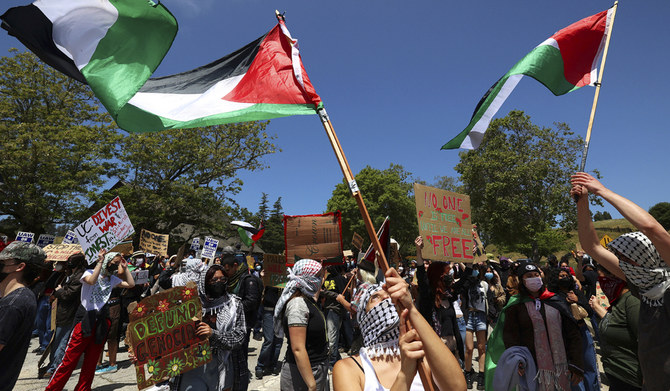
University of California, Santa Cruz graduate students and other academic workers in the UAW 4811 union begin a strike and are joined by UCSC students for Justice in Palestine as they picket the main entrance to campus on Monday, May 20, 2024, in Santa Cruz, Calif. (AP)
Short Url
Updated 21 May 2024
Follow

Yale graduates stage pro-Palestinian walkout of commencement

  • Russia’s UN ambassador, Vassily Nebenzia, denied that his nation was trying to mislead the world. Backed by China and others, he called the vote “a unique moment of truth for our Western colleagues”

NEW HAVEN, Connecticut: Scores of graduating students staged a walkout from Yale University’s commencement exercises on Monday, protesting the Israeli war in Gaza, Yale’s financial ties to weapons makers and its response to pro-Palestinian demonstrations on the Ivy League campus.
The walkout began as Yale President Peter Salovey started to announce the traditional college-by-college presentation of candidates for degrees on the grounds of Yale’s Old Campus, filled with thousands of graduates in their caps and gowns.
At least 150 students seated near the front of the audience stood up together, turned their backs to the stage and paraded out of the ceremony through Phelps Gate, retracing their steps during the processional into the yard.
Many of the protesters carried small banners with such slogans as “Books not bombs” and “Divest from war.” Some wore red-colored latex gloves symbolizing bloodied hands.
Other signs read: “Drop the charges” and “Protect free speech” in reference to 45 people arrested in a police crackdown last month on demonstrations in and around the New Haven, Connecticut, campus.
The walkout drew a chorus of cheers from fellow students in the crowd, but the protest was otherwise peaceful, without disruption. No mention of it was made from the stage.
Yale is one of dozens of US campuses roiled by protests over the mounting Palestinian humanitarian crisis stemming from Israel’s offensive in the Gaza Strip following the bloody Oct. 7 cross-border attack on Jewish settlements by Hamas militants.
The University of Southern California canceled its main graduation ceremony altogether, and dozens of students walked out of Duke University’s commencement last week to protest its guest speaker, comedian Jerry Seinfeld, who has supported Israel throughout the war in Gaza.

ACADEMIC WORKERS STRIKE UC SANTA CRUZ
Fallout from a violent attack weeks ago on pro-Palestinian activists encamped at the University of California, Los Angeles, reverberated on the UC Santa Cruz campus on Monday as academic workers there staged a protest strike organized by their union.
Much of the student activism has been aimed at academic institutions’ financial ties with Israel and US military programs benefiting the Jewish state.
Protests in sympathy with Palestinians have in turn been branded by pro-Israel supporters as antisemitic, testing the boundaries between freedom of expression and hate speech. Many schools have called in police to quell the demonstrations.
At UC Santa Cruz on Monday, hundreds of unionized academic researchers, graduate teaching assistants and post-doctoral scholars went on strike to protest what they said were the university’s unfair labor practices in its handling of pro-Palestinian demonstrations.
The strikers are members of the United Auto Workers (UAW) Local 4811, which represents some 2,000 grad students and other academic workers at UC Santa Cruz, and about 48,000 total across all 10 University of California campuses and the Lawrence Berkeley National Laboratory.
Last week, the UAW 4811 rank-and-file voted to authorize union leaders to organize a series of “standup” strikes through the end of June on individual or groups of UC campuses rather than across the entire university.
The Santa Cruz strike marked the first union-backed protest in solidarity with the recent wave of pro-Palestinian student activists, whose numbers, according to the UAW, include graduate students arrested at several University of California campuses.
Union leaders said a major impetus for the strike was the arrest of 210 people at the scene of a pro-Palestinian protest camp torn down by police at UCLA on May 2.
The night before, a group of pro-Israel supporters physically attacked the encampment and its occupiers in a melee that went on for at least three hours before police moved in to quell the disturbance. The university has since opened an investigation of the incident.
The strikers also are demanding amnesty for grad students who were arrested or face discipline for their involvement in the protests.
UC Santa Cruz issued a statement saying campus entrances were briefly blocked in the morning by demonstrators, prompting the school to switch to remote instruction for the day.
The University of California has filed its own unfair labor practice complaint with the state Public Employee Relations Board asking the state to order a halt to the strike.


With Iran war exit elusive, Trump aides vie to affect outcome

Updated 13 March 2026
Follow

With Iran war exit elusive, Trump aides vie to affect outcome

  • Aides debate when and how to declare victory even as the conflict spreads across the Middle East
  • In taking America to war, US President Donald Trump offered little explanation

WASHINGTON: A complex tug-of-war inside the White House is driving US President Donald Trump’s shifting public statements on the course of the Iran war, as aides debate when and how to declare victory even as the conflict spreads across the Middle East.

Some officials and advisers are warning Trump that surging gasoline prices could exact a political cost from the US-Israeli attacks on Iran, while some hawks are pressing the president to maintain the offensive against the Islamic Republic, according to interviews with a Trump adviser and others close to the deliberations.

Their observations to Reuters offer a previously unreported glimpse inside White House decision-making as it adjusts its approach to the biggest US military operation since the 2003 Iraq war.

Shifting messages, various internal viewpoints

The behind-the-scenes maneuvering underscores the high stakes Trump, who returned to office last year promising to avoid “stupid” military interventions, faces nearly two weeks after plunging the nation into a war that has rattled global financial markets and disrupted the international oil trade.

The jockeying for Trump’s ear is a feature of his presidency, but this time the consequences are a matter of war and peace in one of the world’s most volatile and economically critical regions.

Shifting from the sweeping goals he framed in launching the war on February 28, Trump in recent days has emphasized that he views the conflict as a limited campaign whose objectives have mostly been met.

But the message remains unclear to many, including the energy markets, which have lurched in both directions in response to Trump’s statements.

He told a campaign-style rally in Kentucky on Wednesday that “we won” the war, then abruptly pivoted: “We don’t want to leave early, do we? We’ve got to finish the job.”

Economic advisers and officials, including from the Treasury Department and the National Economic Council, have warned Trump that an oil shock and rising gasoline prices could quickly erode domestic support for the war, said the adviser and two others close to the deliberations, speaking on the condition of anonymity to disclose internal discussions.

Political advisers, including Chief of Staff Susie Wiles and deputy chief James Blair, are making similar arguments, focusing on the political fallout from higher gas prices and urging Trump to define victory narrowly and signal the operation is limited and nearly finished, the sources said.

Pushing in the other direction are hawkish voices urging Trump to sustain military pressure on Iran, including Republican lawmakers such as US Senators Lindsey Graham and Tom Cotton, and media commentators such as Mark Levin, according to people familiar with the matter.

They argue the US must prevent Iran from obtaining a nuclear weapon and respond forcefully to attacks on American troops and shipping.

A third force comes from Trump’s populist base and figures such as strategist Steve Bannon and right-wing television personality Tucker Carlson, who have been pressing him and his top aides to avoid getting dragged into another prolonged Middle East conflict.

“He is allowing the hawks to believe the campaign continues, wants markets to believe the war might end soon and his base to believe escalation will be limited,” the Trump adviser said.

Asked for comment, White House press secretary Karoline Leavitt said in a statement: “This story is based on gossip and speculation from anonymous sources who aren’t even in the room for any discussions with President Trump.

“The President is known for being a good listener and seeking the opinions of many people, but ultimately everyone knows he’s the final decision maker and his own best messenger,” she said. “The President’s entire team is focused on ensuring the objectives of Operation Epic Fury are fully achieved.”

Other people named for their roles in the deliberations did not immediately respond to Reuters’ questions.

Looking for an exit

In taking America to war, Trump offered little explanation, and the administration’s stated war aims have ranged from thwarting an imminent attack by Iran to crippling its nuclear program to replacing its government.

As he seeks an exit from an unpopular conflict, Trump is trying to juggle competing narratives that some critics say have complicated an already difficult situation, with Iran defiant despite the devastating US-Israeli air assault.

Top political aides and economic advisers, whose warnings before the war of the potential economic shock were largely ignored, appear to have played a major role in pushing Trump’s efforts this week to reassure skittish markets and contain rising oil and gas prices.

His public shift to downplaying the war’s impact, describing it as a “short-term excursion,” and his insistence that gas price hikes would be short-lived appeared aimed at calming fears of an open-ended conflict.

Some top aides have advised him to work toward a conclusion to the conflict that he can call a triumph, at least militarily, the sources said, even if much of the Iranian leadership survives, along with remnants of a nuclear program that the campaign was meant to target.

Wave after wave of US and Israeli air strikes have killed a number of top Iranian leaders among some 2,000 people overall – some as far away as Lebanon – devastated its ballistic missile arsenal, sunk much of its navy and degraded its ability to support armed proxies around the Middle East.

But the military achievements have been seriously undercut by Iran’s stepped-up attacks on oil tankers and transport facilities in the Gulf, driving up oil prices.

Trump has said he will decide when to end the campaign. He and his aides say they are far ahead of the four- to six-week timeframe Trump initially announced.

The shifting reasons for launching the conflict, which has spilled over into more than half a dozen other countries, have only made it more difficult to predict what comes next.

For their part, Iran’s rulers will claim victory, analysts say, for simply surviving the US-Israeli onslaught, especially after demonstrating their ability to fight back and inflict damage on Israel, the US and its allies.

Venezuela miscalculation

Critical to the war’s final trajectory will be the Strait of Hormuz. A fifth of the world’s oil shipments, which normally traverses the narrow waterway, has come to a near-standstill. Iran in recent days has struck tankers in Iraqi waters and other ships near the strait, and the new Supreme Leader Mojtaba Khamenei has vowed to keep it shut.

If Iran’s stranglehold on the waterway pushes US gas prices high enough, that could increase political pressure on Trump to end the military campaign to help his Republican Party, which is defending narrow majorities in Congress in November’s midterm elections.

Trump has recently refrained from pushing the idea that the war seeks to topple the government in Tehran. US intelligence indicates that Iran’s leadership is not at risk of collapse anytime soon, Reuters reported on Wednesday.

At least some of the confusion over the war’s trajectory appears rooted in the quick US military success in Venezuela.

Since the start of the war, some aides have struggled to convince Trump that the Iran campaign was unlikely to unfold in the same way as the January 3 Venezuela raid that captured President Nicolas Maduro, according to another source familiar with the administration’s thinking.

That operation opened the way for Trump to coerce former Maduro loyalists into giving him considerable sway over the country’s vast oil reserves – without requiring extended US military action.

Iran, by contrast, has proved a much tougher, better-armed foe with an entrenched clerical and security establishment.

Experts have rejected claims by Trump aides that Iran had been within weeks of being able to produce a nuclear weapon, despite the president’s insistence in June that US-Israeli bombing had “obliterated” its nuclear program.

Most of Iran’s stockpile of highly enriched uranium is believed to have been buried by the June strikes, meaning the material potentially could be retrieved and purified to bomb grade. Iran has always denied seeking nuclear weapons.

If the war drags on, American casualties mount and the economic costs multiply, some analysts say it could erode backing from Trump’s political base. But despite criticism from some supporters opposed to military interventions, members of his “Make America Great Again” movement have so far largely stayed with him on Iran.

“The MAGA base is going to give the president wiggle room,” said Republican strategist Ford O’Connell.