

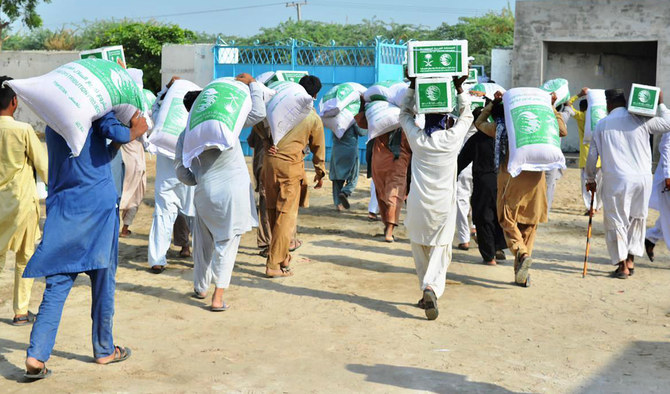
KSrelief distributes food baskets in Pakistan’s flood-affected Bahawalnagar district

In an undated photo, Pakistani flood affectees can be seen taking King Salman Humanitarian Aid and Relief Centre (KSrelief) food packets and relief items. (SPA)
Short Url
Updated 17 September 2023
Follow

KSrelief distributes food baskets in Pakistan’s flood-affected Bahawalnagar district

  • Floods in August displaced thousands of families in Pakistan’s Punjab province, including Bahawalnagar
  • Food baskets benefited 6,300 people as part of KSrelief’s project to support food security in Pakistan

ISLAMABAD: The King Salman Humanitarian Aid and Relief Center (KSrelief) on Sunday distributed 85 tons of food baskets to the most vulnerable groups in Pakistan’s flood-affected Bahawalnagar district, the state-run Associated Press of Pakistan (APP) said in a report. 

Flooding in Pakistan’s Sutlej river started from August 17 after India discharged floodwater in the river following heavy rains. The floods displaced thousands of people in Pakistan’s eastern Punjab province, including Bahawalnagar, during August, prompting authorities to carry out relief activities. 

KSrelief has been providing relief items to Pakistan’s flood-affected masses as part of a food security project. On Wednesday, the Saudi aid agency announced it had completed distribution of 12,000 food packages among people in Pakistan’s northwestern Chitral and Dir districts which were battered by floods in July this year. 

“The King Salman Humanitarian Aid and Relief Center (KSrelief) on Sunday distributed 85 tons and 500 kilograms of food baskets to the most vulnerable groups in the Bahawalnagar area of Punjab province affected by floods,” the APP said. “The aid benefited 6,300 individuals as part of the project’s second phase to support food security in the Republic of Pakistan for the year 2023-2024.”

It said KSrelief would distribute 32,400 food baskets from August to September 2023 during the second phase, adding that the project aims to distribute 105,000 food baskets in four phases. The project aims to benefit 735,000 individuals from the most vulnerable groups across 37 districts of Pakistan’s Sindh, Balochistan, Khyber Pakhtunkhwa, Gilgit-Baltistan and Punjab areas, the APP added. 

“This aid is part of the relief projects provided by the Kingdom of Saudi Arabia through its humanitarian arm, KSrelief, to enhance food security in Pakistan,” it added. 

KSrelief, with one of the largest humanitarian budgets for aid agencies across the world, has been undertaking humanitarian projects across 88 countries. Pakistan is the fifth largest beneficiary of the organization’s aid and humanitarian operations. According to KSrelief data, the agency has completed 185 projects in Pakistan in education, health care, water, sanitation, hygiene, emergency camps, and community support. These projects have collectively cost roughly $173 million in the last 17 years.


Pakistan, China to sign multiple MoUs at major agriculture investment conference today

Updated 18 January 2026
Follow

Pakistan, China to sign multiple MoUs at major agriculture investment conference today

  • Hundreds of Chinese and Pakistani firms to attend Islamabad event
  • Conference seen as part of expanding CPEC ties into agriculture, trade

KARACHI: Islamabad and Beijing are set to sign multiple memorandums of understanding (MoUs) to boost agricultural investment and cooperation at a major conference taking place in the capital today, Monday, with hundreds of Chinese and Pakistani companies expected to participate.

The conference is being billed by Pakistan’s Ministry of National Food Security and Research as a platform for deepening bilateral agricultural ties and supporting broader economic engagement between the two countries.

“Multiple memorandums of understanding will be signed at the Pakistan–China Agricultural Conference,” the Ministry of National Food Security said in a statement. “115 Chinese and 165 Pakistani companies will participate.”

The conference reflects a growing emphasis on expanding Pakistan-China economic cooperation beyond the transport and energy foundations of the flagship China-Pakistan Economic Corridor (CPEC) into agriculture, industry and technology.

Under its first phase launched in 2015, CPEC, a core component of China’s Belt and Road Initiative, focused primarily on transportation infrastructure, energy generation and connectivity projects linking western China to the Arabian Sea via Pakistan. That phase included motorways, power plants and the development of the Gwadar Port in the country's southwest, aimed at helping Pakistan address chronic power shortages and enhance transport connectivity.

In recent years, both governments have formally moved toward a “CPEC 2.0” phase aimed at diversifying the corridor’s impact into areas such as special economic zones, innovation, digital cooperation and agriculture. Second-phase discussions have highlighted Pakistan’s goal of modernizing its agricultural sector, attracting Chinese technology and investment, and boosting export potential, with high-level talks taking place between planning officials and investors in Beijing.

Agri-sector cooperation has also seen practical collaboration, with joint initiatives examining technology transfer, export protocols and value-chain development, including partnerships in livestock, mechanization and horticulture.

Organizers say the Islamabad conference will bring together government policymakers, private sector investors, industry associations and multinational agribusiness firms from both nations. Discussions will center on investment opportunities, technology adoption, export expansion and building linkages with global buyers within the framework of Pakistan-China economic cooperation.