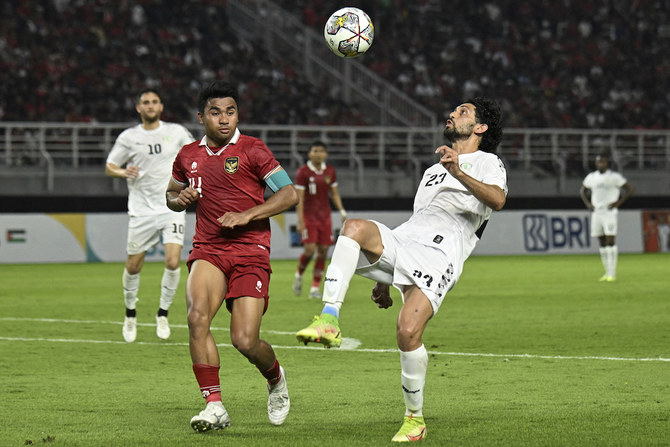

Nationality switches are common in football, but very few might be as impactful as Ataa Jaber’s decision to pursue an international career with Palestine.
The midfielder, who currently plies his trade in Neftchi Baku in Azerbaijan’s topflight, made his Palestine debut in June.
Al-Fida’i has been trending in an upward direction over the past decade. In January, the team will compete at their third straight Asian Cup finals having first qualified for the 2015 edition.
Palestine celebrated the 25th anniversary of their first official game in July, but that short tenure among FIFA’s recognized nations belies rich history with the game. The first football match played in the country was in 1908 when the teams of Rawdat Al-Ma’aref and St. George’s School faced each other.
Twenty years later, Mandatory Palestine would join FIFA and although regarded as a precursor for the Israeli national team, the federation was only allowed to join thanks to the presence of Ibrahim Nusseibeh — a Palestinian and the only qualified referee in the country.
When Palestine was finally allowed to join FIFA after 70 years in international wilderness and multiple rejected applications, there was a decision to make about how the national team programs would be staffed.
The Palestinian Football Association decided to support its nascent league by calling up its best players to represent the nation. At the time, there were many Palestinian footballers (descendants of those Palestinians who managed to avoid the ethnic cleansing campaigns of 1947-48) playing in the first and second tiers of the Israeli football leagues, but depending on an external — and sometimes hostile — organization to provide players was seen as too risky.
Over the following 25 years, there was a gradual change in the position of the PFA. When the West Bank Premier League went professional 13 years ago, Palestinian footballers from the second and third tiers of Israeli football started popping up on pitches in Ramallah, Hebron, and Nablus, eventually earning themselves national team call-ups.
Since then, the modus operandi for Palestinian citizens of Israel to play in the national team has been to move to the WBPL in order to showcase their abilities. Palestine has reaped the talents of players like Haitham Dheeb, Rami Hamada, Abdallah Jaber, and Mohammed Darweesh, who had been overlooked by clubs in the Israeli first tier.
The strategy also meant that Palestine lost out on elite talents by not actively pursuing players playing in a league that has been, on average, in the top 20 of the Union of European Football Associations’ country coefficient for the past 15 years.
Jaber’s path to the Palestinian national team was anything but direct.
The native of Majd Al-Krum was an obvious talent, joining the academy of Maccabi Haifa at 6 years old and making his professional debut at 18. Three years later, he was capped for Israel’s U-21, a team he would go on to captain on four occasions. That captaincy was the subject of much fanfare as Jaber became the first Arab captain in the history of the Israeli national teams — on the same day that Israel’s senior team was captained by the Circassian Bibras Natcho.
That day in 2015 was used to signal the liberal and open nature of Israeli society, but it is a narrative that does not reflect reality in Jaber’s opinion.
“(In Israel), they feed a narrative to (Arab) players that sport should not mix with politics, that you represent your community, that you will have a voice, and that you don’t need to sing the (Israeli) national anthem,” Jaber told Arab News.
A pandemic, a war, and a chance encounter with a teammate led to an epiphany and eventually a one-time nationality switch with FIFA.
“After what happened in Sheikh Jarrah, I realized that it was impossible to separate politics from sport and even if I wanted to represent ‘48 Arabs, there were better ways of doing it,” Jaber said.
Shortly thereafter, Jaber decided that representing Israel’s national teams was no longer an option for him. It was not clear if he would be able to represent Palestine until a teammate explained how it could be done.
Rami Hamadi, Palestine’s star goalkeeper, left the WBPL in 2020 due to financial hardships his team was facing in the aftermath of the COVID-19 pandemic, eventually agreeing to sign for Bnei Sakhnin FC in the Israeli topflight. It was in the small Galilee town of Sakhnin where Jaber’s path to the Palestine national football team became clearer.
“Things changed for me when I met Rami Hamadi while playing for Sakhnin. I then found out that there was a league in the West Bank and a Palestinian national team that we can represent. I didn’t know that was even a possibility because I didn’t have a passport,” Jaber said.
The pursuit of a travel document issued by the Palestinian Authority — a prerequisite for any player wishing to represent Palestine — was a process that took nearly two years.
It was, however, worth the wait as Jaber thoroughly enjoyed his time with the team in June and was pleasantly surprised at the level exhibited by the team in matches that did not feature national team captain Musab Al-Battat and Charleroi star Oday Dabbagh.
“I took the decision to represent the Palestinian national team for many reasons. First because I am Palestinian, second because I have the ability, and third to deliver a message to players inside the Green Line that this choice is available to them,” Jaber said.
That message has resonated both with the PFA and several players. Following Jaber’s debut, the U-23 team called up Bnei Sakhnin’s Abdelhadi Yasin and Hadi Rabah.
For the September FIFA window, the senior team called in two other footballers currently plying their trade in the Israeli Leagues. Winger Alaa Al-Deen Hassan (Bnei Sakhnin) and defender Amid Mahajna (Hapoel Umm El-Fahm) were included in the 24-man squad to face Oman and Vietnam.
Jaber accepts that the path for players who make the decision to represent Palestine could be difficult, especially for those in the top two tiers of Israeli football.
“There is a fear among Palestinian players inside the Green Line because making such a decision could cut off their main source of income, especially given the fact that they cannot play abroad like I do,” he said. “There are pitfalls, but if an individual sets his mind to it and aims to play for Palestine, his path will become easier.”