Court sentences main suspects in Belgium’s deadliest peacetime attack to 20-year to life terms

1 / 2
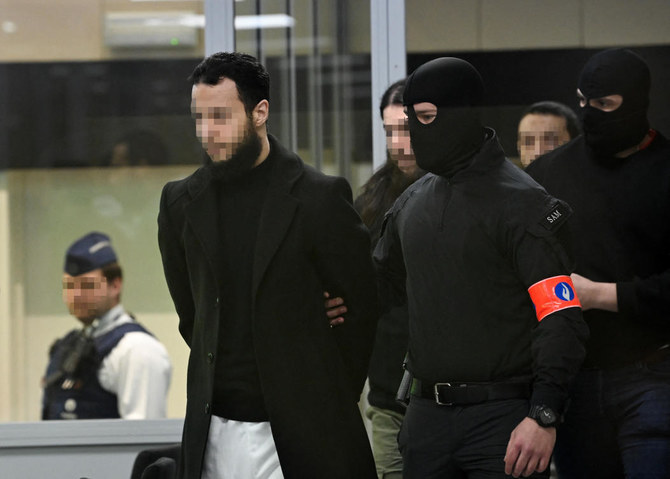
A Belgian court sentenced five men to sentences ranging from 20 years to life in prison on charges of terrorist murder in connection with 2016 suicide bombings that killed 32 people and wounded hundreds at Brussels airport and a busy subway station. (AP/File)
2 / 2
Defendants Salah Abdeslam, Osama Krayem and Mohamed Abrini are escorted by police as they arrive in court during the trial of the 2016 Brussels attacks at the Justitia building in Brussels on April 3, 2023. (Reuters/File)
Short Url
Updated 16 September 2023
Follow

Court sentences main suspects in Belgium’s deadliest peacetime attack to 20-year to life terms

  • A chief suspect, Salah Abdeslam, had previously been given a 20-year sentence for involvement in a shootout days before the March 22, 2016, attacks
  • Abdeslam was serving a life sentence without parole in France over his part in attacks that hit Paris

BRUSSELS: A Belgian court on Friday sentenced five men to sentences ranging from 20 years to life in prison on charges of terrorist murder in connection with 2016 suicide bombings that killed 32 people and wounded hundreds at Brussels airport and a busy subway station, the country’s deadliest peacetime attack.
A chief suspect, Salah Abdeslam, had previously been given a 20-year sentence for involvement in a shootout days before the March 22, 2016, attacks and received no further jail time. It happened after police discovered him and another suspect by accident when they inspected what they thought was an empty apartment. Four officers were hurt.
Abdeslam was serving a life sentence without parole in France over his part in attacks that hit Paris cafes, the Bataclan theater and France’s national stadium in 2015. Both the Paris and Brussels attacks were linked to the same Daesh network.
Taking the stand at a high security court in Brussels on Monday before the jury and magistrates retired to deliberate on sentences, Abdeslam implored them for leniency, insisting that he did not take part in the suicide bombings in Belgium – two at the city’s airport and one on a subway train during the morning rush hour — and was not aware of the plot.
“I have been demonized. You’ve condemned someone who doesn’t deserve it,” the 34-year-old Frenchman said, according to Belgian daily Le Soir. “I ask you to be fair with this last decision,” on sentencing.
In total, 10 defendants were involved in what has been the biggest trial in Belgium’s judicial history. Two brothers were acquitted of all charges. The other eight were convicted of participating in activities of a terrorist group; six of those eight also were convicted of terrorist murder.
Abdeslam was the only survivor among the Daesh extremists who struck Paris in November 2015. After months on the run, he was captured in Brussels on March 18, 2016. His arrest may have prompted other members of the Daesh cell to rush ahead with attack plans on the Belgian capital.
Also convicted of terrorist murder at the trial was Mohamed Abrini, a childhood friend of Abdeslam and a Brussels native who walked away from Zaventem Airport – Belgium’s main air hub – after his explosives failed to detonate. He was sentenced to life in prison.
Two others accused of playing a role in the suicide bombing plot – Osama Krayem and Bilal El Makhoukhi – were sentenced to life in prison, while a third, Ali El Haddad Asufi, received a 20-year term.
Oussama Atar, identified as a possible organizer of the deadly attacks on both Paris and Brussels, was convicted of terrorist murder in absentia. He is believed to have died in the Daesh group’s final months of fighting in Iraq and Syria, but was also sentenced to life in prison.


In rare overlap, Chinese Muslims observe Ramadan with Lunar New Year

Updated 19 February 2026
Follow

In rare overlap, Chinese Muslims observe Ramadan with Lunar New Year

  • Lunar New Year started on Feb. 17 and is celebrated for another two weeks
  • Chinese Indonesians make up about 3 percent of the Indonesian population

JAKARTA: Every year, on the first day of Lunar New Year, Febriani visits relatives and gathers for a feast with her Chinese Muslim family, part of a long-standing tradition honoring their ethnic heritage.

But this year, as Thursday marks the beginning of Ramadan, she is celebrating two important occasions within the same week, in a rare overlap that last took place in 1995.

“I’m very happy and grateful that Lunar New Year and Ramadan are celebrated so closely. I observe both every year, so it’s truly special,” she told Arab News.

Widely observed across Asia, the Lunar New Year or Chinese New Year festival is believed to date back to the 14th century B.C., to the times of the Shang Dynasty, China’s earliest ruling dynasty, when people celebrated good harvests.

In 2026, it started on Feb. 17 and is celebrated for another two weeks. For many, celebrations typically involve elaborate feasts, giving children pocket money in red envelopes, and watching dragon dance parades.

In Indonesia, Chinese-descent citizens make up an estimated 3 percent of the country’s Muslim-majority population of more than 280 million. While most are either Buddhists or Christians, a small minority professes Islam.

For 25-year-old Febriani, both Lunar New Year and Ramadan are equally meaningful.

“The two celebrations teach us to strengthen bonds, to share with one another, and to become closer to family,” she said.

“They are both important to me because they happen only once every year and they’re always an occasion to gather with the extended family. It is also a chance to self-reflect and strengthen relationships with your loved ones.”

For Naga Kunadi, whose family lives in Central Java’s Cepu district, Chinese New Year is all about embracing his ethnic identity.

Earlier in the week, his family was busy preparing for the new year’s feast, which was a fusion of Chinese and Indonesian dishes, such as claypot tofu, meatball soup and shumai, or steamed dumplings.

“To celebrate Chinese New Year, we prepared halal Chinese food at home. It’s also a way to introduce to my children the traditions from our Chinese side, but there’s a bit of a fusion because my wife is Javanese,” Kunadi told Arab News.

Kunadi, an Islamic teacher at the Lautze Mosque in Jakarta, sees both Chinese New Year and Ramadan as opportunities to teach important life values for his two children. 

Upholding Chinese New Year traditions with his family is for him a way of preserving his ethnic heritage.

“We want to preserve cultural values as long as it does not clash with our religion,” he said.

“If we leave our culture behind, we might lose our identity, so this is something I want to teach my children.”

The fasting month of Ramadan, on the other hand, gives him a chance to teach and practice honesty.

“I want to focus on the religious and moral aspects during the holy month of Ramadan, when we practice honesty on a personal level,” Kunadi said.

“There’s always an opportunity to eat or snack in secret without anybody knowing, but we train ourselves not to do that. For me, Ramadan is a time for everyone to put honesty into practice, including myself and my children.”