

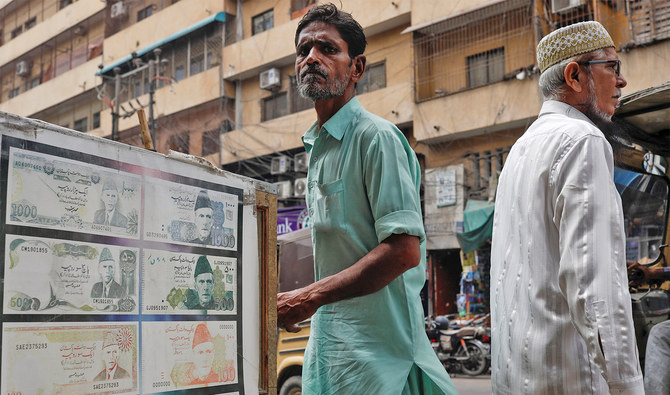

KARACHI: Pakistan’s national currency has seen a significant resurgence recently, with the rupee gaining over three percent value in interbank and about 10 percent in the open market against the US dollar, following the army chief’s meeting with top business leaders on September 4.
General Asim Munir assured the business community the state would deal with foreign currency hoarders and smugglers with an iron fist, promising “transparency in dollar exchange and interbank rates.”
His assertions were followed by a widespread crackdown in the country, resulting in the rupee gaining Rs10.25 in value in the interbank market, where it closed at Rs296.85 on Friday, and surging by Rs32 in the open market to hit Rs297, according to central bank data.
“We had requested the country’s top army brass to take action against hoarders and individuals involved in illegal currency trade,” said Malik Bostan, chairman of the Exchange Companies Association of Pakistan (ECAP), speaking to Arab News.
He mentioned that black market traders had become so audacious they were enticing potential customers to official exchange companies by offering rates higher than those prevailing in the market.
“We lost over 90 percent of our customers,” he said, adding that supplies had been restored after law enforcement agencies took action and made arrests.
“Our trade has increased from $5 million to $15 million per day,” he continued. “And this has happened due to the army’s efforts against criminals.”
The ECAP chief called for the continuation of action against those involved in the illegal currency trade.
Pakistani financial experts also acknowledged the positive outcome of the crackdown, saying it had helped stabilize the currency market.
“The approach of wielding the stick has produced some positive results,” said Ikram-ul-Haq, a Lahore-based economist.
However, he added that it remained to be seen if it would lead to long-term stabilization of the Pakistani rupee.
“The administrative measures have closed loopholes related to illicit outflows, hoarding, speculative transactions, and smuggling, which were caused by weak monitoring along with regulatory and border controls,” he said.
The Pakistani authorities have resorted to multiple crackdowns in the past to artificially stabilize the currency market, although they led to a massive devaluation of the rupee.
Former finance minister Ishaq Dar attempted a similar approach in the recent past, hoping to bring back the US dollar at Rs200. However, it did not happen and led to a significant depreciation in January 2023.
“The same fate may befall the recent crackdown if it is not accompanied by concerted and consistent efforts to control money supply, which is the root cause of the existing crisis,” Haq added.
He pointed out if the country failed to improve the ratio of Net Foreign Assets (NFA) to Net Domestic Assets (NDA), the rupee might undergo yet another phase of devaluation, rendering the current crackdowns meaningless.
Ali Nawaz, another financial expert and the chief executive officer of Chase Securities, a brokerage firm, called for measures to control currency devaluation by increasing exports, remittances, and attracting investments.
“We also need to crack down on smugglers to keep food prices in check and generate economic activity to create more jobs for people,” he added. “By doing all of this, we can control inflation, and the masses can benefit from it.”


