

Prayers for Morocco, Libya dead in quake-hit Syria

1 / 2
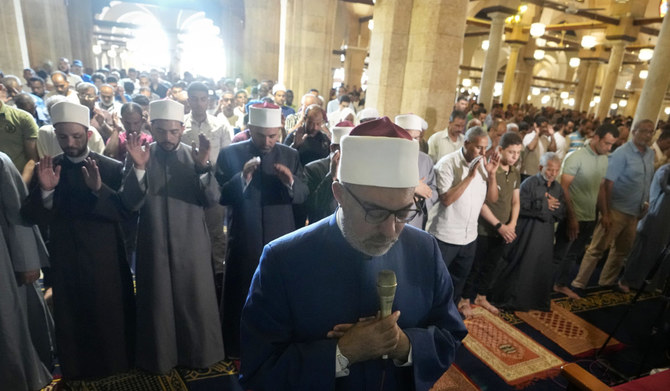
Sheikh Nazir Ayyad leads the absent prayers for the victims of flooding in Libya and earthquake in Morocco at the Al-Azhar mosque, the Sunni Muslim world's premier Islamic institution, in Cairo, Friday, Sept. 15, 2023. (AP)
2 / 2
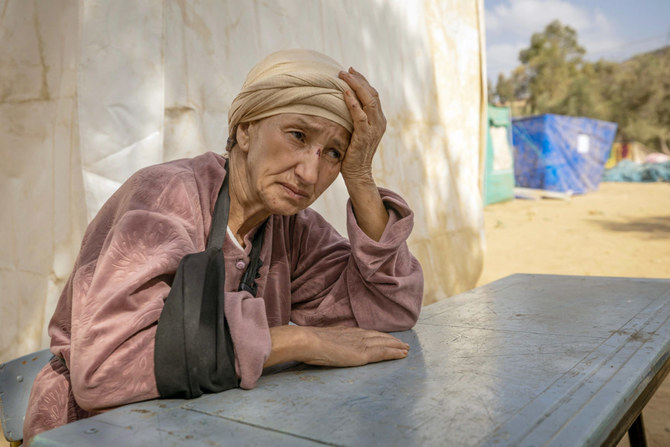
An injured resident rests near a tent in the shade at the mountain village of Tafeghaghte, southwest of Marrakesh city on September 15, 2023, following a devastating earthquake. (AFP)
Short Url
Updated 16 September 2023
Follow

Prayers for Morocco, Libya dead in quake-hit Syria

  • A massive flash flood in eastern Libya triggered by Storm Daniel on Sunday left more than 3,000 people dead, 10,000 missing and entire neighborhoods in ruins
  • A week ago, a magnitude 6.8 earthquake — Morocco’s strongest ever — killed nearly 3,000 people and injured more than 5,600, according to official figures

IDLIB, Syria: More than 2,000 Syrians in the rebel-held Idlib region, devastated by an earthquake in February, held prayers on Friday for the victims of natural disasters in Morocco and Libya.
The February 6 quake, centered on neighboring Turkiye, killed nearly 6,000 people in mainly rebel-held northern and northwestern Syria where survivors are still piecing their lives back together.


In this aerial view, a mosque stands amid the destruction caused by flash floods after the Mediterranean storm "Daniel" hit Libya's eastern city of Derna, on September 13, 2023. (AFP)

“Today, perhaps we are the best placed to pray for our brothers for whom no one has prayed ... Our souls are one, our religion unites us,” said Mahmoud Al-Hubaish, the imam of Idlib’s largest mosque.
Among those taking part in the prayers was Mohamed Al-Bacha, who lost his wife and children in the quake as well as an arm.
“We prayed for our brothers in Libya and Morocco,” the 31-year-old told AFP. “I felt like I was praying for my wife and children.”


A girl stands near a relief tent in the mountain village of Tafeghaghte, southwest of Marrakesh city on September 15, 2023, following a devastating earthquake. (AFP)

A massive flash flood in eastern Libya triggered by Storm Daniel on Sunday left more than 3,000 people dead, 10,000 missing and entire neighborhoods in ruins.
A week ago, a magnitude 6.8 earthquake — Morocco’s strongest ever — killed nearly 3,000 people and injured more than 5,600, according to official figures.
The mosque was packed full for Friday’s prayers, an AFP journalist reported.
“As Syrians, we have experienced what they have experienced,” said Abu Osama, a 45-year-old who fled to Idlib from the central province of Hama earlier in Syria’s more than decade-old civil war.
“The earthquake greatly affected us because we lost our loved ones in an earthquake similar to the one in Morocco,” he said.
“We felt their pain as we prayed.”


Security officer arrested over Syria killings: official

Updated 4 sec ago
Follow

Security officer arrested over Syria killings: official

DAMASCUS: Syria’s authorities have arrested an internal security officer as a suspect in the killing of four civilians in the majority-Druze Sweida province, the local internal security chief said.
Four people were shot dead and a fifth seriously wounded in the incident on Saturday, in the village of Al-Matana, said Hossam Al-Tahan, the state news agency SANA reported.
The initial investigation, carried out with the help of one of the survivors of the attack, indicated that one suspect was a member of the local Internal Security Directorate, he said.
“The officer was immediately detained and referred for investigation,” he added.
The Syrian Observatory for Human Rights had earlier reported that four people were killed and a fifth wounded by gunfire from unknown assailants as they were harvesting olives.
The authorities had cleared the olive pickers to be in the northern part of the province controlled by government forces, it added.
Sweida province is the stronghold of the Druze minority in the south of the country.
Violence erupted there briefly in July last year, with clashes between Druze fighters and Sunni Bedouin that rapidly escalated, drawing in government forces and tribal fighters from other parts of Syria.
Syrian authorities have said their forces intervened to stop the clashes, but witnesses, Druze factions and the London-based Observatory have accused them of siding with the Bedouin and committing abuses against the Druze.
Although a ceasefire was reached later that month, the situation remained tense and access to Sweida difficult.
Residents accuse the government of having imposed a blockade on the province, from which tens of thousands of inhabitants have fled — a charge Damascus denies.
Several aid convoys have entered since then.
According to the Syrian Observatory for Human Rights, more than 185,000 people remain uprooted.