

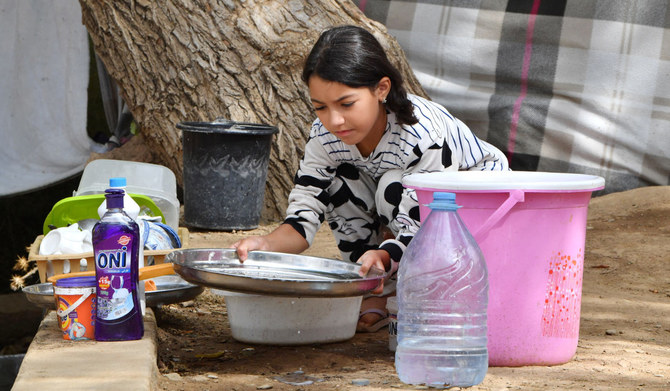

RABAT: Nine-year-old Moroccan girl Ibtissam Ait Iddar was fortunate to have been rescued from under the rubble, but like other children she remains traumatized by the earthquake that devastated her village.
“My father called me and I cried back ‘I’m here, I’m here’,” Ibtissam recalled five days after the disaster that left nearly 3,000 people dead and more than 5,600 injured.
The magnitude 6.8 earthquake — Morocco’s strongest ever — flattened entire villages like Ibtissam’s hometown of Imi N’Tala and left tens of thousands of people homeless.
A week after it struck on Sept. 8, Ibtissam and her family have sought refuge nearby with dozens of other families, living out of a tent.
But two of Ibtissam’s friends, Mouna and Zineb, are not among the survivors.
“We used to go to school together even though we were not in the same class,” she said.
BACKGROUND
The UN’s cultural organization UNESCO has expressed concern over the immediate future of education in Morocco following the devastating quake.
Ibtissam’s 4-year-old sister and both her grandmothers were also killed in the quake, and now her mother, Naima Benhamou, says she is now “worried” about her daughter.
The girl wakes up often at night crying and shouts “Get me out, I’ve fallen,” said Benhamou, expressing concern about her daughter’s psychological state.
Ibtissam was pulled out from the rubble by her father and her uncle after their home was crushed by huge rocks that the quake caused to roll down the mountainside.
Imi N’Tala is located at an altitude of more than 1,400 meters near Mount Toubkal in the High Atlas Mountains.
The village’s houses are built on a narrow and winding road that runs the length of the mountain range, about 75 km south of Marrakech.
Survivors in the village, once home to 400 people, have said the quake killed 84 residents, including 20 children.
The stench of death fills the air, they have said.
On Wednesday, rescuers pulled a body from under rubble and struggled to search for five more.
Youssef Ait Raiss, 11, remembers how his family home “crumbled.”
“We were stuck under the rubble,” said the boy whose parents were away when the quake struck.
“We were with our grandmother. It was like a nightmare,” added his brother Zakaria, 13.
The grandmother has since died while an older brother aged 16 is fighting for his life in a Marrakech hospital. Two of Youssef’s classmates, Taoufik and Khaled, were also killed.
“We went to school together. We played together,” he said.
His school near the village was badly damaged and classes have been suspended, a measure that has been taken in around 40 communities in the nearby provinces of Al Haouz, Chichaoua and Taroudant.
The UN’s cultural organization UNESCO has expressed concern over the immediate future of education in Morocco following the devastating quake.
“The earthquake affected a particularly rural and isolated area, encompassing a school population of around 1 million pupils and a teaching staff of more than 42,000 professionals,” it said in a statement.
Ibtissam has said she was “shocked” to see her school damaged, according to her mother.
“She told me that if she cannot go back to school then we must leave here as soon as possible,” Benhamou added.
But Ibtissam’s uncle Mohammed Ait Toulkine vowed to make sure she goes to school.
“I’ll do everything possible to send her to Marrakech. It is important that she continues to study,” he said.
Nearby a team of rescuers dug through the rubble to retrieve the body of Khadija Ouhssine’s father-in-law.
Ouhssine, 32, also lost two of her children and her mother-in-law, all killed by the quake.
“Losing one’s children is a feeling that no word can describe,” she said, standing outside her flattened house.


