‘Worst enemy’: Morocco quake brings new hardships for farmers

1 / 2
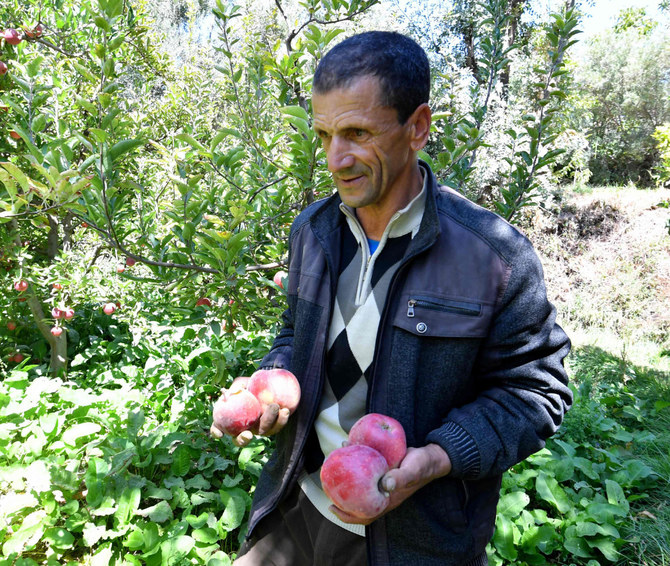
armer Mohammed Al-Moutawak shows apples that fell prematurely from his trees in the village of Ineghede in the High Atlas mountains of central Morocco. (AFP)
2 / 2
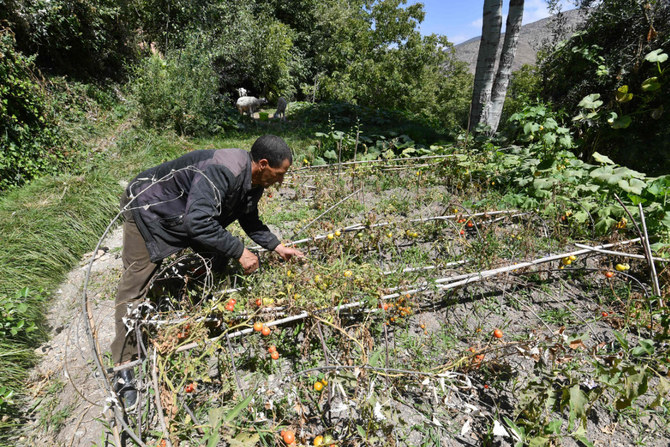
Farmer Mohammed Al Moutawak checks his damaged tomato plants in the village of Ineghede in the High Atlas mountains of central Morocco on September 13, 2023. (Fethi Belaid/AFP)
Short Url
Updated 15 September 2023
Follow

‘Worst enemy’: Morocco quake brings new hardships for farmers

  • Quake aggravates impact of drought and extreme weather that have long taken a toll on the North African kingdom’s growers
  • Access to water is now one of the biggest looming problems as almost all the pipes in the farming region had been destroyed

INEGHEDE, Morocco: Mohammed Al Moutawak’s village was destroyed by Morocco’s powerful earthquake and his apple harvest ruined, but he refuses to leave the land that is vital to small farmers like him.
Drought and extreme weather have long taken a toll on the North African kingdom’s growers, but the quake spells new challenges that are just beginning to come into focus.
“We thought hail was our worst enemy, but now we’ve got another,” said the 56-year-old farmer from the mountain village of Ineghede in the worst-hit Al-Haouz region south of Marrakech.
“The earthquake, it has destroyed everything.”
Days after the quake that killed more than 2,900 people, he was looking sadly at his apple and walnut trees growing on terraces carved into the Atlas Mountains.
With dust-covered hands, he pointed to the trees his family has cultivated for generations and which still stand, unlike the stone and wood houses of his village.
The September 8 disaster killed 11 of the hamlet’s 200 inhabitants and left survivors living in yellow aid tents.
The Golden and Gala apples Moutawak had expected to harvest now laid in the grass, their scent mingling with the stench of a decomposing donkey buried under the rubble.
Because the fruit had not yet ripened, his harvest is lost, along with the profits he had hoped to use to settle his debts.

In the village, the search for survivors is over.
All bodies have been recovered and everyone else is accounted for, unlike in other towns where rescue workers were still searching for signs of life, six days after the quake.
Women were sorting through blankets and clothes delivered by civilians while men were digging through the rubble for the basics of daily life: glasses, pots and water cans.
As elsewhere in these mountains, small-scale farming, along with herding goats, cows and other livestock, is an essential source of food and income.
“We work hard to raise a little money by harvesting apples, so that we can prepare for the start of the new school year and help our families a little,” said another resident, Jamel Ait Bouyahia, 42.
In recent years, the Moroccan government and donors have pushed ahead with aid programs, some aimed at boosting resilience in the face of climate change.
Other development initiatives have more specifically aimed to break through the isolation of village life and provide more autonomy to women.
There have also been programs to reuse treated wastewater in agriculture, and to promote water-saving drip-irrigation.

Access to water is now one of the biggest looming problems.
“The sector most seriously affected by the earthquake is irrigation,” said Bouyahia, who added that almost all the pipes had been destroyed.
There is still water in the wells, but stones that shifted during the quake have blocked the flow from springs, said Moutawak.
Moroccan authorities say the problem is widespread in the region, with water networks also impacted in areas including Amizmiz, Moulay Brahim and Talat Nyacoub.
The upcoming reconstruction efforts will serve as “a wake-up call for development workers,” said Hlima Razkaoui, director of the group Care Maroc, which has worked extensively in the region.
She said the effort will have to help people rebuild in a resilient way, with improved access to water, voicing hope that this will give communities “an opportunity to bounce back.”


Deal is signed in Beirut to transfer 300 Syrian prisoners in Lebanon to their home country

Updated 4 sec ago
Follow

Deal is signed in Beirut to transfer 300 Syrian prisoners in Lebanon to their home country

  • Lebanon’s Deputy Prime Minister Tarek Mitri and Syria’s Justice Minister Mazhar Al-Wais expressed hope that this step will boost confidence and progress relations
  • Lebanon and Syria have signed an agreement to transfer over 300 Syrian detainees from Lebanese prisons to continue their sentences in Syria
BEIRUT: Lebanon and Syria signed an agreement Friday to transfer more than 300 Syrians from Lebanese prisons to continue serving their sentences in their home country, a step that will likely help improve strained relations between the two neighbors.
The signing came a week after Lebanon’s Cabinet approved a treaty with Syria for the transfer of prisoners. The deal was signed at the government headquarters in the Lebanese capital, Beirut, by Lebanon’s Deputy Prime Minister Tarek Mitri and Syria’s Justice Minister Mazhar Al-Wais.
“This is a very important first step on the road of a comprehensive treatement regarding Syrian prisoners in Lebanese prisons,” Mitri told reporters, adding that the implementation of the agreement would start on Saturday.
“Both countries want to move forward but there are some pending matters,” Al-Wais said. “This step will boost existing confidence and we hope that relations will progress more.”
Mitri said that next, officials from the two neighboring countries, will discuss the transfer of Syrian detainees who are still waiting trial in Lebanon.
Lebanon and Syria have a complicated history, with grievances on both sides. Many Lebanese resent nearly three decades of domination and military presence in their country by Syrian forces that ended in 2005.
Many Syrians resent the role played by the Lebanese militant group Hezbollah when it entered Syria’s civil war that broke out in 2011 in defense of then-President Bashar Assad and his government. Assad was overthrown in December 2024 and fled to Russia where he is now in exile.
After Assad’s fall, relations with Syria’s new Islamist-led authorities remained tense and skirmishes occurred along the unmarked border between the two nations.
Mitri also said Saturday’s signing was “an expression of a joint political will that states that the Lebanese-Syrian relations are based on confidence and mutual respect.”
Asked whether the deal will include Lebanese citizens such as Sunni Muslim cleric Ahmed Al-Assir, Mitri said that it only covers Syrian prisoners.
There are about 2,500 Syrian prisoners in Lebanese prisons and jails, some of whom are held on charges related to their involvement with armed opposition groups that sought to overthrow Assad — in some cases, the same groups that are now ruling Syria.
Earlier this week, Mitri told The Associated Press that most of the detainees who will be transferred to Syria were not convicted of violent crimes. Some of those convicted of violent crimes may be transferred if they have already served seven and a half years of their sentence in Lebanon, he said.