

Pakistan’s national airline refutes closure rumors amid ongoing financial crisis

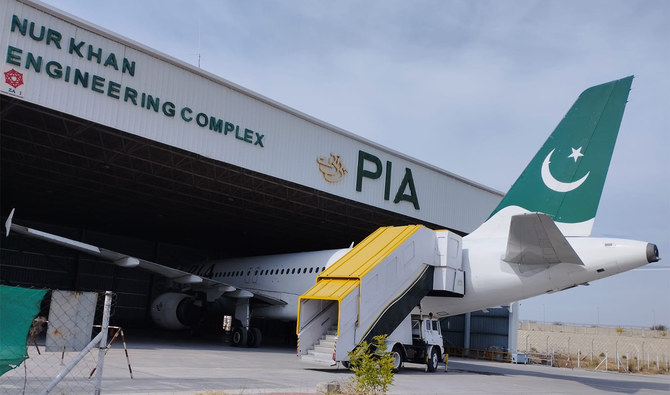
Pakistan International Airlines' aircraft is taxied at Nur Khan Engineering Complex in Islamabad, Pakistan, on February 9, 2023. (Photo courtesy: PIA/File)
Short Url
Updated 15 September 2023
Follow

Pakistan’s national airline refutes closure rumors amid ongoing financial crisis

  • The airline is said to be on the brink of default after the government turned down its request for a $76 million bailout
  • The national flag carrier confirmed earlier this week it had grounded 14 out of its 31 aircraft due to the financial crisis

ISLAMABAD: Pakistan’s national air carrier issued a statement on Friday, denying the rumors of its closure due to an ongoing financial crisis that had led to recent reports suggesting its management was scaling back flight operations.

The airline is said to be on the brink of default after the government turned down its request for a Rs23 billion ($76 million) bailout package to help alleviate its cash crunch.

The authorities have previously released substantial funds to assist Pakistan International Airlines (PIA) in meeting its operational expenses.

However, the airline has continued to accumulate billions of rupees in arrears and losses over the years, prompting the government to seek a restructuring plan before coming to its rescue.

“The apprehensions and reports regarding the closure of PIA are baseless and untrue,” stated its spokesperson, Abdullah Hafiz Khan. “PIA has suffered significant damage to its reputation due to those who falsely claimed September 15 as the date of its closure.”

Khan confirmed that the airline had paid salaries to its employees and was maintaining its flight operations.

“PIA is built on a strong foundation and has the full capacity to handle such situations. It boasts a robust global network, and its fleet operates worldwide.”

Khan also mentioned that the airline had a sufficient number of aircraft to carry out both domestic and international flights.

PIA confirmed earlier this week it had grounded 14 out of its 31 aircraft due to the financial crisis.

The country’s Economic Coordination Committee (ECC) instructed the Finance Division and the State Bank of Pakistan to assist the airline last week, but only after a restructuring plan was finalized and approved.



Pakistan says defense pact with Saudi Arabia elevated brotherly ties to ‘new heights’

Updated 25 February 2026
Follow

Pakistan says defense pact with Saudi Arabia elevated brotherly ties to ‘new heights’

  • Pakistan, Saudi Arabia signed strategic defense pact last year pledging aggression against one will be treated as attack on both
  • Deputy PM Ishaq Dar says enduring bonds with Islamic and Arab nations form vital pillar of Pakistan’s foreign policy 

ISLAMABAD: Deputy Prime Minister Ishaq Dar said on Wednesday that Pakistan’s defense pact with Saudi Arabia elevated its brotherly ties with the Kingdom to “new heights,” stressing that close ties with Arab and Islamic nations form a key pillar of Islamabad’s foreign policy. 

Pakistan and Saudi Arabia signed a Strategic Mutual Defense Agreement on Sept. 17 last year, pledging that aggression against one country would be treated as an attack on both, enhancing joint deterrence and formalizing decades of military and security cooperation.

Both nations agreed in October 2025 to launch an economic cooperation framework to strengthen trade and investment ties. 

“In the Middle East, our landmark Strategic Mutual Defense Agreement with Saudi Arabia has elevated our brotherly ties to new heights,” Dar said while speaking at the Pakistan Governance Forum 2026 event in Islamabad. 

The Pakistani deputy prime minister was speaking on the topic “Navigating International Relations Amidst Changing Geo-Politics.”

Dar noted that Pakistan has reinforced partnerships with other Middle Eastern nations such as the UAE, Qatar, Jordan, Oman, Egypt and Bahrain. He said these partnerships have yielded “concrete agreements” in investment, agriculture, infrastructure, and energy sectors. 

“Our enduring bonds with Islamic and Arab nations form a vital pillar of our foreign policy, and we will continue to expand our partnerships across Asia, Latin America, and Africa,” he said. 

Dar pointed out that the presidents of Kazakhstan, Uzbekistan and Kyrgyzstan have undertaken visits to Pakistan in recent months, reflecting Central Asian nations’ desire to boost cooperation with Islamabad.

On South Asia, the Pakistani deputy PM said Pakistan has successfully transformed its fraternal ties with Bangladesh into “a substantive partnership.”

“Similarly, the trilateral mechanism involving China, Pakistan, and Bangladesh has been launched with a view to expanding and deepening regional cooperation and synergy,” the Pakistani minister said. 

He said Islamabad has strengthened its “all-weather” partnership with China via the second phase of the multi-billion-dollar China-Pakistan Economic Corridor agreement and “unwavering support” from both sides for each other’s core interests. 

Dar said Pakistan had also reinvigorated its partnership with the US, advancing cooperation in trade, technology, investment, and regional stability. 

“This calibrated approach has enhanced our ability to navigate complexity with skill and confidence, ensuring that our national interests are served without compromising our core foreign policy principles,” he said.