

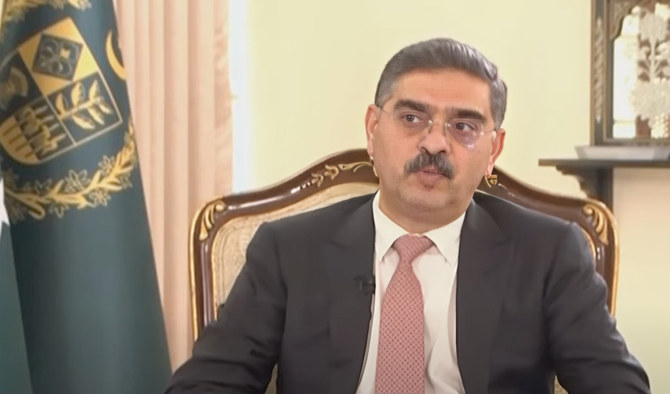

ISLAMABAD: Pakistan’s caretaker prime minister, Anwaar-ul-Haq Kakar, said on Thursday it was the mandate of the country’s election regulator to decide a timeline for general elections across Pakistan, amid a deepening row over the conduct of polls in the South Asian country.
The development comes days after President Arif Alvi wrote to the chief election commissioner and suggested that polls in the country should be held on November 6, urging the Election Commission of Pakistan (ECP) to seek the judiciary’s guidance on finalizing a single date for polls for national and provincial assemblies.
Alvi has maintained that Pakistan’s constitution requires the president to fix a date for polls within 90 days of the dissolution of the National Assembly, however, elections are most likely to be delayed beyond the 90-day constitutional limit, since the outgoing government of Shehbaz Sharif approved the results of a new population census days before it dissolved the assemblies on Aug 9.
The ECP is now bound to redraw hundreds of provincial and federal constituencies on the basis of the latest census data, an exercise the commission says is expected to be finalized by December 14. This effectively delays elections to early next year.
“He (Alvi) has given a proposal, he has not made a decision,” Kakar told Pakistan’s ARY News broadcaster on Thursday night. “Now that proposal has reached the Election Commission of Pakistan, which is a constitutional body, and they will issue a verdict as to when they should hold the [election].”
Last month, Alvi also invited Chief Election Commissioner Sikander Sultan Raja to a meeting to fix a date for the impending elections. Raja snubbed the offer and pointed out that fixing a date for elections was the sole prerogative of the ECP after amendments to the Elections Act in June by the outgoing government.
Previously, the constitution mandated the president to consult the election commission before determining a date for polls.
Asked if there was a need for the president to present such a proposal, Kakar chose to neither support, nor oppose the Alvi’s stance.
“See, we are holding two [separate] offices. President sahib is the constitutional head of the government of Pakistan and he has his own positioning, an opinion with regard to the election, and he is also associated with a political party,” Kakar said.
“My mandate is a bit different in a way that I have to assist this entire process and that assistance has to be held in such a transparent manner... that fingers are not raised.”
Alvi’s party, the Pakistan Tehreek-e-Insaf (PTI) led by former premier Imran Khan, has been campaigning for nationwide polls since Khan’s ouster in a parliamentary no-trust vote in April 2022.
Thursday’s developments came after the Pakistan Peoples Party, a major coalition partner, in the outgoing government once again urged for nationwide elections at the earliest possible time.
While the ECP has assured all stakeholders that polls will be held as soon as the delimitation exercise is concluded, independent analysts believe elections may still get delayed to February and beyond.


