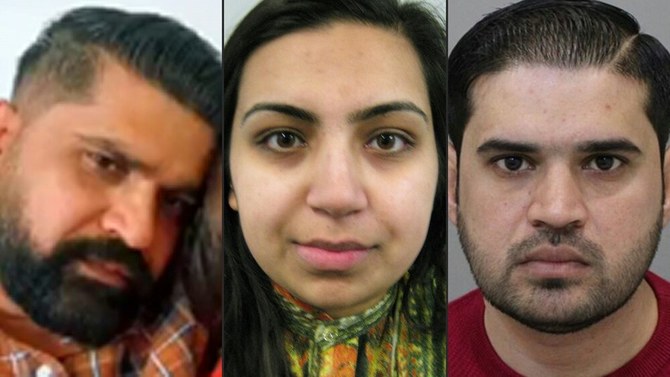
LONDON: UK police on Wednesday arrested three British-Pakistani relatives of a 10-year-old girl on suspicion of her murder, moments after the trio landed back in Britain following a month on the run in Pakistan.
Sara Sharif’s body was discovered at the family’s home near Woking, southeast England, on August 10. A post-mortem examination revealed she had sustained “multiple and extensive injuries” over a sustained period.
Police had said Urfan Sharif, 41, his partner Beinash Batool, 29, and his brother Faisal Malik, 28, fled to Pakistan to take refuge with relatives before Sara’s body was found, sparking an international manhunt.
“This evening... three people were arrested in connection with this investigation at Gatwick Airport,” Surrey Police detective superintendent Mark Chapman said in a televised statement.
“Two men, aged 41 years and 28 years, and a woman aged 29 years were arrested on suspicion of murder after disembarking a flight from Dubai,” he added, without naming the trio in line with UK police practice.
The suspects flew from Pakistan to Britain via the gulf hub.
“They are currently in custody and will be interviewed in due course.”
A Pakistan police spokesman had earlier said that Sharif, Batool and Malik had voluntarily returned to Britain with the prior knowledge of authorities.
“I confirm that they have not been arrested but they left voluntarily,” Raja Haq Nawaz, a lawyer for Urfan Sharif’s father, also told AFP.
Earlier this month, Sharif and Batool appeared in a video distributed to media, in which Batool said they were “willing to cooperate with UK authorities and fight our case in court.”
“All of our family members have gone into hiding as everyone is scared for their safety,” she said, alleging malpractice by the Pakistan police hunting them.
In the two-and-a-half-minute low-quality video there was little mention of Sara’s death, which Batool called “an incident.”
Surrey Police have said the fugitive trio were thought to have flown to Islamabad on August 9, the day before Sara was discovered at the family’s home in the village of Horsell, just outside Woking.
An early morning emergency call alerting officers to Sara’s death was made from Pakistan by a man identifying himself as the father, detectives said.
The house was otherwise empty, and the manhunt continued with Interpol and Britain’s foreign ministry coordinating with authorities in Pakistan.
Five of her purported siblings, aged between one and 13 and brought to Pakistan with the adults, were discovered at the home of Urfan Sharif’s father on Monday.
A magistrate placed the children into state protective services on Tuesday.
Surrey Police have said they are working with other local and international authorities to secure the children’s safe return.
But it is unclear where they will ultimately be sent or for how long they may be kept in the custody of Pakistan’s child protection bureau.
Sara’s Polish mother, Olga Sharif, had been informed of the arrests and is being supported by specialist officers, the UK force also noted.
“Our thoughts remain with her and those affected by Sara’s death at this very difficult time,” Chapman said.
Olga Sharif has said in an interview that she could barely recognize her daughter’s small, battered body when she identified her at the mortuary last month.
She told Polish television one of her cheeks was swollen and the other side of her face was bruised.
Olga and Urfan separated in 2015, and Sara and her older brother had lived with their mother until a family court determined in 2019 that they should reside with their father, according to UK media.
Sara had been removed from primary school in April to be homeschooled by her stepmother and was known to the local council’s social services department, the British reports said.


![]()

UK police arrest three relatives on return from Pakistan over girl’s death
Short Url
https://arab.news/5rmc3
UK police arrest three relatives on return from Pakistan over girl’s death
- “This evening... three people were arrested in connection with this investigation at Gatwick Airport,” Surrey Police detective superintendent Mark Chapman said
- “They are currently in custody and will be interviewed in due course“


Latest updates


© 2026 SAUDI RESEARCH & PUBLISHING COMPANY, All Rights Reserved And subject to Terms of Use Agreement.