

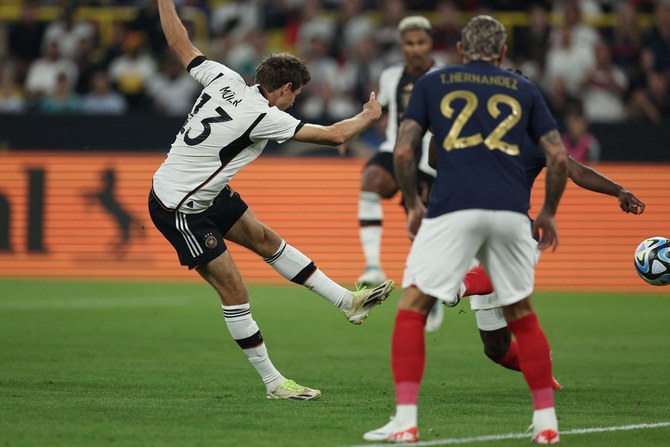
Mueller kick-starts Germany’s post-Flick era with win over France

Short Url
Updated 13 September 2023
Follow

Mueller kick-starts Germany’s post-Flick era with win over France

  • Flick’s sacking on Sunday, brought Rudi Voeller into the dugout for the first time since 2005
  • The home crowd at Borussia Dortmund’s Signal Iduna Park rallied behind their embattled side

DORTMUND: Veteran forward Thomas Mueller kick-started Germany’s post-Hansi Flick era, scoring early to set the Euro 2024 hosts on the way to a 2-1 win over France in Dortmund on Tuesday.

Flick’s sacking on Sunday, brought Rudi Voeller into the dugout for the first time since 2005. The interim coach brought Mueller back into the starting lineup and the move paid off early, Mueller scoring four minutes in.

Mueller’s Bayern teammate Leroy Sane scored with three minutes remaining to double his side’s lead.

Sane gave away a penalty just a minute later. France captain Antoine Griezmann converted but Germany held on for a 2-1 win – just their second victory in seven games since the Qatar World.

Fresh from Thursday’s 2-0 Euro qualifier victory over Ireland, France’s fifth straight win since losing the 2022 World Cup final on penalties to Argentina, coach Didier Deschamps made six changes including benching star striker Kylian Mbappe.

Deschamps counterpart and old friend Voeller – the two won the Champions League with Marseille in 1993 – made just three changes to Flick’s final line-up, including returning Mueller to center-forward for the first time since Qatar.

The home crowd at Borussia Dortmund’s Signal Iduna Park rallied behind their embattled side.

The fans did not need to wait long to celebrate, Mueller rewarding Voeller’s faith by opening the scoring four minutes in, chesting down a spinning Benjamin Henrichs cross and blasting in from close range.

Mueller’s first Germany goal since June 2022 lifted his confidence perhaps a little too much. The Bayern forward tried a mid-air backheel from a Florian Wirtz cross but scuffed the ball wide.

Germany were energized and direct. Even an injury to captain Ilkay Gundogan midway through the first half failed to take the wind out of their sails. Gundogan was replaced by 32-year-old debutant Pascal Gross.

Slotting in alongside the impressive Emre Can in midfield, Gross showed no signs of nerves, barking instructions at his teammates as he sought to direct Germany’s attack.

With nothing but pride at stake, France were in cruise control throughout, their best chance falling to Randal Kolo Muani midway through the second half.

With German goalie Marc-Andre ter Stegen on the floor having kept out a fierce effort from Aurelien Tchouameni, Kolo Muani, who left the Bundesliga for Paris Saint-Germain at the start of the month, slipped with an open goal begging.

With three minutes to go, Sane ran onto a perfect throughball from Kai Havertz, and slotted in his second goal in two games.

Sane quickly turned villain, bringing down Eduardo Camavinga just one minute later.

Griezmann converted the penalty for a fifth goal in Germany-France fixtures, the most of any player.

Germany’s last win over France was a 1-0 victory in the quarter finals of the 2014 World Cup, they have failed to win any of their last six meetings.


How international academies are shaping Saudi football’s next generation

Updated 05 January 2026
Follow

How international academies are shaping Saudi football’s next generation

  • Building a unified national footballing philosophy in Saudi Arabia is no simple task

Saudi Arabia’s football transformation has been impossible to ignore since the arrival of Cristiano Ronaldo at the end of 2022. An influx of global stars followed, and with it, unprecedented attention on the Saudi Pro League.

Yet beneath the spotlight, a more pressing question emerged amongst domestic fans: “What is the long-term strategy for developing local players?”

Building a unified national footballing philosophy in Saudi Arabia is no simple task. The sheer size of the Kingdom presents logistical challenges unlike those faced by smaller neighbouring nations, making grassroots development harder to centralize. In this landscape, the work of individual institutions can contribute significantly to the broader football ecosystem.

One such contributor is Juventus Academy Saudi Arabia, an official extension of one of world football’s most historic clubs, operating under the umbrella of Al-Shoaibi Group. Arab News spoke to head of public relations at Juventus Academy, Malak Al-Awami, based in Alkhobar, to understand how the academy fits into the Kingdom’s long-term football vision.

“Saudi Arabia is experiencing a transformational moment under Vision 2030, prioritizing youth development and active lifestyles,” Al-Awami explained. “The  academy arrives at a perfect time to contribute to a world-class methodology while helping nurture the next generation of Saudi footballers.”

At Juventus Academy, success is deliberately defined beyond results and trophies.

“We’re not just training players,” Al-Awami said. “We’re shaping future leaders for the Kingdom.”

That philosophy has been reflected in how the academy balances Juventus’ global philosophy with local Saudi culture. While all coaches undergo Juventus’ training standards, cultural understanding remains a priority.

“All of our coaches are guided to respect Saudi values, culture and communication styles,” Al-Awami said. “Technical excellence matters, but the coach’s character is just as important as their certification.”

One of the academy’s defining features has been its inclusivity and cultural awareness. Players can join as young as four years old and continue until the age of 18, with programs open to both boys and girls.

That inclusivity has had a tangible impact. Juventus Academy played a role in the formation of Khobar FC, a women’s team that competed in the inaugural season of the SAFF Women’s Second Division League.

“We even used the same kit style as Juventus, getting approval from the club itself,” revealed Al-Awami.

Operating as an extension of the academy, the team finished just a few points behind established clubs like Al-Nahda and Al-Fateh in their regional group.

Al-Awami noted that the group is also exploring complementary initiatives aimed at elite player development beyond the academy itself. Among them is the planned Superior Striker Project, a specialized program designed to bring international attacking expertise to Saudi Arabia through short-term clinics for youth and professional players.

It is this broader contribution that highlights the growing importance of international academies in Saudi Arabia. Beyond providing structured training, they are helping build communities, instil values and strengthen the foundations of the domestic football pyramid. 

When asked about what success would look like for Juventus Academy in 5-10 years, Al-Awami was clear. “It is definitely not about trophies or big contracts,” he said, before adding, “it is the legacy we leave behind. If, in 10 years we see confident young Saudi players competing at elite levels, local coaches growing through our programs, and families trusting football as a tool for personal development, then we will know that we have truly succeeded.”

Juventus Academy Saudi Arabia builds on Al-Shoaibi Group’s original ambition in 2018: to create meaningful football opportunities for families in the Kingdom. Today, that ambition has evolved into a structured pathway contributing to Saudi football future, blending global expertise with local identity to help shape the next generation.