

Germany hopes to repair reputation before hosting Euro 2024

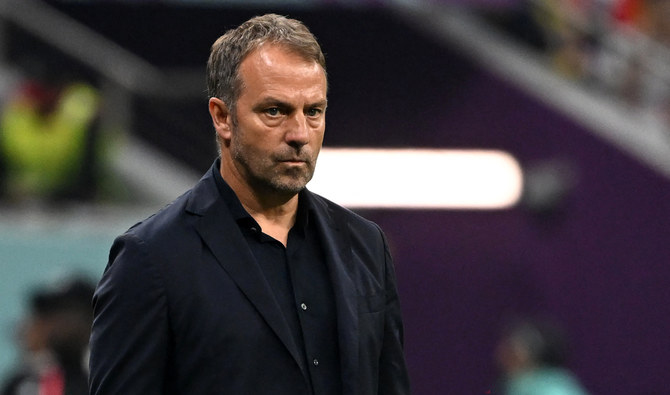
Germany's coach Hans-Dieter Flick watches the Qatar 2022 World Cup Group E football match against Costa Rica at the Al-Bayt Stadium in Al-Khor, north of Doha on December 1, 2022. (AFP/File)
Short Url
Updated 21 March 2023
Follow

Germany hopes to repair reputation before hosting Euro 2024

  • The campaign starts this week with friendly games against Peru in Mainz on Saturday, then Belgium in Cologne three days later

BERLIN: With the European Championship looming next year, host Germany hopes this week to start repairing the tattered reputation of its men’s national soccer team.

Two World Cup flops and a poor showing in between have taken their toll on what was a proud heritage for Germany. The four-time World Cup winner no longer strikes fear among opponents.

The German Soccer Federation wants to change that before the country hosts Euro 2024. It’s an opportunity to restore lost pride, albeit with the potential for more embarrassment.

The campaign starts this week with friendly games against Peru in Mainz on Saturday, then Belgium in Cologne three days later.

The federation has given coach Hansi Flick another chance to lead the team after its first-round exit at the 2022 World Cup. It also brought in former Germany striker and coach Rudi Voller as sporting director to oversee what it hopes will be a successful shakeup.

Another one.

Former coach Joachim Low attempted a shakeup after Germany’s first-round exit at the 2018 World Cup, then ditched it after a 6-0 drubbing by Spain when he recalled veterans Thomas Muller and Mats Hummels for the coronavirus-delayed Euro 2020 tournament. It only got his team as far as the second round, where England ended Low’s 15-year stint in charge.

Flick is banking on more success with the latest focus on youth, building his squad on a foundation of talented but untested under-21 players. Flick has called up six debutants for the games against Peru and Belgium, while leaving out established regulars like Muller, Leroy Sane, Ilkay Gundogan, Antonio Rüdiger and Marco Reus among others.

“We’ve taken this path to see which players have the potential to be at the European Championship next year,” Flick said.

Bayer Leverkusen’s 19-year-old attacking midfielder Florian Wirtz is the German team’s new star, particularly with Bayern Munich’s 20-year-old Jamal Musiala ruled out of the upcoming games through injury. Both were already established players for the senior team, though Wirtz missed the World Cup last November with a knee injury.

Perhaps to underline Germany’s new faith in its youth setup, under-21 coach Antonio Di Salvo appeared alongside Flick and Voller at Monday’s press conference.

Di Salvo is preparing his team for the Under-21 European Championship in Georgia and Romania this summer, but said he was happy to see players like AC Milan defender Malick Thiaw get their chance with Flick’s senior team.

“It’s an honor for the players. It’s also an honor for all the coaches involved along the way from the club to the under-21 team,” Di Salvo said.

Voller also stressed the importance of Germany’s underage sides.

“I myself am a child of the under-21 team,” said Völler, whose goals helped West Germany win the World Cup in 1990.

The now 62-year-old Voller said Germany’s success at the 1982 Under-21 European Championship, where his team reached the final, laid the foundation for the 1990 World Cup win. He also referred to 2009 European champions Manuel Neuer, Sami Khedira, Benedikt Höwedes, Mesut Özil and others helping Germany win the World Cup in 2014.

“That’s the basis for us,” said Voller, who said all the players in Flick and Di Salvo’s teams had the chance to play for Germany at Euro 2024.

“It’s fortunate we have this wonderful European Championship here next year. It’s important for every player and it shows the young players, especially those who are there, how lovely it is to have such a big tournament in your own country,” Völler said. “Every tournament is hugely important and it brings you forward. But to have a tournament in your own country is something special.”

How international academies are shaping Saudi football’s next generation

Updated 05 January 2026
Follow

How international academies are shaping Saudi football’s next generation

  • Building a unified national footballing philosophy in Saudi Arabia is no simple task

Saudi Arabia’s football transformation has been impossible to ignore since the arrival of Cristiano Ronaldo at the end of 2022. An influx of global stars followed, and with it, unprecedented attention on the Saudi Pro League.

Yet beneath the spotlight, a more pressing question emerged amongst domestic fans: “What is the long-term strategy for developing local players?”

Building a unified national footballing philosophy in Saudi Arabia is no simple task. The sheer size of the Kingdom presents logistical challenges unlike those faced by smaller neighbouring nations, making grassroots development harder to centralize. In this landscape, the work of individual institutions can contribute significantly to the broader football ecosystem.

One such contributor is Juventus Academy Saudi Arabia, an official extension of one of world football’s most historic clubs, operating under the umbrella of Al-Shoaibi Group. Arab News spoke to head of public relations at Juventus Academy, Malak Al-Awami, based in Alkhobar, to understand how the academy fits into the Kingdom’s long-term football vision.

“Saudi Arabia is experiencing a transformational moment under Vision 2030, prioritizing youth development and active lifestyles,” Al-Awami explained. “The  academy arrives at a perfect time to contribute to a world-class methodology while helping nurture the next generation of Saudi footballers.”

At Juventus Academy, success is deliberately defined beyond results and trophies.

“We’re not just training players,” Al-Awami said. “We’re shaping future leaders for the Kingdom.”

That philosophy has been reflected in how the academy balances Juventus’ global philosophy with local Saudi culture. While all coaches undergo Juventus’ training standards, cultural understanding remains a priority.

“All of our coaches are guided to respect Saudi values, culture and communication styles,” Al-Awami said. “Technical excellence matters, but the coach’s character is just as important as their certification.”

One of the academy’s defining features has been its inclusivity and cultural awareness. Players can join as young as four years old and continue until the age of 18, with programs open to both boys and girls.

That inclusivity has had a tangible impact. Juventus Academy played a role in the formation of Khobar FC, a women’s team that competed in the inaugural season of the SAFF Women’s Second Division League.

“We even used the same kit style as Juventus, getting approval from the club itself,” revealed Al-Awami.

Operating as an extension of the academy, the team finished just a few points behind established clubs like Al-Nahda and Al-Fateh in their regional group.

Al-Awami noted that the group is also exploring complementary initiatives aimed at elite player development beyond the academy itself. Among them is the planned Superior Striker Project, a specialized program designed to bring international attacking expertise to Saudi Arabia through short-term clinics for youth and professional players.

It is this broader contribution that highlights the growing importance of international academies in Saudi Arabia. Beyond providing structured training, they are helping build communities, instil values and strengthen the foundations of the domestic football pyramid. 

When asked about what success would look like for Juventus Academy in 5-10 years, Al-Awami was clear. “It is definitely not about trophies or big contracts,” he said, before adding, “it is the legacy we leave behind. If, in 10 years we see confident young Saudi players competing at elite levels, local coaches growing through our programs, and families trusting football as a tool for personal development, then we will know that we have truly succeeded.”

Juventus Academy Saudi Arabia builds on Al-Shoaibi Group’s original ambition in 2018: to create meaningful football opportunities for families in the Kingdom. Today, that ambition has evolved into a structured pathway contributing to Saudi football future, blending global expertise with local identity to help shape the next generation.