

Pakistani electric mobility provider raises $1.2 million, launches indigenously developed electric bikes

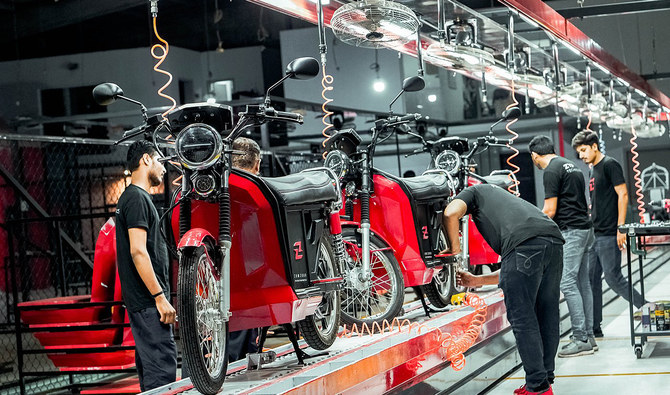
This undated photo shows employees working on an Electric Bike assembly line at the Zyp Technologies facility in Lahore. (Photo courtesy: Zyp Technologies)
Short Url
Updated 12 September 2023
Follow

Pakistani electric mobility provider raises $1.2 million, launches indigenously developed electric bikes

  • With climate change and rising fuel costs in Pakistan, the urgency to electrify transportation has never been greater
  • Zyp Technologies has established an assembly line capable of producing up to 8,000 electric motorcycles annually

KARACHI: Zyp Technologies, a Lahore-based smart mobility solutions provider, on Tuesday announced raising $1.2 million in seed funding and the launch of its “made-in-Pakistan” electric bikes with battery swapping.

With this seed capital investment led by Indus Valley Capital, the firm is driving mass-market adoption of electric mobility in Pakistan by addressing three key hurdles, high upfront cost, range anxiety and long charging times, according to the Lahore-based smart mobility solutions provider.

It was achieved through its indigenously developed product portfolio that includes purpose-built electric motorcycles, innovative battery swap stations, proprietary and patent pending battery architecture, cloud software and mobile apps.

The company has established an assembly line capable of producing up to 8,000 motorcycles annually, underscoring their commitment to meet demand from business customers and individual buyers.

“The backing from Indus Valley Capital has been instrumental. It is enabling us to build the right localized solution for Pakistan,” said Hassan Khan, co-founder and CEO of Zyp Technologies. “Zyp is building beautiful vehicles as we know everyone is tired of the same 40+ years old motorcycle designs and copycat approaches to EVs.”

With climate change and rising fuel costs in Pakistan, the urgency to electrify transportation has never been greater, according to the Zyp CEO. Zyp’s solutions enable motorcycle fleet operators to save up to 70 percent on fuel costs and eliminate air-polluting emissions, making their operations environmentally sustainable and profitable.

“Pakistan deserves better. Zyp is on a mission to make that happen,” Khan said. “The Pakistani government’s EV (Electric Vehicle) Policy was the triggering point which brought all founders together. Successive governments must hold and evolve the policy to reduce Pakistan’s dependence on oil and to help ensure our cities have clean air once again.”

In 2019, Pakistan approved an ambitious National Electric Vehicles Policy (NEVP), offering incentives aimed at seeing electric vehicles capture 30 percent of all the passenger vehicle and heavy-duty truck sales by 2030, and 90 percent by 2040.

Zyp founders joined forces with a mission to create Pakistan’s own homegrown automotive brand in the clean energy sector, and over the past ten months, Zyp Technologies has made remarkable progress in designing and building its complete solution by using in-house experts, innovators, engineers and a network of local and international suppliers and partners, according to the firm.

Its utility motorcycle, ZUM 2000, has been engineered to be gender-neutral, focused on delivery riders, enabling comfortable day-long deliveries at a significantly reduced cost as compared to all other available options. Fleet operators get state-of-the-art fleet management software that includes advanced features like vehicle tracking, geo-fencing, theft detection, ride monitoring, and vehicle service tracking to effectively manage their fleet of ZUM 2000 motorcycles.

The company says its Zyp Energy battery swap station is also a “pivotal achievement” that lays the foundation for Zyp’s battery-as-a-service (BaaS) business model. It enables compatible motorcycles to be “refueled” within 60 seconds.

“With its vision to electrify the 25 million motorbikes in Pakistan, Zyp is building one of the most important products Pakistan needs to help solve the trade imbalance and high inflation,” said Aatif Awan, a founding partner at Indus Valley Capital.

“Zyp team has meticulously designed their electric motorbikes and battery swapping to perform well in the local environment, creating a remarkable indigenous solution we’re proud to back.”


Pakistani, Chinese firms sign 79 MoUs worth $4.5 billion at Islamabad agriculture summit — minister

Updated 11 sec ago
Follow

Pakistani, Chinese firms sign 79 MoUs worth $4.5 billion at Islamabad agriculture summit — minister

  • The summit saw participation from over 300 Pakistani, Chinese firms focusing on modern agricultural techniques and solutions
  • Food security minister says these investments will modernize Pakistan’s agricultural value chains and enhance productivity

KARACHI: The Pakistan–China Agriculture Investment Conference in Islamabad has resulted in 79 Memoranda of Understanding (MoUs) between Pakistani and Chinese companies with an approximate investment value of $4.5 billion, Pakistani Food Security Minister Rana Tanveer Hussain said on Tuesday, signaling confidence of Chinese investors in Pakistan’s agriculture and food sectors.

At least 119 Chinese companies and over 191 Pakistani firms participated in the event held on Monday, focusing on fertilizers, seed varieties, machinery, precision farming and smart irrigation systems, according to the organizers.

The conference was billed by Pakistan’s Ministry of National Food Security and Research as a platform for deepening bilateral agricultural ties and supporting broader economic engagement between the two countries.

Hussain said the scale and depth of investment commitments at the conference reflected a decisive shift from dialogue to on-ground, investment-led collaboration between the two countries.

“The conference was specifically structured to deliver tangible outcomes through direct B2B (business to business) matchmaking, targeted sectoral engagement and project-based investment facilitation, rather than conventional discussions,” he was quoted as saying by his ministry.

Pakistan and China have been expanding cooperation in agriculture under the China-Pakistan Economic Corridor (CPEC) framework, with a focus on mechanization, high-yield seeds, livestock development and value-added food processing. Officials say stronger agricultural ties could help Pakistan boost exports, ensure food security and create jobs, while offering Chinese companies access to a large farming market and new investment opportunities.

Pakistan’s exports to China reached approximately $2.38 billion in Fiscal Year 2024–25 that ended in June, while imports stood at $16.3 billion, reflecting growing demand on both sides despite global economic headwinds, according to the minister.

The food security ministry undertook extensive preparatory work prior to the conference, including structured engagements with Pakistani industry bodies and Chinese enterprises, to align investment proposals with market demand, technology requirements and national priorities, according to Hussain.

As a result, investment agreements were concluded across ten high-impact agricultural and allied sub-sectors, including food processing and value addition, agri-technology, seeds and plant protection, livestock and dairy, meat and poultry, fruits and vegetables, fisheries and aquaculture, animal feed, post-harvest infrastructure, and agricultural inputs.

“These investments will modernize Pakistan’s agricultural value chains, introduce advanced production and processing technologies, and significantly enhance productivity,” the minister said.

“The inflow of capital and technology is expected to generate large-scale employment, particularly in rural areas, strengthen farm-to-market linkages, and reduce post-harvest losses, thereby improving farmer incomes and rural livelihoods.”