



THARPARKAR, Sindh: Last week, Allah Jurio carried a lump of clay to a pottery wheel inside his chaunra, a small thatched-roof hut common in Tharparkar district in Pakistan’s southern Sindh province, and began to spin it into a round shape.
He then used his fingers to turn the clay into a small, hollow ball with four holes called a borrindo, a musical instrument in which the sound is produced by blowing into the largest of the holes, while fingertips placed on the smaller ones help to control notes.
The 76-year-old, who has been making borrindos for around 60 years in the remote village of Allah Jurio Khumber, now only has one customer, Zulfiqar Ali, a 53-year-old musician from a nearby village in the same district, as both the demand and supply has dwindled for the ancient instrument, which traces its origins to the centuries-old Mohenjo Daro city of the Indus Valley Civilization, a Bronze Age culture in the northwestern regions of South Asia, lasting from 3300 BCE to 1300 BCE.
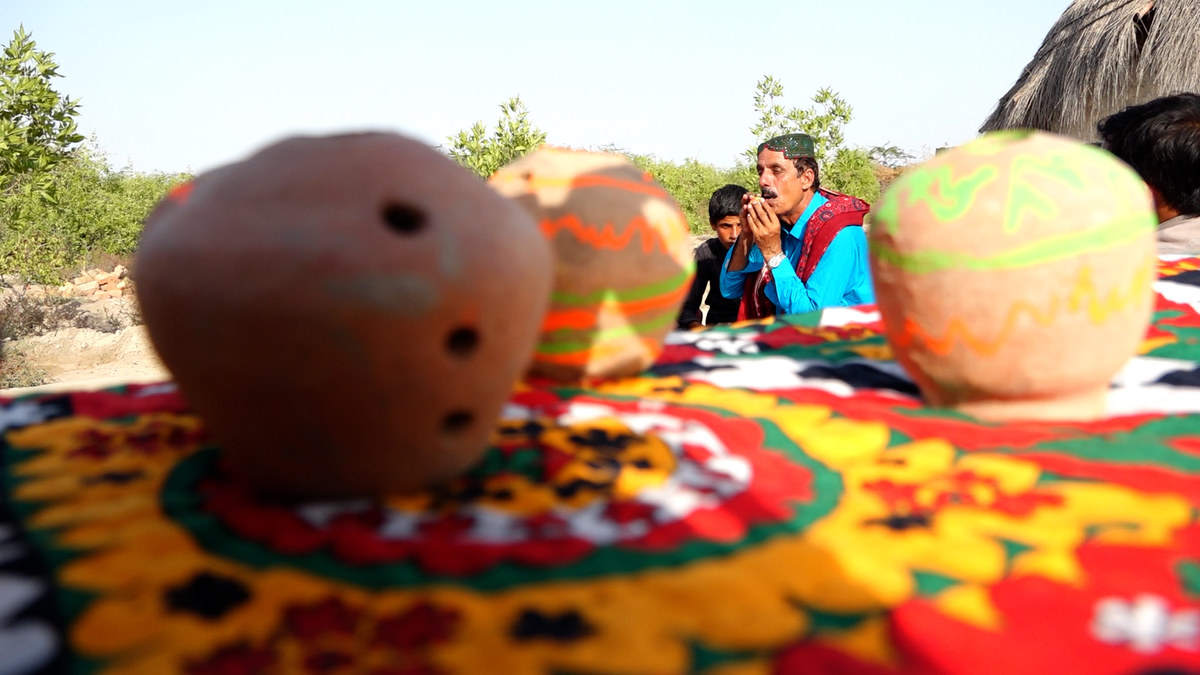
The still image taken from a video shows multiple borrindos (musical instrument made out of clay) displayed on a colorful cloth while musician Zulfiqar Ali plays the instrument in the background in Tharparkar district in the Sindh province of Pakistan, on September 10, 2023. (AN Photo)
Jurio, whose fading eyesight, has made it difficult for him to keep producing borrindos, first started making the instrument six decades ago for Ali’s father Mir Muhammad Khan, also a musician, after Khan showed him a sketch of what the instrument must have looked like when used in Mohenjo Daro.
“My younger son could make them, if Zulfiqar places an order, he can make fifty, a hundred, or even five hundred,” Jurio told Arab News. “But these items are not sold or made anymore.”
Making the borrindo requires craftsmanship but also time, Jurio explained.
The wet clay is dried under the harsh sun after which it is heated in a kiln for two to three days. Once the borrindo is hardened by fire, Jurio’s 72-year-old wife Jamiat and daughter-in-law Mariyam Abdul Rahim paint the instrument in different colors to provide the finishing touches.
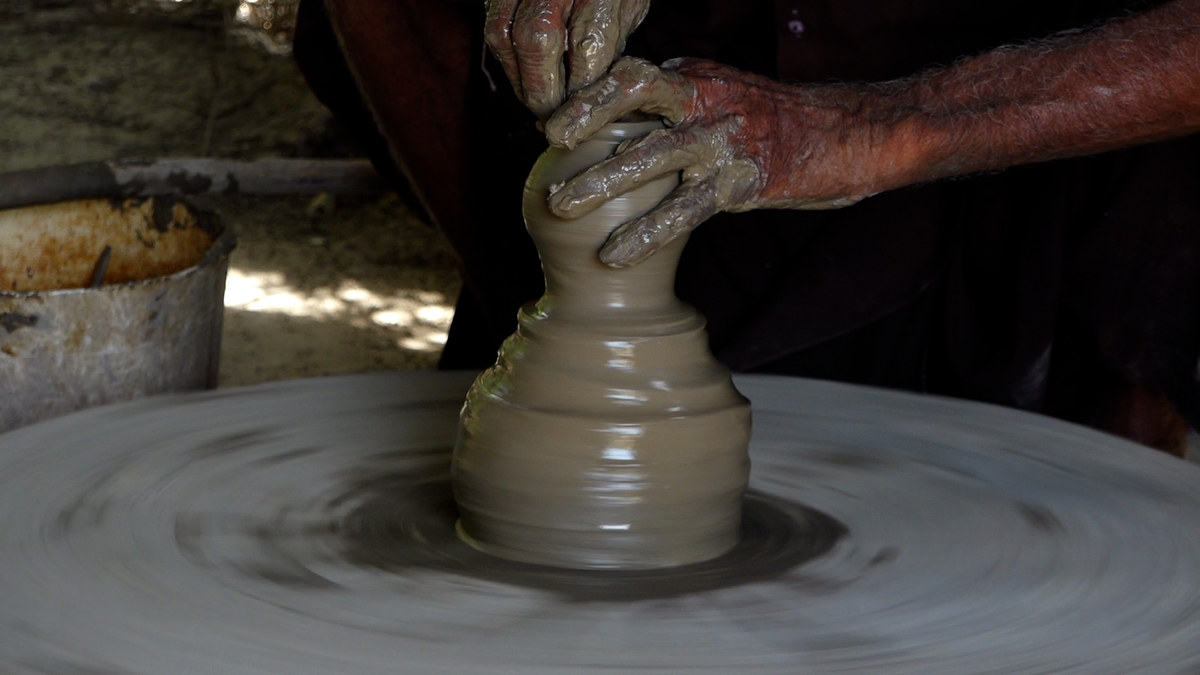
The screen grab taken froma video shows the musical instrument Borrindo being shaped out of clay in the Tharparkar district in the Sindh province of Pakistan, on September 10, 2023. (AN Photo)
Ali introduced his own variation of the centuries-old instrument, which originally featured three holes, adding an extra hole to enhance the borrindo’s capacity to produce a wider range of notes.
“Its physical shape is similar [to the ones that were made in Mohenjo-Daro], but witnessing a rise in diverse melodies in this era, I came to the realization that it [borrindo] was deficient in tones,” Ali told Arab News. “So, I sat down and worked hard and kept adding tones and I succeeded in expanding it to seven tones.”
A third-generation player of the borrindo, Ali is a recipient of the President’s Pride of Performance award in 2021. His father got the award in 1990.
The musician said around forty years ago, the borrindo was played popularly among people in Sindh as they herded animals or traveled to farmlands.
“But it was my father who brought it to music, and introduced it as a musical instrument,” he explained.
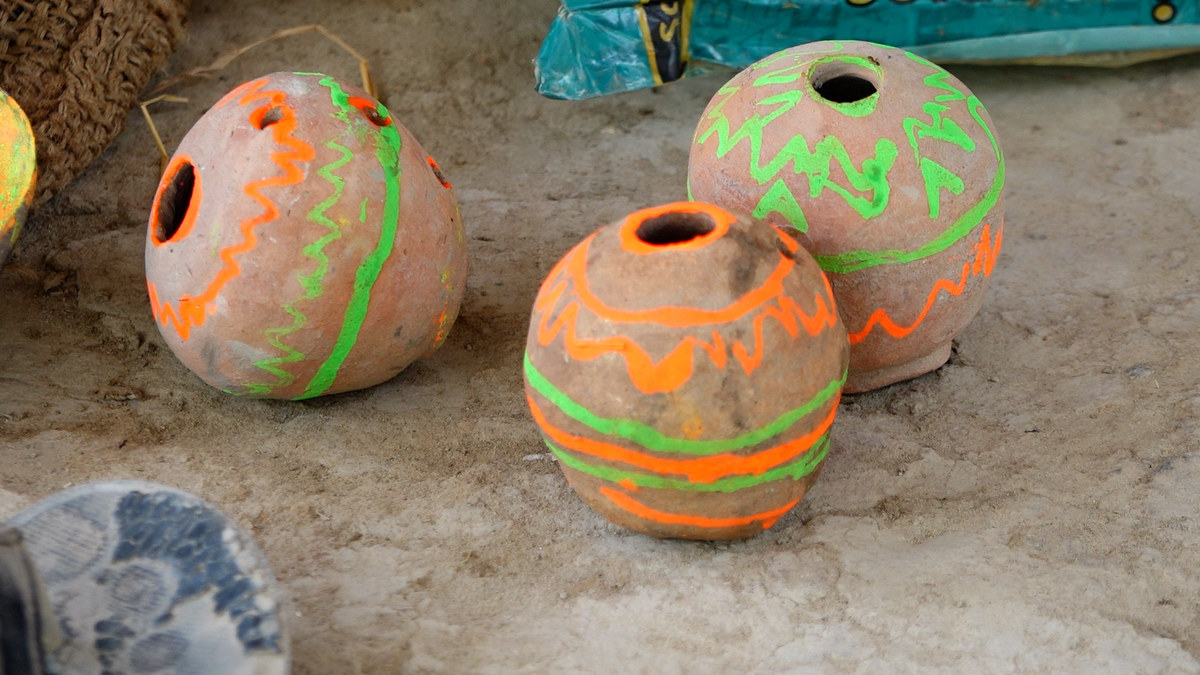
The still image taken from a video shows multiple borrindos (musical instrument made out of clay) designed in bright colours in the Tharparkar district in the Sindh province of Pakistan, on September 10, 2023. (AN Photo)
Though Ali hopes the new generation of his family would keep the tradition of playing the borrindo alive, he feared it would soon be a relic of the past.
“The world has embraced modernity and with the introduction of contemporary instruments, it has faced a loss,” he said. “It can be said that it remains alive through me and through Allah Jurio.
“If we were to quit it, it would make a significant difference,” he lamented, “perhaps resulting in no one playing it.”


