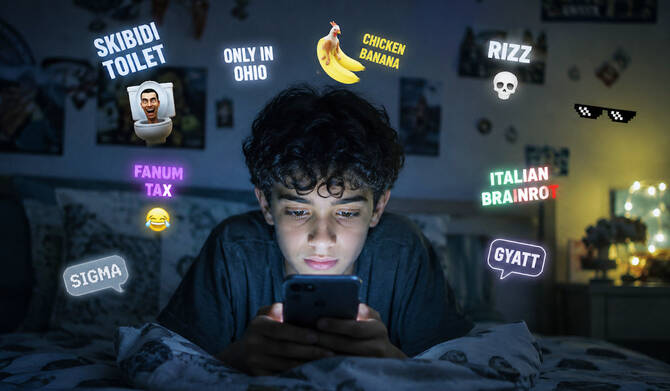

RIYADH: “Sigma,” “chicken banana,” “Italian brain rot” — to an adult scrolling through a child’s phone, the phrases can sound like fragments of a fever dream.
But behind the bizarre characters, repetitive sounds, and seemingly nonsensical memes is a digital language increasingly shaping how young people joke, communicate, and connect — including in Saudi Arabia, where online users are quick to reshape viral trends using local dialect and humor.
Known online as “brain rot,” the phenomenon refers to the perceived mental effects of consuming large amounts of trivial, repetitive or low-quality digital content. Oxford University Press named “brain rot” its 2024 Word of the Year, reflecting how firmly the expression has entered everyday internet vocabulary.
FASTFACT
In Saudi Arabia, where digital platforms are deeply woven into daily life, parents are navigating a media environment in which children can encounter highly stimulating content from an early age.
While the term is usually used humorously, its popularity among Gen Z and Gen Alpha has raised questions about attention, overstimulation, and whether endless streams of short-form content are changing how young people interact with the world.
In Saudi Arabia, where digital platforms are deeply woven into daily life, parents are navigating a media environment in which children can encounter highly stimulating content from an early age.
For Malak Kandiel, a Saudi mother of a six-year-old boy, the answer is to control technology rather than eliminate it altogether.
“My son doesn’t use social media nor a phone or an iPad,” Kandiel told Arab News. “He watches online videos through the TV on YouTube, OSN, or regular TV channels.”
Even without direct access to social media, she has noticed how quickly stimulating content can capture her child’s attention.
“He blocks everything around him and becomes hyper-focused on whatever he’s watching,” she said.
Her son has also started repeating phrases from popular songs and online culture, including “chicken banana” and “Ya Leila Wa Ya Leila.”
“I think their generation are just different,” Kandiel said. “They can’t handle the idea of staying bored and generally they’re overstimulated all the time.”
Her response has been to delay social media exposure, while encouraging activities away from screens, including summer camp, Qur’an classes, soccer, and swimming.
But Saudi social specialist Tariq Al-Ghamdi said the appeal of “brain rot” content goes beyond simple entertainment.
Algorithms widen the trend by delivering rapid bursts of stimulation and encouraging users to keep watching, he told Arab News.
“The brain becomes accustomed to rapid stimuli,” Al-Ghamdi said, adding that constant exposure can make slower activities such as reading and studying feel less engaging.
However, he cautioned against treating every brain-rot meme as a psychological problem.
“It is essentially a temporary form of entertainment,” he said.
The concern comes when consumption becomes excessive, particularly if it is used to escape reality, contributes to social withdrawal, or affects academic performance, language skills or everyday communication.
There is also an important distinction between internet slang and the science behind it.
While there is no medical diagnosis referring to “brain rot,” researchers have examined how repeated exposure to notifications, rapid video changes, and constant switching between content can affect attention and digital habits.
Short-form platforms are particularly suited to this behavior. A single swipe replaces one video with another, leaving users with little reason to stop.
But brain rot is not necessarily about the content itself. It is also about belonging.
Al-Ghamdi said every generation develops its own language to establish an identity separate from older generations. Memes, catchphrases, and obscure references can become a kind of social currency. Understanding the joke means understanding the group.
That language is also becoming increasingly localized in Saudi Arabia.
Global trends are absorbed into Saudi online culture, where young users reshape memes through local dialect, sarcasm, and references to everyday life. A joke that begins as an international trend can take on a different meaning once filtered through Saudi humor.
In that sense, young people in the Kingdom are not simply consuming global internet culture but are remixing it.
And there can be creativity behind some of the apparent nonsense.
Al-Ghamdi said creating brain-rot videos often requires editing, AI tools, visual effects, and unconventional storytelling. What looks meaningless on the surface can involve considerable technical experimentation.
The bigger question, then, may not be whether children encounter brain-rot culture, but whether they have enough balance outside it.
Kandiel worries that unrestricted access to information could affect children’s creativity, skills, and wider understanding.
“Social media promotes a shallow view of the world instead of giving depth and meaning,” she said.
But she does not believe children should simply be kept away from technology.
“What we can do is teach our kids how to benefit from social media. That will help in shifting their minds from consumers and users who suffer from brain rot to creators and entrepreneurs.”
Al-Ghamdi similarly advises parents and teachers to approach the phenomenon with curiosity rather than immediately dismissing it.
Instead of simply telling youngsters to stop watching, he recommends helping them understand how platforms are designed to capture attention and encourage continued engagement.
Warning signs include disrupted sleep, declining academic performance, constant boredom with quiet activities, mental distraction, and difficulty communicating clearly in formal or family settings.
Ultimately, the brain-rot debate may reveal as much about Saudi youth culture as it does about screen time.
The strange memes, repetitive sounds, and absurd characters have become part of a rapidly evolving digital language, allowing young people to joke, connect, and turn global trends into something distinctly local.
The challenge is making sure there is still time for those activities that do not begin with a swipe: reading, playing, learning, having a conversation or simply being bored.
Perhaps the antidote to brain rot is not turning the internet off completely.
It is learning when to scroll, when to stop and, most importantly, when to create something of your own.