

Young Indians have a message for Saudi Arabia: ‘You’re amazing’

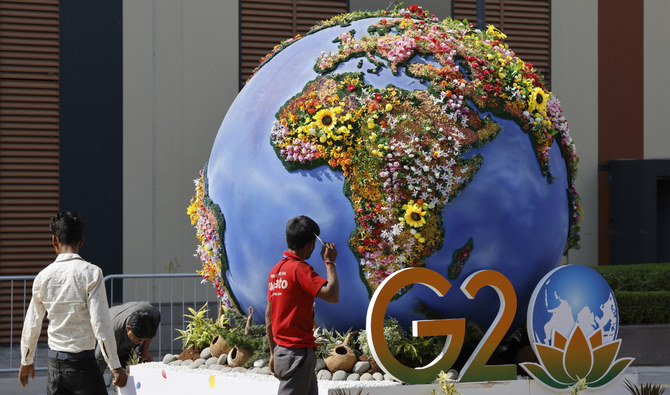
Workers decorate a G20 installation at the International Media Center (IMC) on the eve of the two-day G20 summit in New Delhi on September 8, 2023. (AFP)
Short Url
Updated 11 September 2023
Follow

Young Indians have a message for Saudi Arabia: ‘You’re amazing’

  • Awareness of ongoing social transformation and economic diversification projects has created a buzz in India
  • As Kingdom’s tourism promotion campaigns in India intensify, some want Saudis also to begin visiting India

NEW DELHI: Saudi Indian ties began to see engagement at a high level in 2019 when Crown Prince Mohammed bin Salman undertook his first official trip to India.

Now that he has begun his second state visit, not only Indian politicians but also the nation’s people have noticed how close relations between the two countries have steadily become.

Many diplomatic, economic, trade, and cultural exchanges have taken place since then, especially during India’s G20 presidency this year, including intensified efforts by the Saudi Tourism Authority to promote the Kingdom’s heritage sites and mega-projects among Indians.

Arab News spoke to several young Indians in New Delhi.

Shri Sehgal, a young entrepreneur, said: “It’s amazing — our economic and trade relations and our respect for Crown Prince Mohammed bin Salman.

“We have a huge amount of respect for what he is doing for Saudi Arabia and how he is growing the relationship between Saudi Arabia and India.”

He added that he had been impressed by the projects underway in Saudi Arabia as part of Vision 2030 and noted that footballing star Cristiano Ronaldo’s decision to sign for Al-Nassr last year highlighted the transformation taking place in the Kingdom.

“Saudi Arabia is developing, its cities are changing, and the arrival of Ronaldo has changed the face of Saudi football. I hope Saudi Vision 2030 will gain further momentum going forward.

“You guys are amazing. Keep it up. There’s a great future awaiting Saudis, and I believe things are only going to get better,” Sehgal said.

Abhiraj Sharma, a sales representative, said he had been following local media coverage of India’s efforts to further cement ties with Saudi Arabia.

“We’ve become close lately and the relation between us and Saudi Arabia is very good. And our prime minister is supportive of the Saudis,” he added.

While Saudi Arabia had recently been promoting the country’s tourist attractions to Indian travelers, Sharma hoped Saudis would visit India too.

He said: “To make the relationship, the bond, stronger, we want Saudis also to come here. My message to Saudis would be to come and explore India.”


A vehicle moves through a deserted road on the eve of the two-day G20 summit in New Delhi on September 8, 2023. (AFP)

Saudi Indian relations may have rapidly gained momentum in recent years, but they began growing after the Kingdom opened its doors to Indian expatriate workers.

Raju John, a hospitality professional originally from Kerala, said the Gulf connection brought sudden prosperity to his home state in the 1980s.

“Since the development boom in Saudi Arabia that began 30 or 40 years ago, the Kingdom has been providing enormous job opportunities for Indian workers.

“I have heard about the generosity and kindness of Saudis among other good qualities. I feel very happy about the fast-improving current ties between Saudi Arabia and India,” he added.


Rolls-Royce highlights importance of Saudization for defense readiness

Updated 19 sec ago
Follow

Rolls-Royce highlights importance of Saudization for defense readiness

  • Firm’s Saudization over 80%, vice president tells Arab News
  • Cate Wilkenson spotlights plans to support defense industry

RIYADH: Rolls-Royce, which has most of its in-country workforce consisting of citizens, has highlighted the importance of Saudization in supporting the Kingdom’s defense readiness.

Cate Wilkinson, senior vice president at Rolls-Royce PLC Middle East, told Arab News on the sidelines of the World Defense Show recently that the company’s Saudization level is “over 80 percent” in the Kingdom, with figures varying by site.

“Depending on whether or not we’re talking about our MRO (Maintenance, Repair and Overhaul) facility in Taif or more generally, we are well over 82 percent, nearly 90 percent,” she said.

Wilkinson said the company focuses on developing local talent as a part of that push. “We take talented Saudis from fresh out of school, and we give them skills and help them grow.”

She said localization strengthens the company’s day-to-day processes inside the Kingdom. “We are integrated within the nation. We are there to support it regardless of what happens.”

“Having a Saudi team doing work on Saudi engines is really key for us.”

Wilkinson said predictive maintenance — anticipating problems before they happen — has become essential for fleet availability and mission readiness.

“Predictive maintenance and digital twinning is mission critical for our fleet these days.”

She explained that digital twin technology helps Rolls-Royce monitor performance and anticipate deterioration, improving planning and sustainment.

“Digital-twinning technology helps us understand how the engine is working and how the engine is deteriorating, which means we can provide a better, more cost-effective service to the customer.”

Wilkinson said she is seeing increased demand from Saudi Arabia customers for more integrated approaches, linked to the Kingdom’s Vision 2030 trajectory.

“There’s a lot of opportunity to do things better, to become more integrated and support the defense of Saudi Arabia,” she said.

As an example of Rolls-Royce’s footprint beyond aviation, Wilkinson pointed to the company’s maritime engine base.

“We have about 450 reciprocating engines in the Saudi Navy, Coast Guard and fleets,” she said.

Wilkinson added that it is an area the company has not historically highlighted as much, but sees as increasingly important.

On sustainability, Wilkinson said: “Sustainable fuels is something that we’ve been looking at across the whole of the group for quite a number of years.”

From a defense perspective, she said the company has been working with air forces on reciprocating engines — particularly in the UK and US.

“Within the reciprocating engine side of things, we’re looking at alternative fuels … so it wouldn’t necessarily be diesel going forward,” she said.

Wilkinson argued that sustainability in defense must be broader than fuel efficiency alone. “It’s not just about sustainable aviation fuels.”

She added that defense organizations want to move toward a more sustainable future.

“It’s not just about the fuel they burn. It’s about what you do with them afterwards,” Wilkinson said. “It’s all the way through the life cycle, it’s disposal as well.”