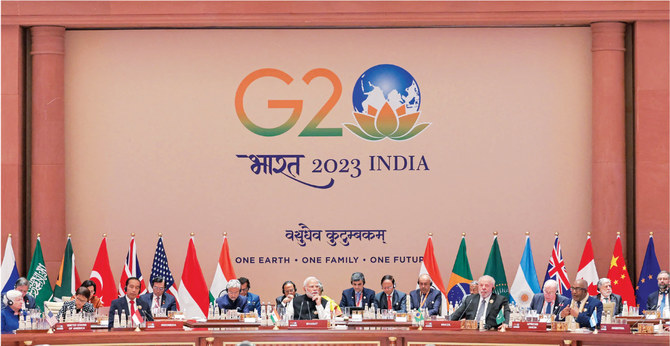

NEW DELHI: Heads of government and international organizations paid their respects to Indian independence leader Mahatma Gandhi as the 18th summit of the G20 came to a close, marking the end of a year-long Indian presidency.
India handed over the baton on Sunday to Brazil, with Prime Minister Narendra Modi calling for a virtual meeting in November to review progress on the policy suggestions and goals announced over the weekend.
“It is our responsibility to look at the suggestions that have been made to see how progress can be accelerated,” he said.
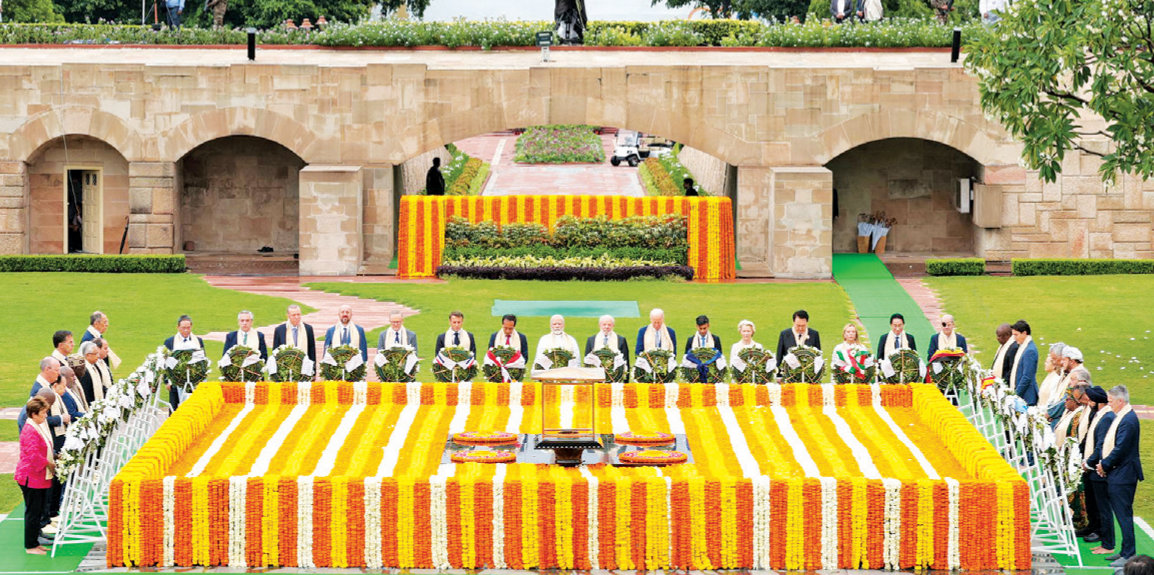
India's Prime Minister Narendra Modi (C) along with world leaders pays respect at the Mahatma Gandhi memorial at Raj Ghat on the sidelines of the G20 summit in New Delhi on September 10, 2023. (PIB handout photo/via AFP)
Under India’s presidency, which officially runs until November, the group addressed the major agenda items on the first day of the annual leaders’ two-day summit, having admitted the 55-member bloc African Union as a permanent member and adopted a leaders’ declaration that had earlier been a matter of contention.
The declaration came as a surprise owing to the known deep divisions within the G20 over Russia’s invasion of Ukraine. Apparently, consensus was reached on Saturday after delegates from the world’s most economically important countries reportedly found a compromise on language used in reference to the war.
FASTFACT
CONSENSUS DECLARATION
During the summit in New Delhi, the G20 adopted a consensus declaration that made commitments on food and energy security, climate change and global debt vulnerabilities among other issues.
In the 37-page document, the G20 avoided condemning fellow member Russia for the war but highlighted the human suffering caused by the conflict as it called on all states not to use force to grab territory.
“We will unite in our endeavor to address the adverse impact of the war on the global economy and welcome all relevant and constructive initiatives that support a comprehensive, just, and durable peace in Ukraine … today’s era must not be of war,” it said.
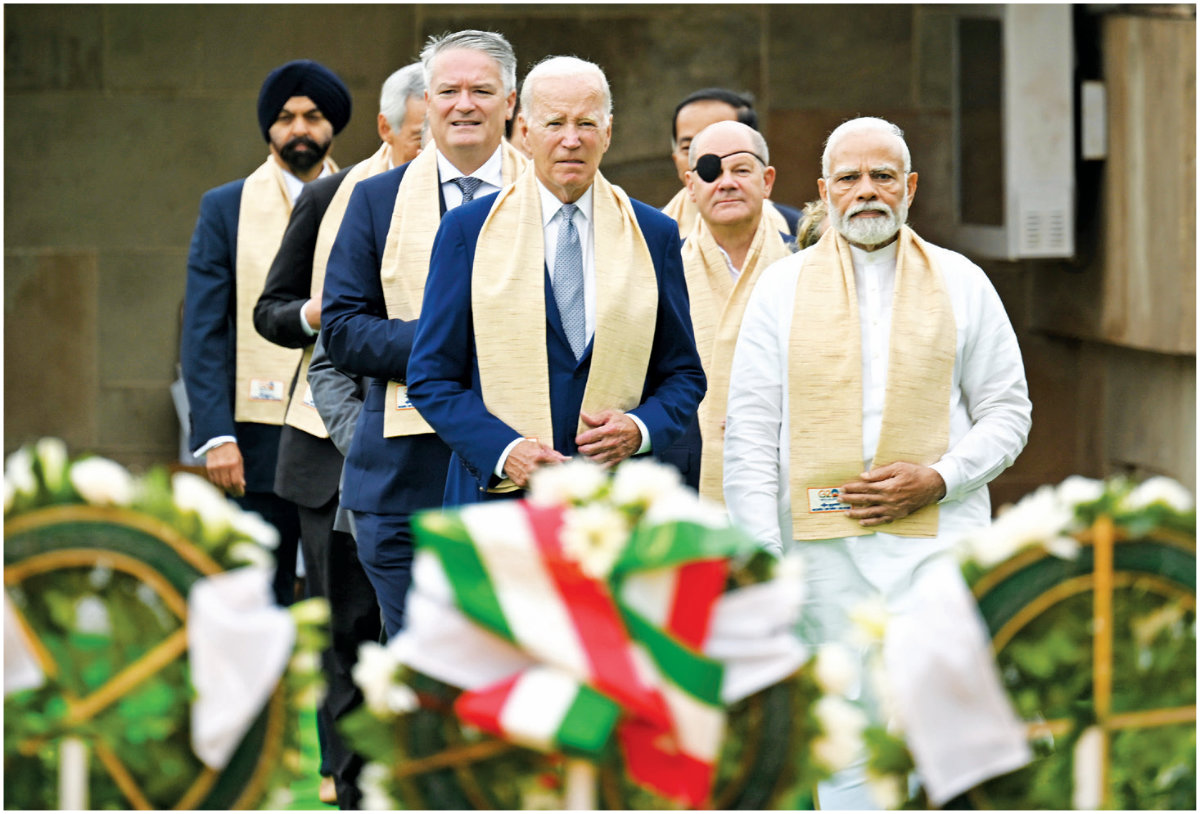
India's Prime Minister Narendra Modi (R), US President Joe Biden (C), German Chancellor Olaf Scholz (3R) and Australia's Prime Minister Anthony Albanese (3L) along with world leaders arrive to pay respect at the Mahatma Gandhi memorial at Raj Ghat on the sidelines of the G20 summit in New Delhi on September 10, 2023. (Ludovic Marin/Pool/AFP)
With those major items taken care of, several G20 heads of government visited the Rajghat memorial site in New Delhi on Sunday, where they shook hands and posed for photos with Modi. Each was given a shawl made of khadi, a handspun fabric Gandhi had promoted during India’s independence movement against British rule.
In a customary show of respect, most of the leaders, including Indonesian President Joko Widodo and British Prime Minister Rishi Sunak, walked barefoot to the site where Gandhi was cremated following his assassination in 1948.
The G20 earlier comprised 19 states and the EU, and accounted for more than 80 percent of global economic output, 75 percent of international trade and about two-thirds of the world’s population.

India's Prime Minister Narendra Modi (L) presents a sapling to Brazil's President Luiz Inacio Lula da Silva during the third working session of the G20 Leaders' Summit in New Delhi on September 10, 2023. (PIB handout photo/via AFP)
For Sanjay Kapoor, editor of the English fortnightly Hard News, the recent summit stood out for several “significant” accomplishments.
“India managed to walk the tightrope without causing embarrassment to world leaders who were absent from the gathering,” he told Arab News.
The leaders of China, Russia, Spain and Mexico did not attend the summit in New Delhi.
“G20, which was being challenged by an empowered and enlarged BRICS, has revived after the Delhi summit.”

Russian Foreign Minister Sergei Lavrov attends a press conference on the second day of the G20 summit in New Delhi on September 10, 2023. (REUTERS)
BRICS, which includes Brazil, Russia, India, China and South Africa, recently invited another six countries to join: Saudi Arabia, Iran, Ethiopia, Egypt, Argentina and the UAE. BRICS has been accelerating its push to reshuffle a world order many see as outdated, challenging the G20’s position as the premier forum for international economic cooperation.
Harsh V. Pant, vice president of Observer Research Foundation in New Delhi, believes the 18th G20 summit has created “a new template for reform multilateralism.”
“By putting the Global South, or the developing world, at the core of its G20 agenda, India has certainly tried to make a case for a new kind of multilateralism that is more dynamic, more forward-looking, and more responsive to the challenges of our times,” Pant told Arab News.

Indian PM Narendra Modi, right, shares a light moment with African Union Chairman and Comoros President Azali Assoumani at Bharat Mandapam convention center in New Delhi on Sept. 9, 2023. (AP Photo/Pool)
According to him, the AU’s entry into the G20 is a concrete example of a more inclusive multilateral process that India has touted since the beginning of its presidency, which is pushing countries to think more creatively on how to solve global challenges.
“India also has framed the global governance agenda around the Global South, and that means that all future endeavors in multilateralism will have to in some ways demonstrate their adaptability to the Global South agenda,” Pant said.
On the sidelines of this year’s summit, India made other breakthroughs, including an international partnership to establish the ambitious India-Middle East-Europe Economic Corridor, which saw Saudi Arabia, the EU, India, UAE, France, Germany, Italy and the US sign a memorandum of understanding.
“The IMEC is expected to stimulate economic development through enhanced connectivity and economic integration between Asia, the Arabian Gulf and Europe,” the MoU reads.
IMEC also seeks efficiency and cost reduction, while promoting economic unity in the hopes of generating jobs and reducing greenhouse gas emissions.
Separately, India launched the Global Biofuel Alliance initiative, which is aimed at fostering global collaboration for the advancement and widespread adoption of biofuels.

From left, Singapore PM Lee Hsien Loong, Bangladesh PM Sheikh Hasina, Italian PM Giorgia Meloni, U.S. President Joe Biden, Indian PM Narendra Modi, Brazilian President Luiz Inacio Lula da Silva, President of Argentina Alberto Fernandez, Mauritius PM Pravind Kumar Jugnauth and UAE Foreign Minister Sheikh Abdullah bin Zayed Al Nahyan attend the launch of the Global Biofuels Alliance at the G20 summit in New Delhi, India, on Sept. 9, 2023. (AP Photo/Pool)
These efforts are seen by many observers as indicative of a sincere attempt to offer solutions to pressing global issues.
“I think there is an attempt to articulate concrete solutions to global problems rather than just words,” Pant said, referring to the accomplishments made by India during its G20 presidency in general and the summit in particular. “The outcome has been very concrete and, in some ways, very target-oriented.”
The general consensus of analysts is that India’s stewardship of the G20 has solidified its reputation on the international stage.
“India has been able to demonstrate its credentials as a global leader. There have been times in the past when it has been questioned, whether India can lead, but with this G20 India has shown it is willing and able to lead on global governance,” Pant said.
His view was seconded by Aditya Ramanathan, a research fellow with the Takshashila Institution in Bengaluru, who said India has been able to elevate its international diplomatic standing through its G20 presidency.
“It is clearly a triumph of Indian diplomacy and a testament to India’s position in the world today,” he told Arab News.
“What we’re seeing is India very consciously raising its diplomatic stature and demonstrating that it can lead as well as shape complex multilateral negotiations.
“India has thus far been successful at leveraging its position in a divided world. However, this is a tricky game and India will need to play its cards cleverly to maintain and expand its diplomatic influence in the future.”