

Pakistan urges France to review ‘Islamophobic’ ban on wearing abaya in schools 

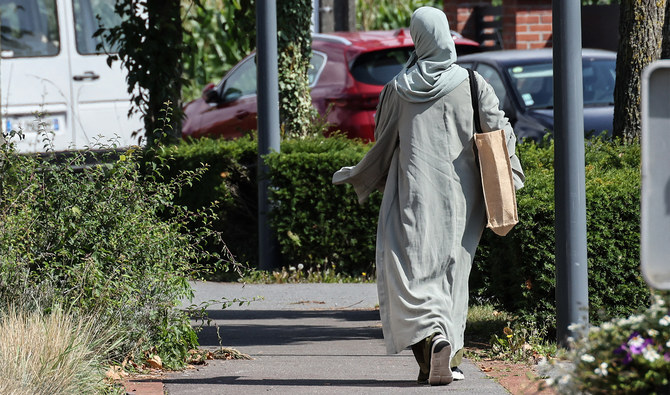
A woman wearing an abaya dress walks through the streets of Lille, northern France, on August 28, 2023. (Photo courtesy: AFP/File)
Short Url
Updated 08 September 2023
Follow

Pakistan urges France to review ‘Islamophobic’ ban on wearing abaya in schools 

  • President Emmanuel Macron’s government last month announced the ban as it broke rules on secularism in education 
  • Islamabad says the French ban violates Muslim women and girls’ human rights, freedoms of expression and religion 

ISLAMABAD: Pakistan’s foreign ministry on Friday urged French authorities to review a ban on traditional over-garments, abaya, worn by some Muslim girls in schools, saying the restriction was “Islamophobic” in nature. 

President Emmanuel Macron’s government last month announced the ban on abaya in schools as it broke the rules on secularism in education. France has already banned headscarves on grounds that they constitute a display of religious affiliation. 

On Thursday, France’s top administrative court upheld the government ban and rejected complaints by an association representing Muslims that it was “discriminatory” and could “incite hatred.” The court ruled the French law did not allow anyone to wear visible signs of any religious affiliation in schools. 

In exclusive comments to The Independent’s Urdu service, a spokesperson for the Pakistani foreign ministry said the French ban “impinges” on the rights of women and girls to profess their identity and effectively participate in public affairs. 

“This is a concerning development as it pertains to the rights of women and girls to profess their identity and impinges on their right to effective and meaningful participation in conduct of public affairs,” the spokesperson said. 

“Such measures are also Islamophobic in nature and violate Muslim girls and women’s human rights and freedoms, especially the freedoms of expression and religion. We urge the French authorities to review their decision on abaya ban.” 

France, which has enforced a strict ban on religious symbols in state schools since 19th century laws removed any traditional Catholic influence from public education, has struggled to update guidelines to deal with a growing Muslim minority. 

The strict brand of secularism, known as “laicite,” is a sensitive topic, and one often quick to trigger tension. 

Around 10 percent of France’s 67 million inhabitants are Muslim, according to official estimates. 

Most have origins in northern African countries Algeria, Morocco and Tunisia, which were French colonies until the second half of the 20th century. 


Pakistan, Bangladesh explore avenues for cooperation in railways sector

Updated 07 February 2026
Follow

Pakistan, Bangladesh explore avenues for cooperation in railways sector

  • Islamabad, Dhaka have lately been looking to strengthen institutional linkages to broaden cooperation amid thaw in ties
  • Pakistan offers expertise in railway development, rolling stock and manufacturing to visiting Bangladeshi officials

KARACHI: Pakistani and Bangladeshi officials have discussed ways to strengthen cooperation in the railways sector, including technical collaboration and capacity-building, the Pakistani railways ministry said on Saturday, as the two sides explore avenues to expand bilateral ties.

The statement came after a visit of Bangladesh’s Secretary for International Organizations Farhad Islam and High Commissioner to Pakistan Mohammad Iqbal Hussain Khan to the Pakistan Railways Workshop Division in Lahore.

It comes amid Islamabad’s efforts to rebuild relations with Bangladesh since the ouster of former prime minister Sheikh Hasina, with both countries looking to strengthen institutional linkages to broaden their cooperation.

The visiting Bangladeshi officials were welcomed at the Pakistan Railways headquarters and briefed on the overall functioning, technical capabilities and projects, according to the Pakistani railways ministry.

“The delegation was subsequently given a detailed tour of the Mughalpura Locomotive Workshop, where they were briefed on various stages of locomotive maintenance, rehabilitation, and manufacturing processes,” the ministry said.

“The distinguished guests termed their visit as highly informative, productive, and encouraging, and appreciated the technical expertise and professional competence of Pakistan Railways.”

Pakistan and Bangladesh were part of the same country until Bangladesh’s secession following a bloody civil war in 1971, an event that long cast a shadow over bilateral ties.

Both countries have moved closer since August 2024, following the ouster of Hasina who was considered an India ally. While Pakistan-Bangladesh ties warm up, relations between Dhaka and New Delhi remain strained over India’s decision to grant asylum to Hasina.

A short documentary highlighting the working and operational strength of Pakistan Railways workshops was also presented to the Bangladeshi officials during their visit.

“Federal Minister for Railways, Mr. Muhammad Hanif Abbasi, remains fully committed to further strengthening bilateral relations with brotherly country Bangladesh, particularly in the areas of railway development, exchange of expertise, rolling stock, and cooperation in manufacturing sectors,” the railways ministry said.

“Minister has expressed his resolve to take forward railway-to-railway cooperation between the two countries, emphasizing that mutual collaboration in the railway sector can yield substantial benefits for both nations.”