

Tunisia to reopen national museum closed in 2021 power seizure

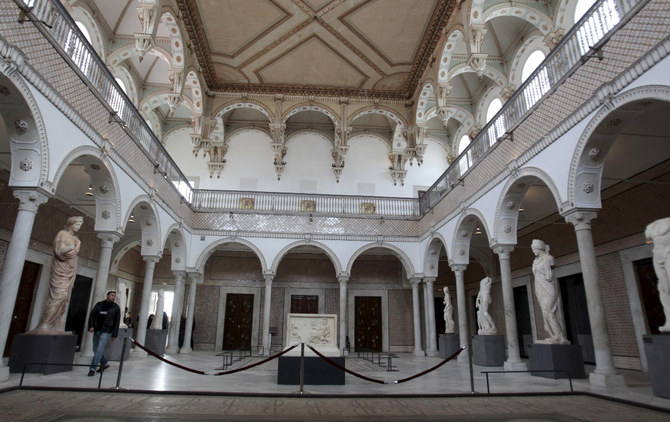
A man walks inside national Bardo museum, in Tunis March 27, 2015. (REUTERS)
Short Url
Updated 06 September 2023
Follow

Tunisia to reopen national museum closed in 2021 power seizure

  • After Tunisia’s 2011 revolution the parliament had emerged under the new democratic system as the most powerful elected body and its arcade-ringed chamber became home to some of the most open political debate of any Arab country

TUNIS: Tunisia will soon reopen its Bardo national museum, the Culture Ministry said on Tuesday, two years after it was closed when President Kais Saied shuttered the parliament, which shares the same building.
The ministry did not give a date to reopen the Bardo, located in a historic palace and home to one of the world’s most magnificent collections of ancient Roman mosaics, but said that some restoration work had been carried out. Saied sent tanks to surround the parliament on July 25, 2021, as he seized most powers in moves his critics called a coup, closing both buildings while he rewrote the constitution and held elections to a new, far less influential, legislature. The new parliament started work this year but there had been no firm information about reopening the national museum — one of the capital’s main attractions in a country economically dependent on tourism.
After Tunisia’s 2011 revolution the parliament had emerged under the new democratic system as the most powerful elected body and its arcade-ringed chamber became home to some of the most open political debate of any Arab country. However, many Tunisians came to blame parliament and the main political parties for years of economic stagnation and government paralysis as a succession of coalition governments failed to bring prosperity.
In 2015 an attack by Islamist militants targeted visitors to the Bardo, killing more than 20 people in the building and its environs soon after completing a major renovation.
Enormous mosaics with rich details and vivid colors are displayed throughout the museum including ones showing the Roman sea god Neptune, hunting scenes and spectacular arrays of sea life.
As the home of ancient Carthage and its Punic culture, and as a major Roman colony that helped provide the empire with food, Tunisia is awash with classical-era sites and archaeological remains.
The Bardo mosaics, along with others in the museums at Sousse and by the amphitheater at El-Djem, are taken from the luxurious villas built during the Roman era and into late antiquity.


Tunisian police arrest member of parliament who mocked president

Updated 05 February 2026
Follow

Tunisian police arrest member of parliament who mocked president

  • Ahmed Saidani mocked the president in a Facebook post, describing him as the “supreme commander of sewage and rainwater drainage”

TUNIS: Tunisian police arrested lawmaker Ahmed Saidani on Wednesday, two of his colleagues ​said, in what appeared to be part of an escalating crackdown on critics of President Kais Saied.
Saidani has recently become known for his fierce criticism of Saied. On Tuesday, he mocked the president in a Facebook post, describing him as the “supreme commander of sewage and rainwater drainage,” blasting what he said ‌was the absence ‌of any achievements by Saied.
Saidani ‌was ⁠elected ​as ‌a lawmaker at the end of 2022 in a parliamentary election with very low voter turnout, following Saied’s dissolution of the previous parliament and dismissal of the government in 2021.
Saied has since ruled by decree, moves the opposition has described as a coup.
Most opposition leaders, ⁠some journalists and critics of Saied, have been imprisoned since he ‌seized control of most powers in 2021.
Activists ‍and human rights groups ‍say Saied has cemented his one-man rule and ‍turned Tunisia into an “open-air prison” in an effort to suppress his opponents. Saied denies being a dictator, saying he is enforcing the law and seeking to “cleanse” the country.
Once a supporter ​of Saied’s policies against political opponents, Saidani has become a vocal critic in recent months, accusing ⁠the president of seeking to monopolize all decision-making while avoiding responsibility, leaving others to bear the blame for problems.
Last week, Saidani also mocked the president for “taking up the hobby of taking photos with the poor and destitute,” sarcastically adding that Saied not only has solutions for Tunisia but claims to have global approaches capable of saving humanity.
Under Tunisian law, lawmakers enjoy parliamentary immunity and cannot be arrested for carrying out their ‌duties, although detention is allowed if they are caught committing a crime.