NEW DELHI: Prime Minister Narendra Modi’s government has replaced the name India with a Sanskrit word in dinner invitations sent to guests attending this week’s Group of 20 summit, in a move that reflects his Hindu nationalist party’s efforts to eliminate what it sees as colonial-era names.
Indian President Droupadi Murmu is referred to as “President of Bharat” instead of “President of India” in the invitation sent to G20 attendees. The nation of more than 1.4 billion people is officially known by two names, India and Bharat, but the former is most commonly used, both domestically and internationally.
Bharat is an ancient Sanskrit word which many historians believe dates back to early Hindu texts. The word also means India in Hindi.
The change in nomenclature is backed by officials of Modi’s Bharatiya Janata Party. They argue that the name India was introduced by British colonials and is a “symbol of slavery.” The British ruled India for about 200 years until the country gained independence in 1947.
“Another blow to slavery mentality,” the top elected official of Uttarakhand state, Pushkar Singh Dhami, said on X, formerly known as Twitter. Dhami, who is a leader of Modi’s governing party, shared the dinner invitation sent to G20 guests in his post.
Modi’s party has long tried to erase names related to India’s Mughal and colonial past.
In 2015, New Delhi’s famous Aurangzeb Road, named after a Mughal king, was changed to Dr. APJ Abdul Kalam Road after protests from Modi’s party leaders. Last year, the government also renamed a colonial-era avenue in the heart of New Delhi that is used for ceremonial military parades.
Modi’s government says the name changes are an effort to reclaim India’s Hindu past.
India’s opposition parties, however, criticized the move.
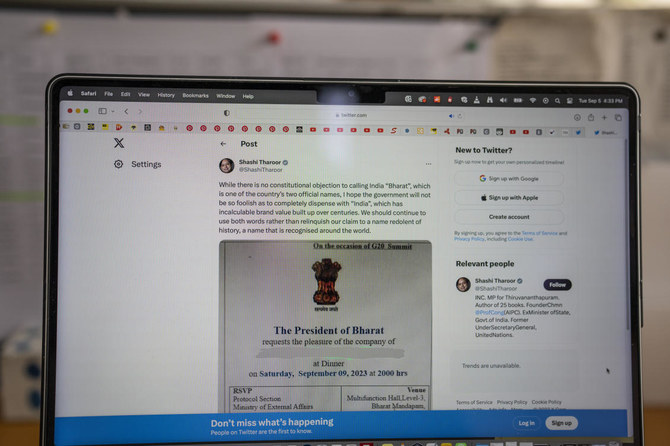
“While there is no constitutional objection to calling India “Bharat,” which is one of the country’s two official names, I hope the government will not be so foolish as to completely dispense with “India,” which has incalculable brand value built up over centuries,” opposition lawmaker Shashi Tharoor said on X.
Tharoor said Indians should “continue to use both words rather than relinquish our claim to a name redolent of history, a name that is recognized around the world.”
Disputes over “India” versus “Bharat” have gained ground since opposition parties in July announced a new alliance — called INDIA — to unseat Modi and defeat his party ahead of national elections in 2024. The acronym stands for Indian National Developmental Inclusive Alliance.
Since then, some officials in Modi’s party have demanded that the country be called Bharat instead of India.

India’s government replaces ‘India’ with ancient name ‘Bharat’ in dinner invitation to G20 guests
https://arab.news/jbh9j
India’s government replaces ‘India’ with ancient name ‘Bharat’ in dinner invitation to G20 guests
- Bharat is an ancient Sanskrit word which many historians believe dates back to early Hindu texts
- Modi’s government says the name changes are an effort to reclaim India’s Hindu past
In show of support, Canada, France open consulates in Greenland
- Decisions taken in a strong show of support for Greenland government amid threats by US President Trump to seize the island
COPENHAGEN, Denmark: Canada and France, which both adamantly oppose Donald Trump’s wish to control Greenland, will open consulates in the Danish autonomous territory’s capital on Friday, in a strong show of support for the local government.
Since returning to the White House last year, Trump has repeatedly insisted that Washington needs to control the strategic, mineral-rich Arctic island for security reasons.
The US president last month backed off his threats to seize Greenland after saying he had struck a “framework” deal with NATO chief Mark Rutte to ensure greater American influence.
A US-Denmark-Greenland working group has been established to discuss ways to meet Washington’s security concerns in the Arctic, but the details of the talks have not been made public.
While Denmark and Greenland have said they share Trump’s security concerns, they have insisted that sovereignty and territorial integrity are a “red line” in the discussions.
“In a sense, it’s a victory for Greenlanders to see two allies opening diplomatic representations in Nuuk,” said Jeppe Strandsbjerg, a political scientist at the University of Greenland.
“There is great appreciation for the support against what Trump has said.”
French President Emmanuel Macron announced Paris’s plans to open a consulate during a visit to Nuuk in June, where he expressed Europe’s “solidarity” with Greenland and criticized Trump’s ambitions.
The newly-appointed French consul, Jean-Noel Poirier, has previously served as ambassador to Vietnam.
Canada meanwhile announced in late 2024 that it would open a consulate in Greenland to boost cooperation.
The opening of the consulates is “a way of telling Donald Trump that his aggression against Greenland and Denmark is not a question for Greenland and Denmark alone, it’s also a question for European allies and also for Canada as an ally, as a friend of Greenland and the European allies also,” Ulrik Pram Gad, Arctic expert at the Danish Institute of International Studies, told AFP.
“It’s a small step, part of a strategy where we are making this problem European,” said Christine Nissen, security and defense analyst at the Europa think tank.
“The consequences are obviously not just Danish. It’s European and global.”
Recognition
According to Strandsbjerg, the two consulates — which will be attached to the French and Canadian embassies in Copenhagen — will give Greenland an opportunity to “practice” at being independent, as the island has long dreamt of cutting its ties to Denmark one day.
The decision to open diplomatic missions is also a recognition of Greenland’s growing autonomy, laid out in its 2009 Self-Government Act, Nissen said.
“In terms of their own quest for sovereignty, the Greenlandic people will think to have more direct contact with other European countries,” she said.
That would make it possible to reduce Denmark’s role “by diversifying Greenland’s dependence on the outside world, so that it is not solely dependent on Denmark and can have more ties for its economy, trade, investments, politics and so on,” echoed Pram Gad.
Greenland has had diplomatic ties with the European Union since 1992, with Washington since 2014 and with Iceland since 2017.
Iceland opened its consulate in Nuuk in 2013, while the United States, which had a consulate in the Greenlandic capital from 1940 to 1953, reopened its mission in 2020.
The European Commission opened its office in 2024.


