GUWAHATI, India: Indian police in Manipur state have filed criminal charges against four journalists, accusing them of misrepresenting facts in a report about the violent clashes between two ethnic groups earlier this year.
The four were senior journalists working on a report for the Editors Guild of India that was seeking to assess how coverage of violence in the state was being conducted.
The report, which was released this month, stated that there “are clear indications that the leadership of the state became partisan during the conflict.”
The chief minister of Manipur, N. Biren Singh, on Monday accused the journalists of trying to “provoke clashes” with the report.
The journalists — Seema Mustafa who is president of the Editors Guild, Seema Guha, Bharat Bhushan and Sanjay Kapoor — could not be immediately reached for comment. The guild did not immediately respond to a request for comment.
The Press Club of India, based in New Delhi, demanded that the charges be withdrawn, saying, “this is a strong arm tactic by the state government which amounts to intimidation of the apex media body of the country.”
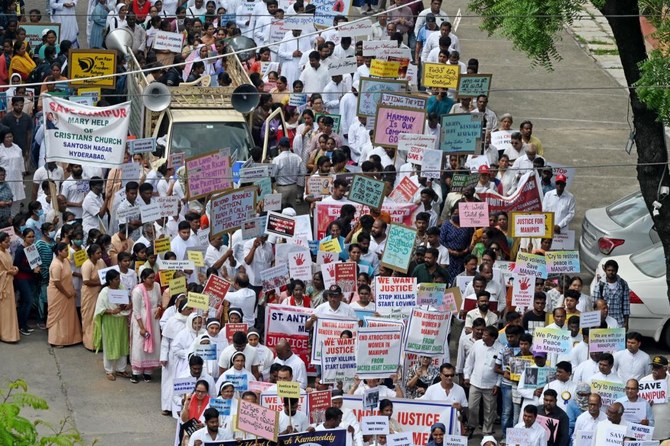
At least 180 people have been killed in Manipur after deadly ethnic violence broke out in May between members of the majority Meitei ethnic group and minority Kuki community over the sharing of economic benefits and quotas.
Meiteis account for half of Manipur’s 3.2 million-strong population and extending limited affirmative action quotas to them would mean they would get a share in education and government jobs that have so far been reserved for Kukis and Nagas.
Federal forces were deployed to quell the unrest that forced tens of thousands to flee into neighboring states or refugee camps.
The report compiled by the journalists said that an Internet shutdown ordered in the state governed by Prime Minister Narendra Modi’s nationalist Bharatiya Janata Party (BJP) contributed to biased reporting by local media aligned with warring ethnic groups. Some local media groups have rejected the allegation.
This year, India has slid 11 places to rank 161st in the World Press Freedom Index, which is compiled by the non-profit group Reporters Without Borders. Modi’s government says India has a vibrant free press.
The Office of the UN High Commissioner for Human Rights this week raised concern about reports of human rights violations in Manipur, describing them as tragic developments in a deteriorating situation for religious and ethnic minorities in India.
The UN statement comes ahead of a summit of G20 leaders in New Delhi that starts on Saturday.


![]()

India’s Manipur charges four journalists with misrepresenting violence in the state
Short Url
https://arab.news/r7h4q
India’s Manipur charges four journalists with misrepresenting violence in the state
- Report blames state leadership of partisanship during conflict
- Manipur chief minister accuses journalists of trying to provoke clashes

Latest updates


© 2026 SAUDI RESEARCH & PUBLISHING COMPANY, All Rights Reserved And subject to Terms of Use Agreement.