

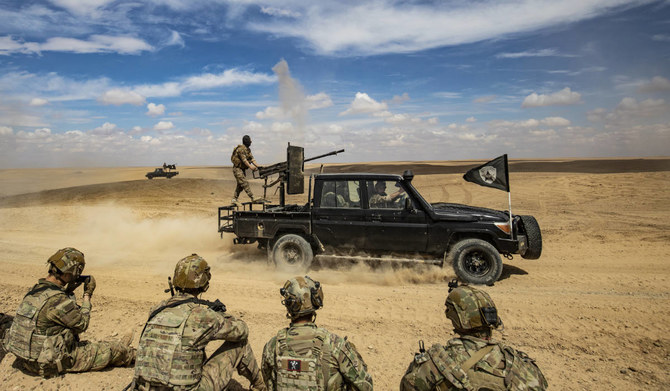


BEIRUT: The US Embassy in Syria said on Sunday that senior officials had met Kurdish-led forces and community leaders in eastern Syria, discussing the need for de-escalation after days of deadly violence.
Fighting erupted in the Kurdish-controlled areas of Deir Ezzor province after the US-backed, Kurdish-dominated Syrian Democratic Forces or SDF detained Ahmad Al-Khabil, the head of the local Deir Ezzor Military Council, last Sunday.
The violence has killed 49 fighters from both sides and eight civilians, according to the Syrian Observatory for Human Rights war monitor, and a curfew went into effect in the area on Saturday.
BACKGROUND
The SDF has denied any dispute with Arab tribes in the region, saying the clashes have mostly involved ‘elements of the regime and some beneficiaries’ of Ahmad Al-Khabil.
US Deputy Assistant Secretary of State for Near Eastern Affairs Ethan Goldrich and Maj. Gen. Joel Vowell, commander of the US-led coalition fighting Daesh in Syria and Iraq, met “in northeast Syria” with the SDF, Kurdish authorities and tribal leaders from Deir Ezzor, the American Embassy said.
“They agreed on the importance of addressing the grievances” of Deir Ezzor residents, “the dangers of outsiders interfering” and “the need to avoid civilian deaths and casualties,” said an embassy statement on X, formerly Twitter.
The participants also agreed on “the need for de-escalation of violence as soon as possible,” said the statement from the US Embassy, which is based outside Syria.
The largely Arab-majority Deir Ezzor province is controlled by the SDF to the east of the Euphrates, while forces loyal to Syrian President Bashar Assad and Iran-affiliated fighters are stationed on the west bank.
Kurdish authorities manage areas under their control through local civilian and military councils, to avoid upsetting local Arab tribes.
The US-led coalition maintains bases in the area, including at Syria’s largest gas field, Al-Omar.
Goldrich and Vowell “reiterated the importance of the strong US partnership with the SDF” in efforts to defeat Daesh, the statement added.
The SDF has denied any dispute with Arab tribes in the region, saying the clashes have mostly involved “elements of the regime and some beneficiaries” of Khabil.
On Sunday, a day after the curfew came into effect, the SDF and the Observatory said the situation appeared to be calming down.
SDF spokesman Farhad Shami said the tensions had been restricted to five villages out of 120 in the area, adding that “in one remaining village, matters are moving toward resolution.”
The situation “is being handled with great sensitivity, but we hope the issues will be settled soon, whether militarily or in communication with the Arab tribes in the region,” he added.
The SDF spearheaded the offensive that defeated Daesh’s self-declared caliphate in Syria in 2019.
Syria’s war has killed more than half a million people since it broke out in 2011.


