

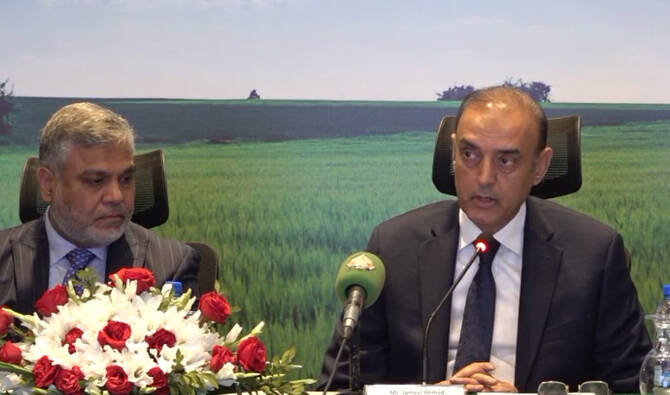

KARACHI: Pakistan disbursed a record Rs2.58 trillion ($9.2 billion) in agricultural loans during fiscal year 2024–25, a 16 percent increase from the previous year, State Bank of Pakistan (SBP) Governor Jameel Ahmad said on Thursday while chairing a meeting of the Agricultural Credit Advisory Committee (ACAC).
Agricultural financing is considered critical to Pakistan’s rural economy, where farming contributes nearly one-fifth of GDP and employs a large share of the workforce. The government has repeatedly emphasized expanding credit access to small farmers as part of broader efforts to boost productivity, stabilize food supply and support economic recovery under an IMF-backed reform program.
According to official data shared at the meeting, agricultural credit disbursement reached Rs2.58 trillion in FY25, marking a record high. In the first half of FY26 alone, banks disbursed Rs1,412 billion in agricultural loans, while the number of borrowers increased to 2.97 million.
“During fiscal year 2025, record agricultural loans of Rs2.58 trillion were disbursed, reflecting an annual growth of 16 percent,” the State Bank governor said, according to a statement issued after the meeting.
He added that Pakistan had regained macroeconomic stability and that the economy was moving toward sustainable growth.
The governor said GDP growth in the first quarter of FY26 stood at 3.7 percent, while full-year growth was projected between 3.75 percent and 4.75 percent.
He also noted that headline inflation had declined to 5.8 percent in January 2026.
The committee reviewed measures to further expand credit access, including greater use of the central bank’s Zarkhez-e scheme to facilitate agricultural lending. Members also discussed promoting electronic warehouse receipt financing to enhance post-harvest liquidity and reduce distress sales of crops.
The statement said the purpose of electronic warehouse receipt financing was to “reduce forced sales of crops and strengthen linkages within the agricultural market.”
Agricultural lending has been a focus of Pakistan’s financial inclusion strategy, particularly as policymakers seek to improve rural incomes, stabilize food prices and strengthen export-oriented crop production amid broader economic reforms.


