China's Xi calls for a Palestinian state to become ‘full member’ of UN

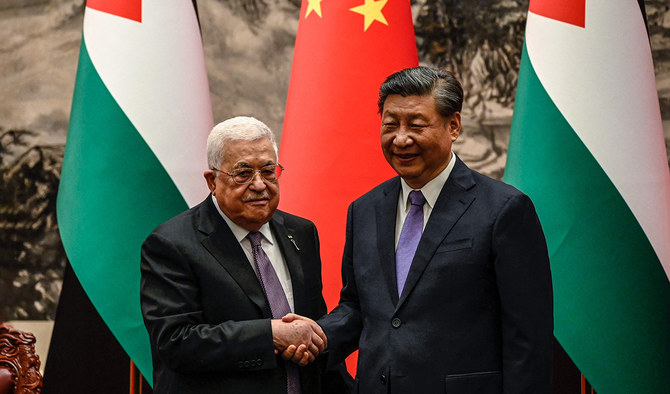
China's President Xi Jinping, right, shakes hands with Palestinian President Mahmud Abbas during a welcoming ceremony at the Great Hall of the People in Beijing on June 14, 2023. (AFP)
Short Url
Updated 14 June 2023
Follow

China's Xi calls for a Palestinian state to become ‘full member’ of UN

  • Latest call comes as Asian powerhouse works to strengthen its role as mediator in Middle East
  • China has emphasised push for peace talks on basis of implementing “two-state solution”

BEIJING: Chinese President Xi Jinping reiterated to Palestinian leader Mahmud Abbas on Wednesday his call for a state of Palestine to become a “full member” of the United Nations, state media reported.

Xi expressed Beijing’s position during a summit with Arab countries in Saudi Arabia in December, although the latest call comes as the Asian powerhouse works to strengthen its role as mediator in the Middle East.

Xi met Abbas during the December trip and pledged to “work for an early, just and durable solution to the Palestinian issue.”

Beijing has since positioned itself as a mediator in the Middle East, brokering the restoration in March of ties between Iran and Saudi Arabia in a region where the United States has for decades been the main powerbroker.

“China supports Palestine in becoming a full member State of the United Nations,” Xi said during a meeting with Abbas in Beijing, according to Chinese state broadcaster CCTV.

“The fundamental way out of the Palestinian issue lies in the establishment of an independent Palestinian State,” he said.

Abbas will be in the Chinese capital until Friday, his fifth official visit to the world’s second-largest economy.

Xi told Abbas at a welcome ceremony at the Great Hall of the People that China was “ready to strengthen coordination and cooperation with the Palestinian side.”

“Today, we will jointly announce the establishment of a China-Palestine strategic partnership, which will be an important milestone in the history of bilateral relations,” Xi said.

Abbas arrived in Beijing on Monday to hold talks with top Chinese leaders including Xi and Premier Li Qiang.

The two sides are using the opportunity to discuss ways to advance relations and resolve longstanding challenges to the Palestinian-Israel relationship.

Beijing has sought to boost its ties in the Middle East, challenging US influence — efforts that have sparked unease in Washington.

Chinese foreign ministry spokesperson Wang Wenbin called long-time Palestinian leader Abbas an “old and good friend of the Chinese people” during a regular media briefing last week.

Finding a lasting solution to Israeli-Palestinian tensions may prove elusive, as peace negotiations between the two sides have been stalled since 2014.

Chinese Foreign Minister Qin Gang told his Israeli and Palestinian counterparts in April that his country was willing to aid peace negotiations, Xinhua reported.

And Qin told Palestinian foreign minister Riyad Al-Maliki that Beijing supports the resumption of talks as soon as possible, according to the state news agency.

In both calls Qin emphasised China’s push for peace talks on the basis of implementing a “two-state solution.”


Hungary says it will block a key EU loan to Ukraine until Russian oil shipments resume

Updated 9 sec ago
Follow

Hungary says it will block a key EU loan to Ukraine until Russian oil shipments resume

  • Szijjártó said: “As long as Ukraine blocks the resumption of oil supplies to Hungary, Hungary will block European Union decisions that are important and favorable for Ukraine”
  • Hungary’s decision to block the key funding came two days after it suspended diesel shipments

BUDAPEST: Hungary will block a planned 90-billion-euro ($106-billion) European Union loan to Ukraine until the flow of Russian oil through the Druzhba pipeline resumes, Hungary’s foreign minister said.
Russian oil shipments to Hungary and Slovakia have been interrupted since Jan. 27 after what Ukrainian officials said was a Russian drone attack damaged the Druzhba pipeline, which carries Russian crude across Ukrainian territory and into Central Europe.
Hungary and Slovakia, which have both received a temporary exemption from an EU policy prohibiting imports of Russian oil, have accused Ukraine — without providing evidence — of deliberately holding up supplies. Both countries ceased shipping diesel to Ukraine this week over the interruption in oil flows .
In a video posted on social media Friday evening, Foreign Minister Péter Szijjártó accused Ukraine of “blackmailing” Hungary by failing to restart shipments. He said his government would block a massive interest-free loan the EU approved in December to help Kyiv to meet its military and economic needs for the next two years.
“We will not give in to this blackmail. We do not support Ukraine’s war, we will not pay for it,” Szijjártó said. “As long as Ukraine blocks the resumption of oil supplies to Hungary, Hungary will block European Union decisions that are important and favorable for Ukraine.”
Hungary’s decision to block the key funding came two days after it suspended diesel shipments to its embattled neighbor and only days before the fourth anniversary of Russia’s full-scale invasion.
Nearly every country in Europe has significantly reduced or entirely ceased Russian energy imports since Moscow launched its war in Ukraine on Feb. 24, 2022. Yet Hungary and Slovakia — both EU and NATO members — have maintained and even increased supplies of Russian oil and gas.
Hungary’s nationalist Prime Minister Viktor Orbán has long argued Russian fossil fuels are indispensable for its economy and that switching to energy sourced from elsewhere would cause an immediate economic collapse — an argument some experts dispute.
Widely seen as the Kremlin’s biggest advocate in the EU, Orbán has vigorously opposed the bloc’s efforts to sanction Moscow over its invasion, and blasted attempts to hit Russia’s energy revenues that help finance the war. His government has frequently threatened to veto EU efforts to assist Ukraine.
On Saturday, Slovakia’s populist Prime minister Robert Fico said his country will stop providing emergency electricity supplies to Ukraine if oil is not flowing through the Druzhba by Monday. Orbán’s chief of staff, Gergely Gulyás, said earlier this week that Hungary, too, was exploring the possibility of cutting off its electricity supplies to Ukraine.
Not all of the EU’s 27 countries agreed to take part in the 90-billion-euro loan package for Kyiv. Hungary, Slovakia and the Czech Republic opposed the plan, but a deal was reached in which they did not block the loan and were promised protection from any financial fallout.