

US seeks de-escalation in Kurdish-held eastern Syria

1 / 2
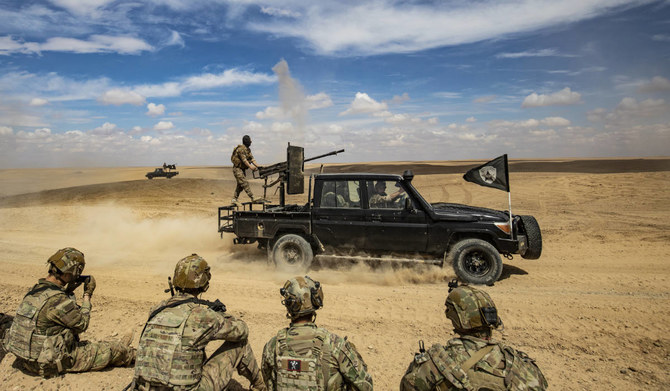
Troops from the Syrian Democratic Forces (SDF) Special Operations and the US-led anti-terrorist coalition, take part in heavy-weaponry military exercises in the countryside of Deir Ezzor in northeastern Syria, on March 25, 2022. (AFP)
2 / 2
Ethan Goldrich
Short Url
Updated 03 September 2023
Follow

US seeks de-escalation in Kurdish-held eastern Syria

  • Key officials reiterate importance of strong American partnership with SDF in efforts to defeat Daesh

BEIRUT: The US Embassy in Syria said on Sunday that senior officials had met Kurdish-led forces and community leaders in eastern Syria, discussing the need for de-escalation after days of deadly violence.

Fighting erupted in the Kurdish-controlled areas of Deir Ezzor province after the US-backed, Kurdish-dominated Syrian Democratic Forces or SDF detained Ahmad Al-Khabil, the head of the local Deir Ezzor Military Council, last Sunday.
The violence has killed 49 fighters from both sides and eight civilians, according to the Syrian Observatory for Human Rights war monitor, and a curfew went into effect in the area on Saturday.

BACKGROUND

The SDF has denied any dispute with Arab tribes in the region, saying the clashes have mostly involved ‘elements of the regime and some beneficiaries’ of Ahmad Al-Khabil.

US Deputy Assistant Secretary of State for Near Eastern Affairs Ethan Goldrich and Maj. Gen. Joel Vowell, commander of the US-led coalition fighting Daesh in Syria and Iraq, met “in northeast Syria” with the SDF, Kurdish authorities and tribal leaders from Deir Ezzor, the American Embassy said.
“They agreed on the importance of addressing the grievances” of Deir Ezzor residents, “the dangers of outsiders interfering” and “the need to avoid civilian deaths and casualties,” said an embassy statement on X, formerly Twitter.
The participants also agreed on “the need for de-escalation of violence as soon as possible,” said the statement from the US Embassy, which is based outside Syria.
The largely Arab-majority Deir Ezzor province is controlled by the SDF to the east of the Euphrates, while forces loyal to Syrian President Bashar Assad and Iran-affiliated fighters are stationed on the west bank.
Kurdish authorities manage areas under their control through local civilian and military councils, to avoid upsetting local Arab tribes.
The US-led coalition maintains bases in the area, including at Syria’s largest gas field, Al-Omar.
Goldrich and Vowell “reiterated the importance of the strong US partnership with the SDF” in efforts to defeat Daesh, the statement added.
The SDF has denied any dispute with Arab tribes in the region, saying the clashes have mostly involved “elements of the regime and some beneficiaries” of Khabil.
On Sunday, a day after the curfew came into effect, the SDF and the Observatory said the situation appeared to be calming down.
SDF spokesman Farhad Shami said the tensions had been restricted to five villages out of 120 in the area, adding that “in one remaining village, matters are moving toward resolution.”
The situation “is being handled with great sensitivity, but we hope the issues will be settled soon, whether militarily or in communication with the Arab tribes in the region,” he added.
The SDF spearheaded the offensive that defeated Daesh’s self-declared caliphate in Syria in 2019.
Syria’s war has killed more than half a million people since it broke out in 2011.


Hamas to hold leadership elections in coming months: sources

Updated 4 sec ago
Follow

Hamas to hold leadership elections in coming months: sources

  • A Hamas member in Gaza said Hayya is a strong contender due to his relations with other Palestinian factions, including rival Fatah, which dominates the Palestinian Authority, as well as his regional standing

GAZA CITY, Palestinian Territories: Hamas is preparing to hold internal elections to rebuild its leadership following Israel’s killing of several of the group’s top figures during the war in Gaza, sources in the movement said on Monday.
“Internal preparations are still ongoing in order to hold the elections at the appropriate time in areas where conditions on the ground allow it,” a Hamas leader told AFP.
The vote is expected to take place “in the first months of 2026.”
Much of the group’s top leadership has been decimated during the war, which was sparked by Hamas’s unprecedented attack on Israel in October 2023.
The war has also devastated the Gaza Strip, leaving its more than two million residents in dire humanitarian conditions.
The leadership renewal process includes the formation of a new 50-member Shoura Council, a consultative body dominated by religious figures.
Its members are selected every four years by Hamas’ three branches: the Gaza Strip, the occupied West Bank and the movement’s external leadership.
Hamas prisoners in Israeli prisons are also eligible to vote.
During previous elections, held before the war, members across Gaza and the West Bank used to gather at different locations including mosques to choose the Shoura Council.
That council is responsible, every four years, for electing the 18-member political bureau and its chief, who serves as Hamas’s overall leader.
Another Hamas source close to the process said the timing of the political bureau elections remains uncertain “given the circumstances our people are going through.”
After Israel killed former Hamas chief Ismail Haniyeh in Tehran in July 2024, the group chose its then-Gaza chief Yahya Sinwar as his successor.
Israel accused Sinwar of masterminding the October 7 attack.
He too was killed by Israeli forces in the southern Gaza city of Rafah, three months after Haniyeh’s assassination.
Hamas then opted for an interim five-member leadership committee based in Qatar, postponing the appointment of a single leader until elections are held and given the risk of being targeted by Israel.
According to sources, two figures have now emerged as frontrunners to be the head of the political bureau: Khalil Al-Hayya and Khaled Meshaal.
Hayya, 65, a Gaza native and Hamas’s chief negotiator in ceasefire talks, has held senior roles since at least 2006, according to the US-based NGO the Counter-Extremism Project (CEP).
Meshaal, who led the Political Bureau from 2004 to 2017, has never lived in Gaza. He was born in the West Bank in 1956.
He joined Hamas in Kuwait and later lived in Jordan, Syria and Qatar. The CEP says he oversaw Hamas’s evolution into a political-military hybrid.
He currently heads the movement’s diaspora office.
A Hamas member in Gaza said Hayya is a strong contender due to his relations with other Palestinian factions, including rival Fatah, which dominates the Palestinian Authority, as well as his regional standing.
Hayya also enjoys backing from both the Shoura Council and Hamas’s military wing, the Ezzedine Al-Qassam Brigades.
Another source said other potential candidates include West Bank Hamas leader Zaher Jabarin and Shoura Council head Nizar Awadallah.