

What We Are Reading Today: ‘The Laws of Human Nature’

Photo/Supplied
Short Url
Updated 03 September 2023
Follow

What We Are Reading Today: ‘The Laws of Human Nature’

  • The book emphasizes the importance of self-awareness as the foundation for understanding and interacting with others

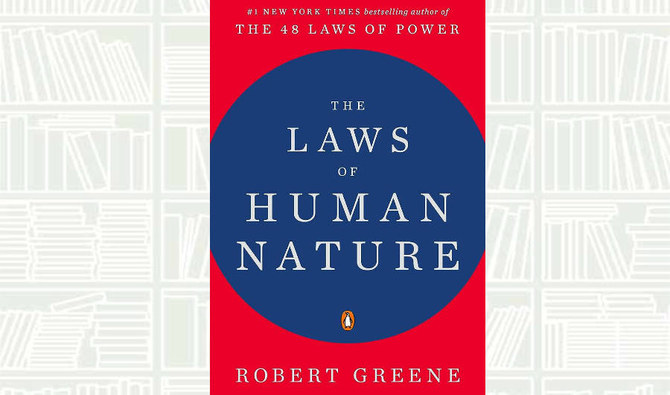
“The Laws of Human Nature” by Robert Greene was published in 2018. Greene, who is known for his books on strategy, power and human behavior, is the bestselling author of “The 48 Laws of Power.”

His latest book delves into the fundamental principles that govern human behavior, aiming to provide readers with a deeper understanding of themselves and others.

Building upon historical examples and case studies, Greene comprehensively examines human behavioral patterns and motivations. He also provides practical advice and strategies for readers to navigate these dynamics effectively.

The book emphasizes the importance of self-awareness as the foundation for understanding and interacting with others. By becoming aware of your own emotions, tendencies and biases, you can gain better control over your behavior and responses. This self-awareness allows you to project authenticity and build trust with others.

The author highlights the value of active listening, which involves fully engaging with, and understanding, what others are saying. By giving your full attention and demonstrating genuine interest, you can foster stronger connections and deeper understanding in your interactions. Active listening also helps you pick up on subtle cues and nonverbal communication.

Nonverbal cues play a significant role in interpersonal interactions. “The Laws of Human Nature” emphasizes the importance of observing and interpreting body language, facial expressions and other nonverbal signals. Developing the ability to read these cues can help you better understand the emotions, intentions and underlying feelings of other people.

Understanding human nature and the factors that motivate people can help you become more influential. “The Laws of Human Nature” provides insights into persuasion techniques, negotiation strategies and how to navigate power dynamics. It emphasizes the importance of building rapport, understanding desires and fears, and framing your arguments in ways that appeal to the self-interest of others.

These strategies, among others discussed in the book, can help individuals enhance their interpersonal skills, build stronger relationships and navigate social dynamics more effectively.


What We Are Reading Today: ‘Ego is the Enemy’

Photo/Supplied
Updated 19 January 2026
Follow

What We Are Reading Today: ‘Ego is the Enemy’

  • Reading this made me reflect on moments when I was more focused on proving myself than improving myself, when ego pushed me to speak before listening or rush before learning

Author: Ryan Holiday

I did not pick up “Ego is the Enemy” by Ryan Holiday because I thought I had a big ego. Like most people, I assumed the book was meant for someone else: the overly confident, the loud, the self-obsessed. I certainly did not think I was being sabotaged by my own ego.

That assumption did not last long. By the time I moved through the first section of the book, it became clear that ego is not always obvious and that was the unsettling part. 

What Holiday does so effectively is break the book into three distinct stages: when you are aspiring for success, when you are successful, and when you hit failure.

In each stage, he shows how ego quietly and secretly works against you. Not through arrogance alone, but through impatience, comparison, defensiveness, and the need to validate yourself instead of doing the work. 

In the aspiration stage, ego disguises itself as ambition. It convinces you that wanting something badly is the same as earning it, and that recognition should come before mastery.

Reading this made me reflect on moments when I was more focused on proving myself than improving myself, when ego pushed me to speak before listening or rush before learning. 

The success stage was even more uncomfortable. Holiday explains how ego, once fed, can turn success into a trap. It creates a false sense of permanence, making you believe past wins are enough to carry you forward.

This section felt like a reminder to stay grounded, to resist entitlement, and to understand that real confidence often shows up as humility and restraint, not noise. 

Then comes failure, the stage we try hardest to avoid. Here, ego becomes fragile. It refuses accountability, blames circumstances, and turns setbacks into personal attacks. Holiday reframes failure as a test of character rather than identity, and this shift felt liberating.

The book does not just point out how ego sabotages you at this stage; it shows you how to catch it, sit with discomfort, and respond with discipline instead of defensiveness. 

What I appreciated most about “Ego is the Enemy” is that it does not try to motivate you with grand promises. It simply sharpens your awareness.

Through historical examples, athletes, writers, and leaders, Holiday illustrates how ego has quietly undone many capable people and how others learned to master it. 

For me, this book became less about fixing myself and more about managing myself. It encouraged me to detach from validation, focus on process over praise, and recognize ego not as an enemy to destroy, but as something to constantly monitor. 

If you are looking for a book that flatters you, this is not it. But if you are willing to acknowledge that your ego may be working against you even when you think it is not, “Ego is the Enemy” is a powerful and honest place to start.