

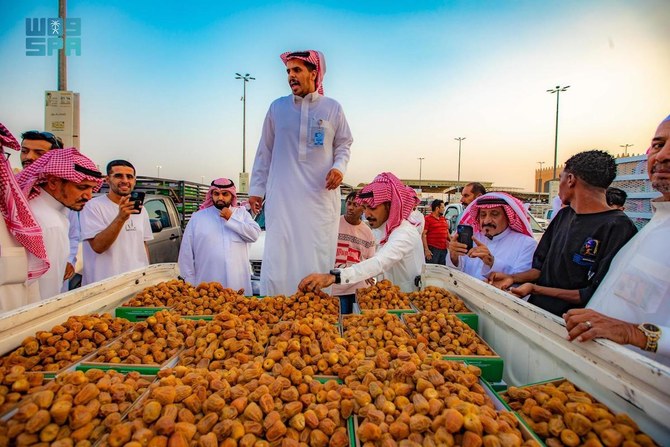
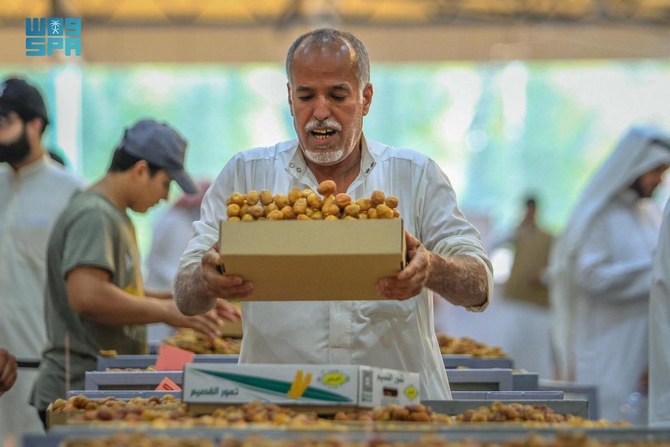


RIYADH: Summer is considered the golden season in most regions of the Kingdom because it is when dates are harvested. Many Saudi regions known for producing dates compete by holding festivals to attract more customers to buy their produce.
The Riyadh Seasonal Date Fair, organized by the Ministry of Environment, Water and Agriculture in collaboration with the Riyadh Municipality and the National Center for Palms and Dates, debuted in early August. The 60-day fair, which features a number of agricultural associations, aims to support the palm and date sector, which accounts for SR7.5 billion ($2 billion), or 12 percent of the Kingdom’s total agricultural output.
Riyadh’s production exceeds 400,000 tons, accounting for nearly a quarter of the Kingdom’s total output, while the number of palm trees in the Kingdom exceeds 33 million, accounting for nearly 27 percent of the world’s total palm trees.
FASTFACT
The Riyadh Seasonal Date Fair features a number of agricultural associations, aims to support the palm and date sector, which accounts for SR7.5 billion ($2 billion), or 12 percent of the Kingdom’s total agricultural output.
According to Sulaiman Al-Jatily, director general of the General Administration of Agricultural Associations and Marketing at the ministry, the fair aims to improve the marketing environment for dates in Riyadh and create the right conditions to increase the benefits for farmers, investors and consumers.
“The fair targets farmers who have obtained the Saudi Dates mark, and the certificate of organic farming and quality, and also seeks to activate the role of the farmer by marketing his crop and displaying it directly inside the fair,” he said.
Meanwhile, the Buraidah Date Festival, which lasts 30 days and features more than 40 different varieties of dates, draws shoppers and date traders from the Arab Gulf nations every year. More than 4,000 young men and women, and a number of productive families and artisans take part, according to the festival’s organizers.
Majid Al-Khamis, director of the Majid Al-Khamis Agricultural Consulting Office, said that date festivals are very important in Saudi Arabia for a variety of reasons, including promoting culture and heritage.
The fairs provide an opportunity to showcase and promote Saudi Arabia’s rich cultural heritage related to date cultivation and production.
They exhibit various types of local dates and hosts heritage events and shows that highlight customs and traditions associated with date cultivation and harvesting.
Al-Khamis said that date festivals help to support the local economy while also attracting tourists and visitors from both within and outside the Kingdom. Many people come to watch and buy different types of dates, as well as to learn about the culture of date cultivation in Saudi Arabia. Visitors also enjoy the accompanying entertainment and cultural activities during these festivals.
The festivals, he said, serve as a venue for the presentation of new date cultivation and development techniques and scientific research. They also showcase modern techniques in date cultivation and improving quality and production efficiency. These events promote the exchange of knowledge and experience among scientists, farmers and those interested in the date industry.
Fawaz Abdulwahhab, a retail date trader from the town of Alkohaifiah, which is renowned for producing a type of date known as Al-Fankha, acknowledged that the Al-Fankha Festival in the town of Al-Khafah (160 km southeast of Hail) inspired him to make investments in the date industry. He also said that he received a sizable financial return from taking part in the festival, which was held in October of last year.
While he does not own a single farm, he has purchased the entire output of many farms and is now in the process of packing them. He begins to dry some of the dates and keeps the others in the palm fronds until it is time to harvest them, then packs them at the factory. After that, he prepares the quantities that are ready to be sold and displayed during festival days.


