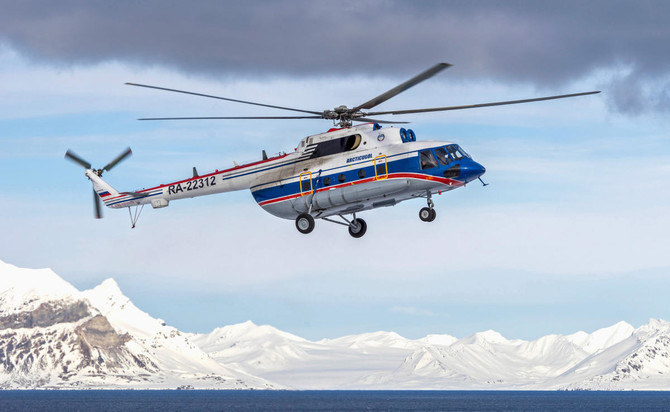
MOSCOW: An FSB security services helicopter crashed Tuesday in central Russia leaving three people dead, regional officials said.
The MI-8 helicopter went down near the village of Krasnoe Pole in the Chelyabinsk region, the governor said without indicating a cause for the incident.
“According to preliminary information, three people died,” governor Aleksei Teksler said on social media.
There was no damage to buildings or individuals on the ground, he added in the statement linking the aircraft to the FSB.
Aviation accidents are common in Russia due to lax safety rules and poor maintenance, and have become even more frequent after Moscow sent troops to Ukraine last year.

Three dead after FSB helicopter crash in Russia
https://arab.news/y266t
Three dead after FSB helicopter crash in Russia
- There was no damage to buildings or individuals on the ground
Fourth pair of Filipino conjoined twins to undergo separation surgery in Riyadh
- The Manuel twins and their parents met with the Saudi ambassador to Manila
- Kingdom’s flagship program for conjoined twins has separated over 140 children
MANILA: Conjoined twins Olivia and Gianna Manuel will travel to Riyadh for separation surgery, becoming the fourth pair of Filipino twins to be treated under the Saudi Conjoined Twins Program, the Kingdom’s Embassy in Manila said on Tuesday.
The 20-month-old girls from the town of Talavera in the central Philippine province of Nueva Ecija were born in April 2024. They are joined from the chest to the abdomen, a condition known as omphalopagus.
Saudi Ambassador Faisal Ibrahim Al-Ghamdi received them on Monday, “ahead of their departure to the Kingdom,” the embassy said in a statement.
“The family of the twins conveyed their profound gratitude and appreciation to the Government of the Kingdom of Saudi Arabia for this generous gesture and the medical and humanitarian care extended to their daughters.”
Olivia and Gianna’s mother first learned about the Saudi Conjoined Twins Program last year when she was still in the hospital with the girls, closely monitored by doctors for three months after they were born.
“From the time I gave birth to the twins, I already started searching about conjoined twins,” Ginalyn Manuel told Arab News.
In the beginning, she followed updates on Akhizah and Ayeesha Yusoph, the second pair of Filipino twins to be selected for separation surgery under the program.
But at the time, she could not find anyone who was able to help connect her to the King Salman Humanitarian Aid and Relief Center, which runs the conjoined twins initiative.
“Then in May, I saw the Misa twins. The mother posted that they were about to fly and she was thanking Saudi Arabia and the embassy,” Manuel said.
Maurice Ann and Klea Misa are the third pair of conjoined twins from Lubang, a municipality on the Philippine island of Mindoro, who flew to Riyadh earlier this year in May for a separation surgery.
Through their social media posts, Manuel tried again to make online connections, eventually finding the right people to link her up with KSrelief.
“Then in July, (KSrelief) sent us an email asking for the medical records of my twins, and that started the whole process,” she said.
Conjoined twins are a rare phenomenon, estimated to occur once in every 50,000 to 60,000 births.
Saudi Arabia is known as a pioneer in the field of separation surgery. KSrelief was established by King Salman in 2015 and is headed by Dr. Abdullah Al-Rabeeah, one of the world’s most renowned pediatric surgeons.
Since 1990, he and his team have separated more than 140 children from 27 countries who were born sharing internal organs with their twins.
The Misa twins, who are joined at the head, are currently being prepared for their surgery in Riyadh.
The first pair of Filipino conjoined twins, Ann and Mae Manzo, were separated under the program in March 2004. They were joined at the abdomen, pelvis and perineum.
They were followed by the Yusoph twins, who were joined at the lower chest and abdomen and shared one liver. Their successful separation surgery was conducted in September 2024.