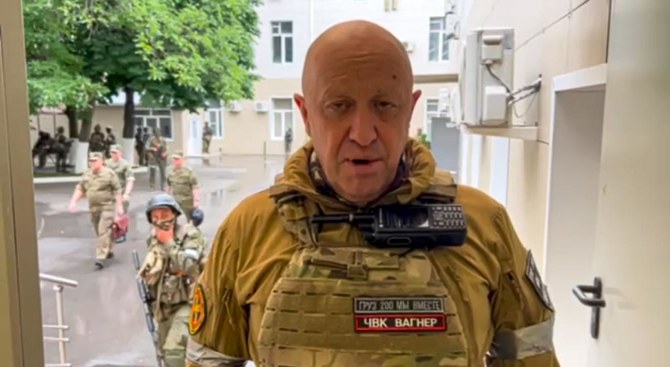

MOSCOW: Russian authorities on Sunday confirmed the death of Wagner Group chief Yevgeny Prigozhin, putting to rest any doubts about whether the wily mercenary leader turned mutineer was on a plane that crashed Wednesday, killing everyone on board.
Genetic testing on the 10 bodies recovered at the crash site “conform to the manifest ” for the flight, Russian Investigative Committee spokeswoman Svetlana Petrenko said in a statement.
“As part of the investigation of the plane crash in the Tver region, molecular-genetic examinations have been completed,” Russia’s Investigative Committee said in a statement on the Telegram messaging app.
Russia’s civil aviation authority had said Prigozhin and some of his top lieutenants were on the list of seven passengers and three crew members.
Prigozhin’s second-in-command, Dmitry Utkin, as well as Wagner logistics mastermind Valery Chekalov, also were killed in the crash. Utkin was long believed to have founded Wagner and baptized the group with his nom de guerre.
The Investigative Committee did not indicate what might have caused the business jet to plummet from the sky halfway between Moscow and St. Petersburg, Prigozhin’s hometown.
But the crash’s timing raised suspicions of a possible Kremlin-orchestrated hit, while Prigozhin’s chameleon-like background allowed for speculation that he wasn’t on the plane or had somehow escaped death.
Two months ago, Prigozhin, 62, mounted a daylong mutiny against Russia’s military, leading his mercenaries from Ukraine toward Moscow. Russian President Vladimir Putin decried the act as “treason” and vowed punishment for those involved.
Instead, the Kremlin quickly cut a deal with Prigozhin to end the armed revolt, saying he would be allowed to walk free without facing any charges and to resettle in Belarus. Questions remained about whether the former ally of Russia’s leader would face a comeuppance for the brief uprising that posed the biggest challenge to Putin’s authority of his 23-year rule.
A preliminary US intelligence assessment concluded that an intentional explosion caused the plane to go down. As suspicions grew that the Russian president was the architect of an assassination, the Kremlin rejected them as a “complete lie.”
One of the Western officials who described the initial assessment said it determined that Prigozhin was “very likely” targeted and that an explosion would be in line with Putin’s “long history of trying to silence his critics.”
’Stab in the back’
Muscovites laid flowers on Sunday at a makeshift shrine festooned with Russian flags and photographs set up a short distance from the Kremlin to the memory of Prigozhin and Utkin.
“I have got used to comrades in arms dying,” said Dmitry Karpov, who wore military fatigues, adding that Prigozhin had shown by his actions how things should be done in wartime. “Such people remain in history as an example.”
Another man who came to pay his respects, Alexander Dykhov, alluded to criticism by President Vladimir Putin of Prigozhin’s past mistakes. “The talk about some mistakes, different opinions, I think all this will be forgotten. And in people’s memory there will be the image of a hero. He and Dmitry Utkin are real heroes.”
Putin described the June 23-24 mutiny as a treacherous “stab in the back,” but later met with Prigozhin in the Kremlin. He sent his condolences on Thursday to the families of those killed in the crash.
Western politicians and commentators have suggested, without presenting evidence, that Putin ordered Prigozhin to be killed as punishment for the mutiny, which also represented the biggest challenge to Putin’s own rule since he came to power in 1999.
Putin paid a mixed tribute to Prigozhin on Thursday, describing him as a “talented businessman” but also as a flawed character who “made serious mistakes in life.”
Kremlin spokesman Dmitry Peskov said on Friday that such suggestions were “an absolute lie.” Asked whether Putin might attend Prigozhin’s funeral, Peskov said it was too early to say and also noted the president’s “busy schedule.”
Wagner fighters played a prominent role in the fighting in eastern Ukraine, especially in the months-long siege of the city of Bakhmut, despite Prigozhin’s frequent, profanity-laced attacks on Russia’s military high command over their conduct of the war that culminated in the failed mutiny.
The fate of Wagner, which until recently played a prominent role in Russia’s military campaign in Ukraine and was involved in a number of African and Middle Eastern countries, is uncertain.
After the mutiny, the Kremlin said Prigozhin would be exiled in Belarus, and his fighters were offered three options: to follow him there, retire or enlist in Russia’s regular army and return to Ukraine, where Wagner mercenaries had fought alongside Russian troops.
Several thousand Wagner mercenaries opted to move to Belarus, where a camp was erected for them southeast of the capital, Minsk.
The Wagner fighters have now left Ukraine and some have relocated to neighboring Belarus under the terms of a deal that ended their mutiny.
Some are expected to be absorbed into Russia’s armed forces but many will be angry over the sudden demise of the group’s founder who inspired a high degree of loyalty among his men.