

After Wagner chief death, Russia vows to keep helping Mali

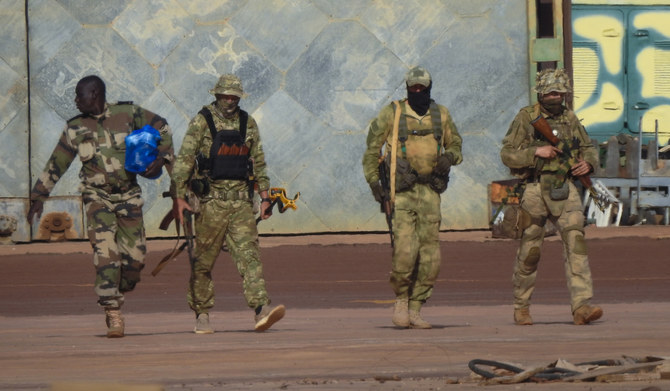
This undated photograph provided by the French military shows three Russian mercenaries in northern Mali. (AP)
Short Url
Updated 28 August 2023
Follow

After Wagner chief death, Russia vows to keep helping Mali

  • The 15-member council in June voted to end a decade-long peacekeeping mission in Mali after the military junta abruptly asked the 13,000-strong force (MINUSMA) to leave — a move the United States said was engineered by the Wagner group

UNITED NATIONS: Russia pledged at the United Nations on Monday to keep providing “comprehensive assistance” to Mali, where about 1,000 fighters with Russia’s Wagner mercenary group are helping the West African state’s junta fight an Islamist insurgency.
Wagner chief Yevgeny Prigozhin died in a plane crash last week and Russian President Vladimir Putin then ordered Wagner fighters to sign an oath of allegiance to the Russian state.
Russia’s Deputy UN Ambassador Dmitry Polyanskiy said that bilateral cooperation between Russia and Mali and the military junta’s “sovereign choice” of international security partners “are keeping our former Western partners up at night.”
“Russia, for its part, will continue to provide Mali and other interested African partners with comprehensive assistance on a bilateral, equal and mutually respectful basis,” he told the UN Security Council.
The 15-member council in June voted to end a decade-long peacekeeping mission in Mali after the military junta abruptly asked the 13,000-strong force (MINUSMA) to leave — a move the United States said was engineered by the Wagner group.
Mali has struggled to stem the Islamist insurgency that took root following an uprising in 2012. UN sanctions monitors reported to the Security Council this month that “in less than a year, Islamic State in the Greater Sahara has almost doubled its areas of control in Mali.”
Mali’s junta, which seized power in coups in 2020 and 2021, teamed up with Wagner in 2021.
“As many of us feared, the transition government’s decision to close MINUSMA has already triggered renewed violence on the ground,” US Ambassador to the United Nations, Linda Thomas-Greenfield, told the Security Council on Monday.
“Additionally, MINUSMA’s withdrawal limits the ability of the international community to protect civilians from the predations of Wagner, whose activities contribute to greater insecurity in the country,” she said. 


Indian forces kill Maoist rebel leader: police

Updated 5 sec ago
Follow

Indian forces kill Maoist rebel leader: police

  • New Delhi has launched an all-out campaign against the insurgents and vowed to end the Maoist rebellion by March 2026
  • Police in the eastern state of Odisha said they had killed Maoist commander Ganesh Uike in a gunfight

BHUBANESWAR, India: Indian security forces killed a senior Maoist rebel commander and three other fighters including two women in a raid on Thursday, police said, as authorities push a major offensive against the guerrillas.
New Delhi has launched an all-out campaign against the insurgents and vowed to end the Maoist rebellion by March 2026.
Police in the eastern state of Odisha said they had killed Maoist commander Ganesh Uike in a gunfight in Kandhamal district, after security forces received a tip-off about his location.
Uike, 69, the leader of the Maoist rebels in the coastal state, had a bounty of more than $120,000 on his head.
“Four dead bodies of Maoists” were recovered following the gunfight, top state police officer Yogesh Bahadur Khurania said, identifying one of them as Uike.
Khurania said that the other three — two women and a man — were also rebel fighters, adding that their identities were being ascertained.
There were no casualties among the security forces.
Two Maoist fighters were killed in the same state on Wednesday.
India has been cracking down on the remnants of the Naxalite rebellion, named after the village in the Himalayan foothills where the Maoist-inspired insurgency began nearly six decades ago.
The rebellion once controlled nearly a third of the country, with an estimated 15,000 to 20,000 fighters at its peak in the mid-2000s, but it has been dramatically weakened in recent years.
Since 2024, over 500 Maoist rebels have been killed, according to the Indian government.