

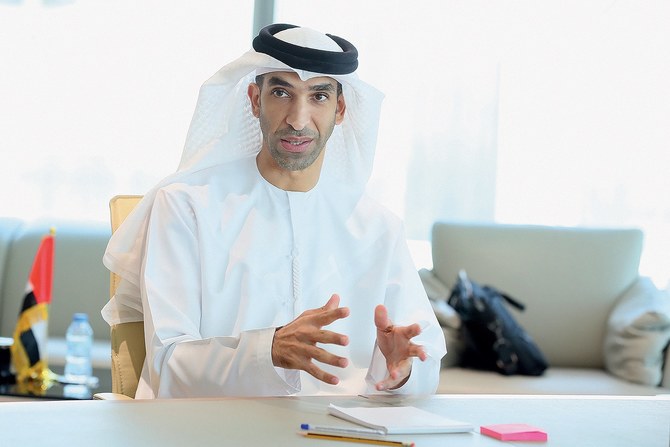
UAE urges free flow of capital, goods and services at B20 Summit

Addressing the B20 Summit in New Delhi, Thani bin Ahmed Al-Zeyoudi, the minister of state for foreign trade, underscored the necessity for collective action to support the multilateral trading system. File
Short Url
Updated 28 August 2023
Follow

UAE urges free flow of capital, goods and services at B20 Summit

RIYADH: With the dual objectives of driving economic growth and fostering worldwide development, the UAE has reiterated its call for increased international collaboration to facilitate the seamless movement of capital, goods and services.  

Addressing the B20 Summit in New Delhi, India, Thani bin Ahmed Al-Zeyoudi, the minister of state for foreign trade, underscored the necessity for collective action to support the multilateral trading system.  

Al-Zeyoudi further emphasized the importance of strengthening international supply chains and accelerating technology integration to enhance supply-chain efficiency and inclusivity. His remarks were directed toward an audience of ministers and senior government officials.  

With the UAE’s non-oil trade reaching 2.23 trillion dirhams ($607 billion) in 2022, surpassing the 2 trillion dirhams mark for the first time, the minister highlighted the vitality of trade in the country’s economic agenda. 

He also urged nations to thwart the rise of protectionism and isolationism, which have threatened supply-chain integrity since the global pandemic.

Al-Zeyoudi called for global collaboration to rejuvenate international trade in preparation for the World Trade Organization’s 13th Ministerial Conference, scheduled for February 2024 in Abu Dhabi. 

He suggested it could be achieved by enhancing dispute-resolution mechanisms, maintaining regulations against market-distorting subsidies, ensuring equitable global trading access and adopting new technologies for supply-chain sustainability and efficiency.

During his visit to New Delhi, Al-Zeyoudi represented the UAE delegation at the India-UAE Business Forum. The forum explored untapped trade and investment opportunities presented by the Comprehensive Economic Partnership Agreement between the two nations. 

The event, organized by the Ministry of Economy in partnership with the Federation of Indian Chambers of Commerce and Industry, facilitated discussions between business representatives from both countries. 

At the forum, representatives delved into investment and joint-venture prospects across energy, ICT, logistics and food production systems. 

Al-Zeyoudi also unveiled the “Global Trade Risks 2023: Barriers to Growth” report during the B20 Summit. The study, produced by the Ministry of Economy, gathered insights from over 500 global corporate leaders about the most significant threats to international trade.

Survey results indicated that the most significant risk to global trade is the rising levels of public and private debt and their repercussions on consumer demand, financial liquidity, investment and the demand for goods. 

Risks related to technology adoption and regulation followed closely, including quick technological change, cyber threats to trade infrastructure and data privacy issues. 

Furthermore, the report highlighted environmental risks, particularly the depletion of natural resources and reduced access to water. 

Al-Zeyoudi said: “The perspectives presented in the Global Trade Risks report are central to informing and shaping the policy decisions required to create a more sustainable, equitable and resilient global trading system.” 

He added: “As we move toward the G20 Summit and the WTO’s Ministerial Conference in Abu Dhabi next year, we must understand the private sector’s concerns and develop a policy program that properly addresses them. In particular, the high ranking of technology adoption and regulation concerns underscore the work required to create a global trading system fit for the 21st century.”


Saudization rates in marketing, sales professions announced

Updated 5 sec ago
Follow

Saudization rates in marketing, sales professions announced

RIYADH: Saudi Arabia’s Ministry of Human Resources and Social Development has announced the issuance of two decisions to increase Saudization rates in marketing and sales professions.

This comes as part of the ministry’s efforts to enhance the participation of national talent in the labor market, raise the level of Saudization in specialized professions, and provide stimulating and productive job opportunities for Saudi citizens across the Kingdom.

The first decision stipulates raising the Saudization rate to 60 percent in marketing professions in the private sector, effective Jan. 19, 2026. It applies to establishments with three or more employees in marketing professions, with a minimum wage of SR5,500 ($1,466). 

The targeted professions include: marketing manager, advertising agent, and advertising manager, as well as graphic designer, advertising designer, and public relations specialist. They also include advertising specialist and marketing specialist, as well as public relations manager and photographer.

The decision will be implemented three months after the announcement date to allow establishments sufficient time to prepare and implement it.

The second decision stipulates raising the Saudization rate to 60 percent in sales positions within the private sector, effective Jan. 19, 2026. This applies to establishments with three or more employees in sales roles, including: sales manager, retail sales representative, and wholesale sales representative as well as sales representative, IT and communications equipment sales specialist, and sales specialist. They also include a commercial specialist and a goods broker.

The decision will take effect three months after the announcement date to allow targeted establishments time to fulfill the requirements and achieve the Saudization target.

The entity clarified that private sector establishments will benefit from a package of incentives offered by the Ministry of Human Resources and Social Development, including support for recruitment, training and development, and employment, as well as job stability and priority access to Saudization support programs and programs of the Human Resources Development Fund.

The ministry also confirmed that its decision to raise Saudization rates in marketing and sales professions was based on analytical studies of labor market needs, in line with the number of job seekers in related specializations and the current and future requirements of the sales and marketing sectors.

It noted that implementing these decisions would enhance the attractiveness of the labor market, contribute to increasing quality job opportunities, and promote job stability for Saudi nationals.

The ministry further published the procedural guide for the two decisions on its website, which includes details of the targeted professions, the mechanisms for calculating Saudization rates, and the required compliance steps.

It urged all covered establishments to comply with the implementation to avoid penalties and to take advantage of the grace period provided for preparation and fulfillment of the requirements.