

'Happy moment' as first cargo arrives in Pakistan under new road trade deal with China 

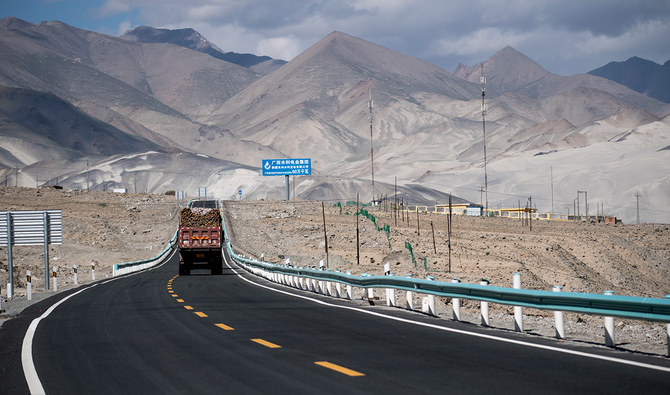
This picture taken on June 27, 2017 shows a truck driving along the China-Pakistan Friendship Highway before the Karakorum mountain range near Tashkurgan in China's western Xinjiang province. (AFP/File)
Short Url
Updated 27 August 2023
Follow

'Happy moment' as first cargo arrives in Pakistan under new road trade deal with China 

  • Development comes days after Pakistan, China launched an international road transport (TIR) route between Kashgar and Islamabad 
  • This is the first inaugural TIR trade route between China and Pakistan that highlights a fresh mode of cross-border transport for Xinjiang 

KHAPLU: A first-ever cargo carrying trade goods entered Pakistan on Sunday under a new road trade deal with China, a Pakistani customs official said, with local traders describing it as a “happy moment” for the northern Gilgit-Baltistan region. 

The development comes days after the two countries opened an international road transport (TIR) route between China’s inland city of Kashgar and the Pakistani capital of Islamabad, aiming to enhance cross-border trade. 

This is the first inaugural TIR trade route between China and Pakistan that highlights a fresh mode of cross-border transport for Xinjiang and potentially setting a precedent for future trade routes within the China-Pakistan Economic Corridor (CPEC). 

“Two consignments, bound for Afghanistan, have reached the Sost Dry Port under the TIR agreement,” Imtiaz Hussain, an assistant collector at Pakistan’s Silk Route Dry Port (SRDP) Sost, told Arab News. 

“The cargo will be cleared on Monday before leaving for Afghanistan.” 

Longtime ally Beijing has pledged over $65 billion in building CPEC infrastructure projects in Pakistan as part of China’s Belt and Road Initiative (BRI). The corridor includes a network of roads, railways, pipelines, and ports in Pakistan that will connect China to the Arabian Sea and help Islamabad expand and modernize its economy. 

Currently, the total volume of trade between China and Pakistan is above $12.06 billion, up nearly 19 percent as compared with 2021 when it stood at $10.14 billion due to COVID-19 pandemic. 

Speaking to Arab News, Imran Ali, president of the Gilgit-Baltistan Chamber of Commerce said the new trade route would bring prosperity to the region. 

“This is a happy moment for us. It will bring prosperity to the region and open the door for different kinds of business opportunities in Pakistan,” he told Arab News. 

“With the opening of this route, prices of commodities will also be slashed in the future.” 

Ali said this would be a “very feasible and shortest way” for Central Asian countries to connect with China. “The opening of this route is a good omen for Pakistani traders,” he added. 


Pakistan business body writes to PM seeking ‘clear roadmap’ to spur investment

Updated 5 sec ago
Follow

Pakistan business body writes to PM seeking ‘clear roadmap’ to spur investment

  • Business confidence in Pakistan has fallen sharply amid rising inflation, high energy costs and unpredictable tax environment
  • In a letter written to PM Shehbaz Sharif, the Pakistan Business Forum president highlights challenges facing the business community

KARACHI: The Pakistan Business Forum (PBF), a representative body of traders and businesspersons in the country, on Monday urged Prime Minister Shehbaz Sharif’s intervention in outlining a “clear economic roadmap” to promote long-term investment in Pakistan.

Business confidence in Pakistan has fallen sharply amid rising inflation, high energy costs and an unpredictable tax environment. Currency volatility and slowing demand have prompted many firms to delay investments and scale back expansion plans.

In a letter to PM Sharif, PBF President Khawaja Mehboob-ur-Rehman highlighted the challenges facing the business community, including high input costs, soaring energy tariffs and an increasingly “uncompetitive” tax regime that weakens exports.

“Looking ahead to 2026, the Pakistan Business Forum urged the prime minister to provide the business community with a clear, credible, and forward-looking economic roadmap,” read a PBF statement.

“Such clarity... is essential to restore confidence, encourage investment, and enable long-term planning by businesses.”

The South Asian country of more than 241 million people is currently navigating a tricky path to economic recovery under a $7 billion International Monetary Fund (IMF) program since averting a default in 2023.

Besides introducing structural reforms relating to expansion of the country’s tax base and privatization of loss-making entities, the government of PM Sharif says it is taking various measures to boost foreign investment and trade.

The PBF highlighted the business community is ready to play its role in competing with regional markets, if provided with the “necessary competitive tools.” It outlined critical reforms relating to regionally competitive electricity tariffs and corporate tax rates.

An increase in electricity tariffs would put further strain on industries and could lead to widespread downsizing and the closure of industrial units, according to the PBF.

It urged the government to include business representatives in the policymaking process to ensure it understands “on-ground realities.”