SAN ANTONIO, ZAMBALES, Philippines: Australian and Filipino troops held exercises on Friday near flashpoint South China Sea waters claimed by China, with Philippine President Ferdinand Marcos hailing them as an “extremely important” example of close cooperation.
China deploys hundreds of coast guard, navy and other vessels to patrol and militarize reefs in the South China Sea, which it claims almost entirely despite an international ruling that its position has no legal basis.
Friday’s joint drills took place at a naval base about 240 kilometers east of Scarborough Shoal, a rich fishing ground that China seized from the Philippines in 2012 after a tense standoff.
“Considering that there have been so many events that attest to the volatility of the region, this kind of exercise, this kind of close strategic cooperation between countries around the region is extremely important,” Marcos told reporters.
“It is an important aspect of how we prepare for any eventuality,” he said of the drills, which he watched with Australian Defense Minister Richard Marles.
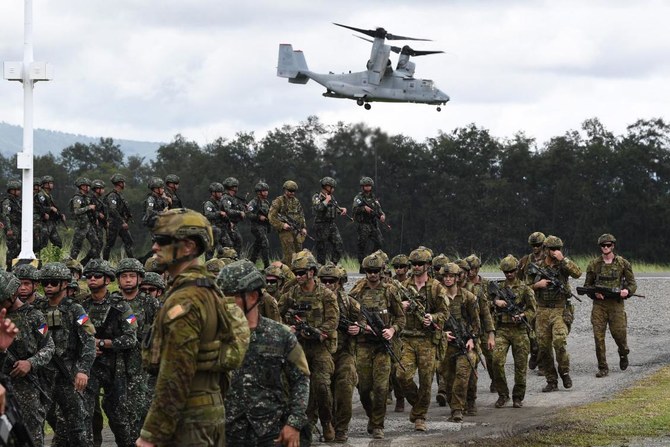
These are the first major air, sea and land drills between the two countries. They simulated retaking an enemy-controlled island.
About 1,200 Australian soldiers and 560 Filipino marines stormed a beach in the drill, arriving in amphibious assault vehicles, by parachute and on US Osprey aircraft.
Two advanced Australian F-35 fighter jets provided close air support, and Australian warships secured the surrounding waters.
The exercise came after Chinese coast guard vessels fired water cannon and blocked a Philippine resupply mission to Second Thomas Shoal in the South China Sea on August 5.
The Philippine Navy deliberately grounded a World War II-era vessel on the shoal and set up a tiny garrison in 1999 to check China’s advance in the area.
On Tuesday, a second Philippine mission managed to deliver supplies to the outpost.
The Chinese coast guard said it had decided to allow the resupply on humanitarian grounds as the Philippine vessels “did not carry illegal building materials for large-scale reinforcements.”
The Philippines hosted a meeting this week with its fellow members in the Association of Southeast Asian Nations and China to negotiate a code of conduct in the South China Sea.


![]()

Philippine, Australian troops practice retaking island in South China Sea drill
Short Url
https://arab.news/vdsj3
Philippine, Australian troops practice retaking island in South China Sea drill
- Friday’s joint drills took place at a naval base about 240 kilometers east of Scarborough Shoal
- About 1,200 Australian soldiers and 560 Filipino marines stormed a beach in the drill


Latest updates




© 2026 SAUDI RESEARCH & PUBLISHING COMPANY, All Rights Reserved And subject to Terms of Use Agreement.