Pakistan, Turkmenistan vow to speed up TAPI gas pipeline project

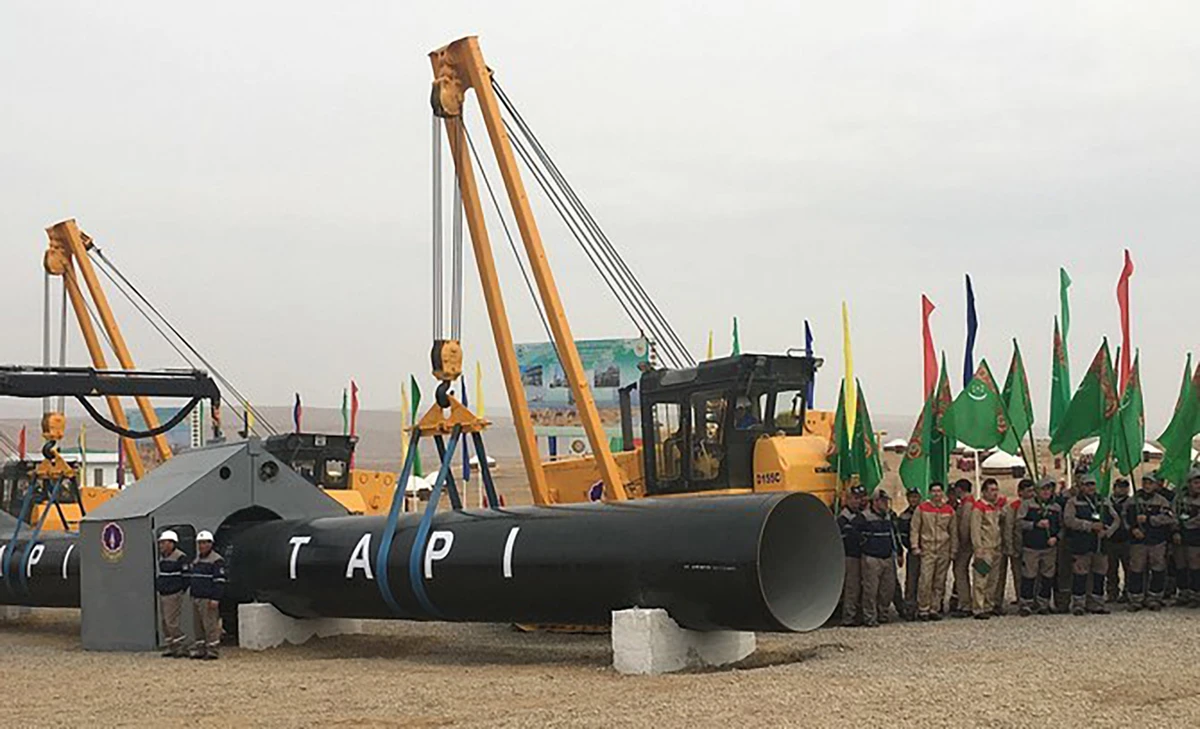
Workers attend the launching ceremony of construction work of the TAPI project on the Afghan section of a natural gas pipeline, near the town of Serhetabat, Turkmenistan on February 23, 2018. (REUTERS/File)
Short Url
Updated 24 August 2023
Follow

Pakistan, Turkmenistan vow to speed up TAPI gas pipeline project

  • Construction of Turkmenistan-Afghanistan-Pakistan-India project stalled for years
  • Reasons for the delay relate to differences over price review and delivery points

ISLAMABAD: Pakistan and Turkmenistan on Thursday agreed to speed up work on the Turkmenistan Afghanistan Pakistan India (TAPI) gas pipeline project, whose construction has remained stalled for years, the Pakistani energy ministry said.

The pipeline will link the energy-rich Central Asian country of Turkmenistan through Afghanistan to Pakistan and India, and is expected to carry 33 billion cubic meters (bcm) of natural gas each year along a route stretching 1,800 km (1,125 miles) from Galkynysh, the world's second-biggest gas field, to the Indian city of Fazilka near the Pakistan border.

The Afghan stretch of the pipeline will run from the northwestern border with Turkmenistan, south through the western city of Herat to Kandahar near the border with Pakistan.

Work on the project has been stalled due to differences over price review and delivery points.

As per the original deal, Pakistan, Afghanistan and India would have 15% share of gas, while Turkmenistan would get 85%. Under the existing gas sale-purchase agreement, the gas delivery point is the Afghanistan-Turkmenistan border, which Pakistan wants moved to the Pakistan-Afghanistan border.

“Both sides agreed to speed up the TAPI gas pipeline project,” the energy ministry said in a statement after Turkmenistan Ambassador Atadjan Movlamov called on Pakistan’s Interim Federal Minister for Energy Muhammad Ali today, Thursday.

Ali underscored the importance of gas for the economy of Pakistan.

"With increasing energy demand of the country, such projects need aggressive approach," he was quoted as saying. “Progress on this project is in the right direction and will bear fruit. In this context, host government agreement (HGA) is expected to be concluded, with mutual consensus, in October.”

The minister said frequent meetings of the working group on the Turkmenistan Afghanistan Pakistan (TAP) electricity project would also be held to expedite the project.

In recent months, Pakistan, hit by a shortage of imported gas, has cut power output, hurting the economy just as it reels from soaring inflation and a sliding currency.
UK says Pakistan regulatory overhaul to yield £1 billion a year as Islamabad launches reform drive

Updated 13 December 2025
Follow

UK says Pakistan regulatory overhaul to yield £1 billion a year as Islamabad launches reform drive

  • Britain says it worked with Pakistan on 472 proposed reforms to streamline business rules across key sectors
  • PM Shehbaz Sharif says Pakistan has stabilized economy and now aims to attract investment by cutting red tape

ISLAMABAD: Britain’s development minister Jenny Chapman said on Saturday Pakistan’s sweeping new regulatory overhaul could generate economic gains of nearly £1 billion a year, as Islamabad formally launched the reform package aimed at cutting red tape and attracting foreign investment.

The initiative, driven by Prime Minister Shehbaz Sharif’s government and the Board of Investment, aims to introduce legislative changes and procedural reforms designed to streamline approvals, digitize documentation and remove outdated business regulations.

Chapman said the UK had worked with Pakistan on 472 reform proposals as part of its support to help the country shift from economic stabilization to sustained growth.

“These reforms will break down barriers to investment, eliminate more than 600,000 paper documents, and save over 23,000 hours of labor every year for commercial approvals,” Chapman said at the launch ceremony in the presence of Sharif and his team. “The first two packages alone could have an economic impact of up to 300 billion Pakistani rupees annually — nearly one billion pounds — with more benefits to come.”

Addressing the ceremony, the prime minister said the reforms were central to Pakistan’s effort to rebuild investor confidence after the country narrowly avoided financial default in recent years.

“Our economy was in a very difficult situation when we took office,” he said. “But we did not lose hope, and today Pakistan is economically out of the woods. Now we are focused on growing our economy and attracting foreign investment.”

He described the new regulatory framework as a “quantum jump” that would reduce corruption, speed up approvals and remove longstanding procedural hurdles that have discouraged businesses.

Chapman told the audience that more than 200 British companies operate in Pakistan, with the largest six contributing around one percent of Pakistan’s GDP.

She said the UK saw Pakistan as a partner rather than a recipient of aid.

“Modern partners work together not as donors but as investors, bringing all our strengths to the table,” she said, adding that the reforms would make Pakistani exports more competitive and encourage UK firms to expand their footprint.

Sharif highlighted the role of the British Pakistani diaspora and said Pakistan hoped to unlock more private capital by engaging diaspora entrepreneurs and financial institutions in the UK.