BAGHDAD: Britain’s security minister on Monday pledged more UK support for Iraq’s security forces in combatting drug production and trafficking..
In a visit to Baghdad on Monday, Security Minister Tom Tugendhat said British officials “want to build on our strong counterterrorism cooperation” and expand the countries’ security relationship to “identify and address shared serious organized crime threats” including “human smuggling, trafficking, narcotics and money laundering that work together as a criminal network that undermines the entire state of Iraq.”
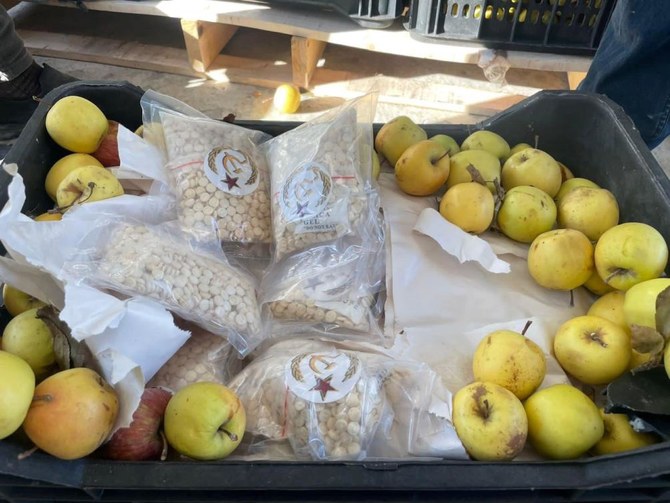
While Iraq has in recent years primarily served as a transit country for drugs — particularly the amphetamine Captagon, which is largely produced in neighboring Syria — there have been some indications that Iraq is also moving into production.
Tugendhat pointed to the discovery by Iraqi authorities last month of a factory that was producing Captagon in Iraq.
“There is always an overlap between drugs, human trafficking, terrorism and violence,” Tugendhat told the Associated Press. “We are seeing criminal groups, human trafficking and drugs affecting not just Iraq, but the whole region and many of our friends and allies in the region.”
Iraqi Prime Minister Mohammed Shia Al-Sudani said in a statement that his country has made “significant efforts” to combat drugs and human trafficking.
Sudani said the Iraqi and British interior ministries were preparing to sign agreements outlining their cooperation on these issues.
A British official who spoke on condition of anonymity according to regulations said the agreements would focus on information sharing to support counter terrorism and on “serious organized crime.”

UK, Iraq agree to increase cooperation on combating drug trafficking, terrorism
https://arab.news/vr9jh
UK, Iraq agree to increase cooperation on combating drug trafficking, terrorism
- Tugendhat said British officials “want to build on our strong counterterrorism cooperation” and expand the countries’ security relationship
Voter registration closes for West Bank municipal elections: Palestinian official
- Officials argue that strengthening local government, improving service delivery and renewing council mandates can help rebuild public trust at a time when the PA faces widespread criticism over corruption, stagnation and declining legitimacy
- Hamas boycotted the previous municipal elections held in 2021-2022 after the PA postponed long-overdue parliamentary and presidential polls, deepening an internal Palestinian political split
RAMALLAH, Palestinian Territories: Voter registration closed across the West Bank on Sunday ahead of municipal elections on April 25, when Palestinians will cast ballots to elect 420 local councils, a rare democratic exercise in the Israeli-occupied territory.
Voting will also take place in central Gaza for the Deir Al-Balah council, a spokesman for the Ramallah-based Central Election Commission told AFP.
“The elections in both the West Bank and in (Deir el-Balah) Gaza will be organized on April 25,” Farid Tumallah said.
“Registration of candidates will open on February 23 for a period of one week,” he added.
President Mahmud Abbas’s Fatah movement is widely expected to dominate candidate lists, with the Fatah-dominated Palestinian Authority exercising tight political control.
It remains unclear whether Hamas, the Islamist group that governs parts of the Gaza Strip not occupied by Israeli forces, will participate.
Hamas boycotted the previous municipal elections held in 2021-2022 after the PA postponed long-overdue parliamentary and presidential polls, deepening an internal Palestinian political split.
Fatah and Hamas relations broke down in 2007, when Hamas seized control of Gaza following a brief but bloody clashes, leaving the Palestinian territories divided between the two factions.
The Islamist group had won the parliamentary elections the previous year, the last time they were held.
“Organizing elections in Gaza is logistically challenging. We are trying to develop special procedures for voting and elections in Deir Al-Balah,” Tumallah said, without elaborating.
“Holding elections in the remaining municipalities of the Gaza Strip is not currently feasible due to compelling security and logistical circumstances,” the commission said in a statement.
This year’s municipal elections are being closely watched as part of what Abbas has described as a reform and renewal process within the PA, pledged amid growing international pressure for greater accountability, improved governance and political inclusion.
Western and regional donors have increasingly tied financial and diplomatic support to visible reforms, particularly at the local governance level, as national elections remain frozen.
With no presidential or legislative elections held since 2006, municipal councils have become one of the few functioning democratic institutions under PA administration.
Officials argue that strengthening local government, improving service delivery and renewing council mandates can help rebuild public trust at a time when the PA faces widespread criticism over corruption, stagnation and declining legitimacy.
The Fatah-dominated PA controls parts of the West Bank, while Gaza has been devastated by nearly two years of war following Hamas’s October 2023 attack on Israel.
The war has further complicated Palestinian political reconciliation and electoral planning.
Municipal councils are responsible for basic services such as water, sanitation and local infrastructure and don’t enact legislation.
While many candidate lists are aligned with political factions, independent lists are also permitted to run.


