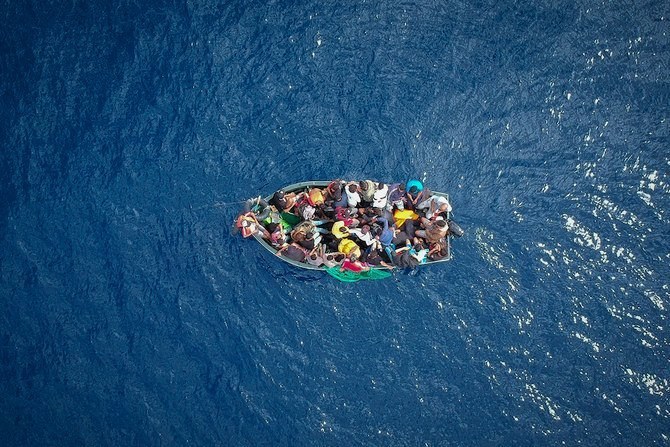
Cyprus rescues 86 migrants in Mediterranean

European Union member Cyprus argues that it is a “frontline country” on the Mediterranean migrant route. (File/AFP)
Short Url
Updated 21 August 2023
Follow

Cyprus rescues 86 migrants in Mediterranean

  • Operation was successful, with 61 men, six women and 19 children brought safely to shore

NICOSIA: Cypriot authorities rescued 86 migrants on Sunday after their boat got into difficulty 12 nautical miles off the Mediterranean island’s southeast coast, officials said.
The Joint Rescue Coordination Center (JRCC) said the operation was successful, with 61 men, six women and 19 children brought safely to shore.
They are expected to be transferred to a migrant reception center on the outskirts of the capital Nicosia.
A marine police patrol boat and two speedboats were involved in the rescue off Cape Greco, near the resort of Ayia Napa, a JRCC statement said.
No details were immediately available on the nationalities of those rescued or from where their boat had set sail.
On August 15, Cypriot authorities rescued 60 migrants in distress in the same area.
Authorities say there has been a rise in the number of migrants arriving by boat this year, with a 60 percent increase recorded in the first five months compared with the same period last year.
According to the Aliens and Immigration Unit, most irregular migrants arriving by sea board boats in the Syrian port of Tartus, and these vessels are usually detected off Cape Greco.
European Union member Cyprus argues that it is a “frontline country” on the Mediterranean migrant route, with asylum-seekers making up 5 percent of the 915,000 people living in government-controlled areas of the island — the highest proportion in the bloc.
Returns of failed asylum seekers have exceeded 4,370 so far this year, sharply up on the 2,353 recorded for 2022, Interior Minister Constantinos Ioannou said last month.


In Ethiopia, Tigrayans fear return to ‘full-scale war’

Updated 44 min 10 sec ago
Follow

In Ethiopia, Tigrayans fear return to ‘full-scale war’

  • Flights have been suspended into Tigray since Thursday and local authorities reported drone strikes on goods lorries
  • The international community fears the fighting could turn into an international conflict between Ethiopia and Eritrea

ADDIS ABABA: Tigrayans in northern Ethiopia fear a return to all-out war amid reports that clashes were continuing between local and federal forces on Monday, barely three years after the last devastating conflict in the region.
The civil war of 2020-2022 between the Ethiopian government and Tigray forces killed more than 600,000 people and a peace deal known as the Pretoria Agreement has never fully resolved the tensions.
Fighting broke out again last week in a disputed area of western Tigray called Tselemt and the Afar region to the east of Tigray.
Abel, 38, a teacher in Tigray’s second city Adigrat, said he still hadn’t recovered from the trauma of the last war and had now “entered into another round of high anxiety.”
“If war breaks out now... it could lead to an endless conflict that can even be dangerous to the larger east African region,” added Abel, whose name has been changed along with other interviewees to protect their identity.
Flights have been suspended into Tigray since Thursday and local authorities reported drone strikes on goods lorries on Saturday that killed at least one driver.
In Afar, a humanitarian worker, speaking to AFP on condition of anonymity, said there had been air strikes on Tigrayan forces and that clashes were ongoing on Monday, with tens of thousands of people displaced.
AFP could not independently verify the claims and the government has yet to give any comment on the clashes.
In the regional capital Mekele, Nahom, 35, said many people were booking bus tickets this weekend to leave, fearing that land transport would also be restricted soon.
“My greatest fear is the latest clashes turning into full-scale war and complete siege like what happened before,” he told AFP by phone, adding that he, too, would leave if he could afford it.
Gebremedhin, a 40-year-old civil servant in the city of Axum, said banks had stopped distributing cash and there were shortages in grocery stores.
“This isn’t only a problem of lack of supplies but also hoarding by traders who fear return of conflict and siege,” he said.
The region was placed under a strict lockdown during the last war, with flights suspended, and banking and communications cut off.
The international community fears the fighting could turn into an international conflict between Ethiopia and Eritrea, whose relations have been increasingly tense in recent months.
The Ethiopian government accuses the Tigrayan authorities and Eritrea of forging closer ties.
United Nations Secretary-General Antonio Guterres is “deeply concerned about... the risk of a return to a wider conflict in a region still working to rebuild and recover,” his spokesman said.
The EU said that an “immediate de-escalation is imperative to prevent a renewed conflict.”