TOKYO: Japanese Prime Minister Fumio Kishida made a brief visit to the tsunami-wrecked Fukushima nuclear plant on Sunday to highlight the safety of an impending release of treated radioactive wastewater into the Pacific Ocean, a divisive plan that his government wants to start soon despite protests at home and abroad.
His trip comes hours after he returned home Saturday from a summit with US and South Korean leaders at the American presidential retreat of Camp David. Before leaving Washington on Friday, Kishida said it is time to make a decision on the treated water’s release date, which has not been set due to the controversy surrounding the plan.
Since the government announced the release plan two years ago, it has faced strong opposition from Japanese fishing organizations, which worry about further damage to the reputation of their seafood as they struggle to recover from the accident. Groups in South Korea and China have also raised concerns, turning it into a political and diplomatic issue.
The government and the plant operator, Tokyo Electric Power Co., say the water must be removed to make room for the plant’s decommissioning and to prevent accidental leaks from the tanks because much of the water is still contaminated and needs further treatment.
Japan has obtained support from the International Atomic Energy Agency to improve transparency and credibility and to ensure the plan by TEPCO meets international safety standards. The government has also stepped up a campaign promoting the plan’s safety at home and through diplomatic channels.
IAEA, in a final report in July, concluded that the TEPCO plan, if conducted strictly as designed, will cause negligible impact on the environment and human health, encouraging Japan to proceed.
Kishida told reporters after Sunday’s plant visit that he hoped to meet with the head of the national fisheries organization on Monday before his ministers decide the date at a meeting next week, Kyodo News agency reported. Kishida did not mention a starting date for the water release, which is widely expected to be at the end of August.
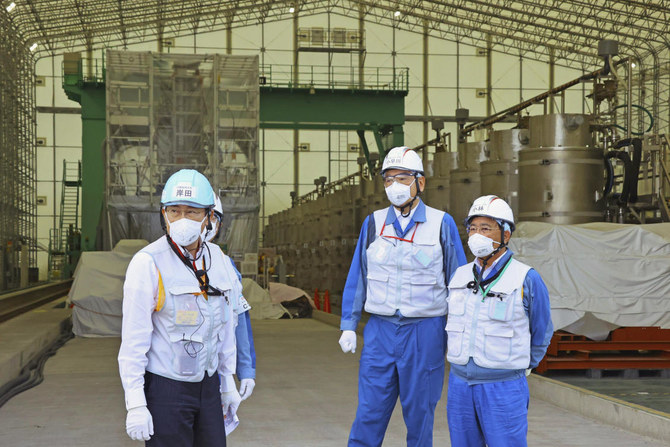
During his visit on Sunday, Kishida saw wastewater filtering and dilution facilities and met with TEPCO president Tomoaki Kobayakawa and other top officials. He urged the officials to prioritize safety in the release and help prevent reputational damage to local fisheries, Kyodo said.
While seeking understanding from the fishing community, the government has also worked to explain the plan to South Korea to keep the issue from interfering with their relationship-building. Japan, South Korea and the US are working to bolster trilateral ties in the face of growing Chinese and North Korean threats.
South Korean President Yoon Suk Yeol’s government recently showed support for the Japanese plan, but he faces criticism at home. During a joint news conference at Camp David, Yoon said he backs the IAEA’s safety evaluation of the plan but stressed the need for transparent inspection by the international community.
Kishida said Friday the outreach efforts have made progress, and that the decision will factor in safety preparations and measures for possible reputation damage on the fisheries.
A massive March 11, 2011, earthquake and tsunami destroyed the Fukushima Daiichi plant’s cooling systems, causing three reactors to melt and contaminating their cooling water. The water is collected, filtered and stored in around 1,000 tanks, which will reach their capacity in early 2024.
The water is being treated with what’s called an Advanced Liquid Processing System, which can reduce the amounts of more than 60 selected radionuclides to government-set releasable levels, except for tritium, which the government and TEPCO say is safe for humans if consumed in small amounts.
Scientists generally agree that the environmental impact of the treated wastewater would be negligible, but some call for more attention to dozens of low-dose radionuclides that remain in it.

Japan’s Kishida visits Fukushima plant to highlight safety before start of treated water release
https://arab.news/2deus
Japan’s Kishida visits Fukushima plant to highlight safety before start of treated water release
- Since the government announced the release plan two years ago, it has faced strong opposition
Trump set to repeal scientific finding that serves as basis for US climate change policy
- The endangerment finding is the legal underpinning of nearly all climate regulations under the Clean Air Act for motor vehicles, power plants and other pollution sources that are heating the planet
WASHINGTON: The Trump administration on Thursday will revoke a scientific finding that long has been the central basis for US action to regulate greenhouse gas emissions and fight climate change, the White House announced.
The Environmental Protection Agency will issue a final rule rescinding a 2009 government declaration known as the endangerment finding. That Obama-era policy determined that carbon dioxide and other greenhouse gases endanger public health and welfare.
President Donald Trump and EPA Administrator Lee Zeldin will “formalize the rescission of the 2009 Obama-era endangerment finding” at a White House ceremony, White House press secretary Karoline Leavitt said Tuesday.
The action “will be the largest deregulatory action in American history, and it will save the American people $1.3 trillion in crushing regulations,” she said. The bulk of the savings will stem from reduced costs for new vehicles, with the EPA projecting average per vehicle savings of more than $2,400 for popular light-duty cars, SUVs and trucks. Leavitt said.
The endangerment finding is the legal underpinning of nearly all climate regulations under the Clean Air Act for motor vehicles, power plants and other pollution sources that are heating the planet. It is used to justify regulations, such as auto emissions standards, intended to protect against threats made increasingly severe by climate change — deadly floods, extreme heat waves, catastrophic wildfires and other natural disasters in the United States and around the world.
Legal challenges would be certain for any action that effectively would repeal those regulations, with environmental groups describing the shift as the single biggest attack in US history on federal efforts to address climate change.
EPA press secretary Brigit Hirsch said the Obama-era rule was “one of the most damaging decisions in modern history” and said EPA “is actively working to deliver a historic action for the American people.”
Trump, who has called climate change a “hoax,” previously issued an executive order that directed EPA to submit a report on “the legality and continuing applicability” of the endangerment finding. Conservatives and some congressional Republicans have long sought to undo what they consider overly restrictive and economically damaging rules to limit greenhouse gases that cause global warming.
Zeldin, a former Republican congressman who was tapped by Trump to lead EPA last year, has criticized his predecessors in Democratic administrations, saying they were “willing to bankrupt the country” in an effort to combat climate change.
Democrats “created this endangerment finding and then they are able to put all these regulations on vehicles, on airplanes, on stationary sources, to basically regulate out of existence ... segments of our economy,″ Zeldin said in announcing the proposed rule last July. ”And it cost Americans a lot of money.”
Peter Zalzal, a lawyer and associate vice president of the Environmental Defense Fund, countered that the EPA will be encouraging more climate pollution, higher health insurance and fuel costs and thousands of avoidable premature deaths.
Zeldin’s push “is cynical and deeply damaging, given the mountain of scientific evidence supporting the finding, the devastating climate harms Americans are experiencing right now and EPA’s clear obligation to protect Americans’ health and welfare,” he said.
Zalzal and other critics noted that the Supreme Court ruled in a 2007 case that planet-warming greenhouse gases, caused by burning of oil and other fossil fuels, are air pollutants under the Clean Air Act.
Since the high court’s decision, in a case known as Massachusetts v. EPA, courts have uniformly rejected legal challenges to the endangerment finding, including a 2023 decision by the US Court of Appeals for the District of Columbia Circuit.
Following Zeldin’s proposal to repeal the rule, the National Academies of Sciences, Engineering, and Medicine reassessed the science underpinning the 2009 finding and concluded it was “accurate, has stood the test of time, and is now reinforced by even stronger evidence.”
Much of the understanding of climate change that was uncertain or tentative in 2009 is now resolved, the NAS panel of scientists said in a September report. “The evidence for current and future harm to human health and welfare created by human-caused greenhouse gases is beyond scientific dispute,” the panel said.


