Pakistan president approves amended media bill aimed at thwarting ‘fake news’

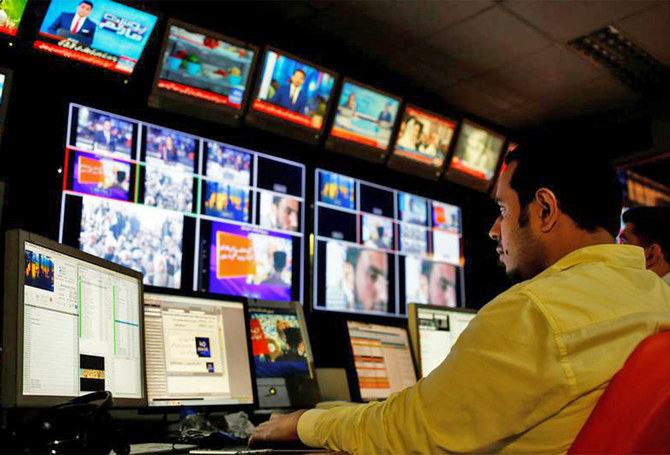
An employee works at the control room of a television channel in Karachi, Pakistan, on April 11, 2018. (Photo courtesy: REUTERS/File)
Short Url
Updated 16 August 2023
Follow

Pakistan president approves amended media bill aimed at thwarting ‘fake news’

  • The PEMRA Amendment Act 2023 raises financial penalty for deliberately spreading false news from Rs1 million to Rs10 million
  • Media outlets critical of the outgoing government previously objected to the bill, saying it would impose restrictions on news channels

ISLAMABAD: Pakistan President Arif Alvi on Tuesday signed into law an amended media bill that aims to thwart “fake news,” Pakistani state media reported. 

The Pakistan Electronic Media and Regulatory Authority (PEMRA) Amendment Bill 2023 provides definitions for “fake news,” “disinformation,” and “misinformation,” while increasing the financial penalty for deliberately spreading false news from Rs1 million to Rs10 million, according to a report published by the state-run Radio Pakistan broadcaster. 

It uses the term “certified news” instead of “news” in the preamble and seeks to broaden the scope of public entertainment, education, and information. 

“President Dr. Arif Alvi has assented the Pakistan Electronic Media and Regulatory Authority Amendment Bill 2023,” the report read. “He approved the bill under Article 75 of the Constitution.” 

Under the new law, a three-member committee would be granted the authority to shut down a channel instead of the PEMRA chairman. It also mentioned the Council of Complaints that would address the problems of delayed payments of journalists’ salaries by their organizations. 

Outgoing information minister, Marriyum Aurangzeb, last month said the PEMRA bill had been finalized after “extensive consultations with all stakeholders.” 

“The primary objective of the bill is to improve the welfare of journalists, and enable a free, responsible and ethical media environment in Pakistan, as practiced in democratic countries around the world,” she continued. 

However, media outlets critical of the outgoing government had objected to the development at the time. ARY News, a Pakistani television news channel, described it as an attempt to impose restrictions on news channels and their coverage of important events. 

The channel’s president, Ammad Yousaf, said no government or bureaucrat could determine the news agenda of a news channel. 

Pakistani president arrives in Iraq to deepen trade, energy cooperation

Updated 20 December 2025
Follow

Pakistani president arrives in Iraq to deepen trade, energy cooperation

  • Visit follows recent high-level contacts as Islamabad seeks to expand limited commercial ties with Baghdad
  • Talks are expected to cover investment, manpower and facilitation of Pakistani pilgrims visiting holy sites in Iraq

ISLAMABAD: President Asif Ali Zardari arrived in Iraq on Saturday on an official visit aimed at expanding cooperation in trade, energy and investment, as Pakistan seeks to deepen ties with Baghdad after years of limited engagement.

Pakistan and Iraq established diplomatic relations in 1947 and have traditionally maintained cordial ties, though commercial links remain modest, with officials and business groups identifying scope for cooperation in construction services, pharmaceuticals, manpower and agricultural exports.

“President Asif Ali Zardari arrived in Baghdad on a four-day official visit to Iraq,” his office said in a post on X. “He was received by Culture Minister Dr. Ahmed Fakkak Al-Badrani. During the visit, meetings with senior Iraqi leadership are expected to advance cooperation and further strengthen Pakistan-Iraq relations.”

Zardari’s visit follows a series of recent high-level contacts between the two countries, reflecting efforts to broaden bilateral engagement beyond traditional diplomatic ties and explore collaboration across economic, political and people-to-people domains.

According to Pakistan’s foreign office, the president is expected to hold meetings with Iraq’s senior leadership to discuss cooperation in various areas such as trade and investment, energy, technology, education and manpower.

He is also expected to discuss regional and international issues with Iraqi officials.

Earlier this month, Pakistan’s Interior Minister Mohsin Naqvi met his Iraqi counterpart, Abdul Ameer Al-Shammari, on the sidelines of meetings in Brussels, where both sides agreed to enhance cooperation on security and facilitate travel for Pakistani Shia pilgrims to Najaf and Karbala.

The two officials discussed measures to ensure the smoother movement of these pilgrims and their compliance with visa regulations.