

Ex-FBI counterintelligence official pleads guilty to conspiracy charge for helping Russian oligarch

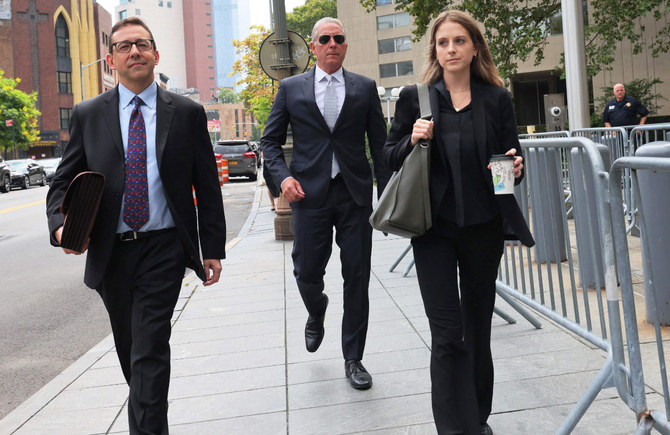
Former FBI agent Charles McGonigal (C) arrives for a change of plea hearing at Manhattan Federal Court on August 15, 2023 in New York City. (AFP)
Short Url
Updated 16 August 2023
Follow

Ex-FBI counterintelligence official pleads guilty to conspiracy charge for helping Russian oligarch

  • McGonigal pleaded guilty to a single count of conspiring to launder money and violate the International Emergency Economic Powers Act

NEW YORK: A former high-ranking FBI counterintelligence official pleaded guilty Tuesday to conspiring to violate sanctions on Russia by going to work, after he retired, for an oligarch he once investigated.
Appearing before a federal judge in New York City, Charles McGonigal, 55, said he was “deeply remorseful” for work he did in 2021 for the billionaire industrialist Oleg Deripaska.
McGonigal told the judge he accepted over $17,000 to help Deripaska collect derogatory information about another Russian oligarch who was a business competitor. Deripaska has been under US sanctions since 2018 for reasons related to Russia’s occupation of Crimea.
McGonigal was also trying to help Deripaska get off the sanctions list, Assistant US Attorney Rebecca Dell said, and was in negotiations along with co-conspirators to receive a fee of $650,000 to $3 million to hunt for electronic files revealing hidden assets of $500 million belonging to the oligarch’s business rival.
McGonigal pleaded guilty to a single count of conspiring to launder money and violate the International Emergency Economic Powers Act. He could face up to five years in prison. Judge Jennifer H. Rearden scheduled his sentencing for Dec. 14.
McGonigal, who lives in New York, is separately charged in federal court in Washington, D.C. with concealing at least $225,000 in cash he allegedly received from a former Albanian intelligence official while working for the FBI.
McGonigal was special agent in charge of the FBI’s counterintelligence division in New York from 2016 to 2018. He supervised investigations of Russian oligarchs, including Deripaska.
The US District Court for the District of Columbia later affirmed the sanctions against Deripaska, finding there was evidence he had acted as an agent of Russian President Vladimir Putin.
McGonigal, who became choked up at one point as he described his crime, said Deripaska funneled the $17,500 payment he received through a bank in Cypress and a corporation in New Jersey before it was transferred into his bank account.
“This, as you can imagine, has been a painful process not only for me, but for my friends, family and loved ones,” McGonigal said. “I take full responsibility as my actions were never intended to hurt the United States, the FBI and my family and friends.”
In a release, Matthew G. Olsen, assistant attorney general of the Justice Department’s National Security Division, said, “McGonigal, by his own admission, betrayed his oath and actively concealed his illicit work at the bidding of a sanctioned Russian oligarch.”
“Today’s plea shows the Department of Justice’s resolve to pursue and dismantle the illegal networks that Russian oligarchs use to try to escape the reach of our sanctions and evade our laws,” he added.


2025 among world’s three hottest years on record, WMO says

Updated 4 sec ago
Follow

2025 among world’s three hottest years on record, WMO says

  • All eight datasets confirmed that the last three years were the planet’s three hottest since records began, the WMO said
  • The slight differences in the datasets’ rankings reflect their different methodologies and types of measurements

BRUSSELS: Last year was among the planet’s three warmest on record, the World Meteorological Organization said on Wednesday, as EU scientists also confirmed average temperatures have now exceeded 1.5 degrees Celsius of global warming for the longest since records began.
The WMO, which consolidates eight climate datasets from around the world, said six of them — including the European Union’s European Center for Medium-Range Weather Forecasts (ECMWF) and the British national weather service — had ranked 2025 as the third warmest, while two placed it as the second warmest in the 176-year record.
All eight datasets confirmed that the last three years were the planet’s three hottest since records began, the WMO said. The warmest year on record was 2024.

THREE-YEAR PERIOD ABOVE 1.5 C AVERAGE ⁠WARMING LEVEL
The slight differences in the datasets’ rankings reflect their different methodologies and types of measurements — which include satellite data and readings from weather stations.
ECMWF said 2025 also rounded out the first three-year period in which the average global temperature was 1.5 C above the pre-industrial era — the limit beyond which scientists expect global warming will unleash severe impacts, some of them irreversible.
“1.5 C is not a cliff edge. However, we know that every fraction of a degree matters, particularly for worsening extreme weather events,” said Samantha Burgess, strategic ⁠lead for climate at ECMWF.
Burgess said she expected 2026 to be among the planet’s five warmest years.

CHOICE OF HOW TO MANAGE TEMPERATURE OVERSHOOT
Governments pledged under the 2015 Paris Agreement to try to avoid exceeding 1.5 C of global warming, measured as a decades-long average temperature compared with pre-industrial temperatures.
But their failure to reduce greenhouse gas emissions means that target could now be breached before 2030 — a decade earlier than had been predicted when the Paris accord was signed in 2015, ECMWF said. “We are bound to pass it,” said Carlo Buontempo, director of the EU’s Copernicus Climate Change Service. “The choice we now have is how to best manage the inevitable overshoot and its consequences on societies and natural systems.”
Currently, the world’s long-term warming level is about 1.4 C above the pre-industrial era, ECMWF said. Measured on a short-term ⁠basis, average annual temperatures breached 1.5 C for the first time in 2024.

EXTREME WEATHER
Exceeding the long-term 1.5 C limit would lead to more extreme and widespread impacts, including hotter and longer heatwaves, and more powerful storms and floods. Already in 2025, wildfires in Europe produced the highest total emissions on record, while scientific studies confirmed specific weather events were made worse by climate change, including Hurricane Melissa in the Caribbean and monsoon rains in Pakistan which killed more than 1,000 people in floods.
Despite these worsening impacts, climate science is facing political pushback. US President Donald Trump, who has called climate change “the greatest con job,” last week withdrew from dozens of UN entities including the scientific Intergovernmental Panel on Climate Change.
The long-established consensus among the world’s scientists is that climate change is real, mostly caused by humans, and getting worse. Its main cause is greenhouse gas emissions from burning fossil fuels like coal, oil and gas, which trap heat in the atmosphere.