

Niger junta says open to talks as Putin, US stress peace

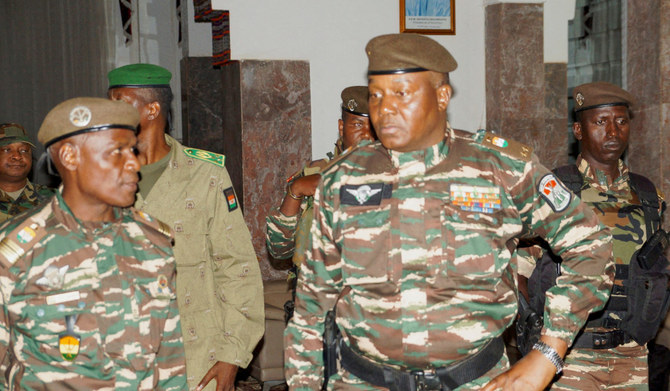
General Abdourahmane Tiani, who was declared as the new head of state of Niger by leaders of a coup, arrives to meet with ministers in Niamey, Niger July 28, 2023. (REUTERS)
Short Url
Updated 16 August 2023
Follow

Niger junta says open to talks as Putin, US stress peace

  • Russian President Vladimir Putin spoke to Mali’s military leader about the recent coup in neighboring Niger on Tuesday, a call likely to cause concern among Western governments that fear growing Russian influence in West Africa’s Sahel region

NIAMEY: Niger’s junta on Tuesday said that it was open to talks to resolve a regional crisis caused by last month’s military coup, while Russia and the United States called for a peaceful resolution.
Western powers and democratic African governments have called for the coup leaders to reinstate ousted President Mohamed Bazoum, who they have detained since July 26, but the military leaders have refused and rejected attempts at negotiation.
West African army chiefs will meet on Thursday and Friday in Ghana to prepare for a possible military intervention, which the main regional bloc, the Economic Community of West African States (ECOWAS), has threatened to launch if diplomacy fails.
Any military intervention could further destabilize the impoverished Sahel, where an insurgency by groups linked to Al-Qaeda and Islamic State has displaced millions over the past decade and fueled a hunger crisis.
“We are in a process of transition. We have explained the ins and outs, reiterated our willingness to remain open and to talk to all parties, but we have insisted on the need for the country to be independent,” said Ali Mahamane Lamine Zeine, who was appointed prime minister by the military last week.
He spoke after a trip to meet Chad’s President Mahamat Deby, who staged his own coup in 2021. Niger’s takeover is the seventh in West and Central Africa in three years.
The coup and its aftermath have sucked in international powers with strategic interests in the region.
Russian President Vladimir Putin spoke to Mali’s military leader about the recent coup in neighboring Niger on Tuesday, a call likely to cause concern among Western governments that fear growing Russian influence in West Africa’s Sahel region.
Putin “stressed the importance of a peaceful resolution of the situation for a more stable Sahel,” Mali’s interim President Assimi Goita said on social media platform X, formerly known as Twitter.
Pentagon spokesperson Sabrina Singh said US President Joe Biden’s administration was committed to a diplomatic resolution, and said Niger was a partner it did not want to lose.
Singh declined to call the takeover a coup but said it “certainly looks like an attempted coup.”
Meanwhile, ECOWAS has the support of Central Africa’s regional bloc ECCAS in efforts to overturn Niger’s coup and restore constitutional order, Nigerian President and ECOWAS Chairman Bola Tinubu said on Tuesday.
“I understand the fear of our people on any form of military action. We are working to keep the sanctions in place and we are following them to the letter,” he said in a statement.
Russian influence in West Africa has grown while the West’s has waned since a string of coups began. Military leaders in Mali and Burkina Faso have kicked out troops from former colonial power France and strengthened ties with Moscow.
In Mali, the army government also brought in mercenaries from Russia’s Wagner group, who have been accused of executing civilians and committing other grave human rights abuses.
Under Bazoum, Niger remained a Western ally. The US, France, Germany and Italy have troops stationed there under agreements with the now-deposed civilian government.
Putin has called for a return to constitutional order in Niger, while Wagner chief Yevgeny Prigozhin welcomed the army takeover and offered his services.
Support for Russia has appeared to surge in Niger since the coup, with junta supporters waving Russian flags at rallies and calling for France to disengage.
Niger’s coup leaders have revoked a raft of military agreements with France, although Paris shrugged this off by saying that it did not recognize them as legitimate authorities.


Power outages hit Ukraine and Moldova as Kyiv struggles against the winter cold

Updated 10 sec ago
Follow

Power outages hit Ukraine and Moldova as Kyiv struggles against the winter cold

  • Outages had been caused by a technical malfunction affecting power lines linking Ukraine and Moldova
  • Blackouts were reported in Kyiv, as well as Zhytomyr and Kharkiv regions

KYIV: Emergency power cuts swept across several Ukrainian cities as well as neighboring Moldova on Saturday, officials said, amid a commitment from the Kremlin to US President Donald Trump to pause strikes on Kyiv as Ukraine battles one of its bleakest winters in years.
Ukraine’s Energy Minister Denys Shmyhal said that the outages had been caused by a technical malfunction affecting power lines linking Ukraine and Moldova.
The failure “caused a cascading outage in Ukraine’s power grid,” triggering automatic protection systems, he said.
Blackouts were reported in Kyiv, as well as Zhytomyr and Kharkiv regions, in the center and northeast of the country respectively. The outage cut water supplies to the Ukrainian capital, officials said, while the city’s subway system was temporarily suspended because of low voltage on the network.
Moldova also experienced major power outages, including in the capital Chisinau, officials said.
“Due to the loss of power lines on the territory of Ukraine, the automatic protection system was triggered, which disconnected the electricity supply,” Moldova’s Energy Minister Dorin Junghietu said in a post on Facebook. “I encourage the population to stay calm until electricity is restored.”
Weaponizing winter
The large-scale outage followed weeks of Russian strikes against Ukraine’s already struggling energy grid, which have triggered long stretches of severe power shortages.
Moscow has sought to deny Ukrainian civilians heat, light and running water over the course of the war, in a strategy that Ukrainian officials describe as “weaponizing winter.”
While Russia has used similar tactics throughout the course of its almost four-year invasion of Ukraine, temperatures throughout this winter have fallen further than usual, bringing widespread hardship to civilians.
Forecasters say Ukraine will experience a brutally cold period stretching into next week. Temperatures in some areas will drop to minus 30 degrees Celsius (minus 22 Fahrenheit), Ukraine’s State Emergency Service said.
Trump said late Thursday that President Vladimir Putin had agreed to a temporary pause in targeting Kyiv and other Ukrainian towns amid the extreme weather.
“I personally asked President Putin not to fire on Kyiv and the cities and towns for a week during this ... extraordinary cold,” Trump said during a Cabinet meeting at the White House. Putin has “agreed to that,” he said, without elaborating on when the request to the Russian leader was made.
The White House didn’t immediately respond to a query seeking clarity about the scope and timing of any limited pause.
Kremlin spokesperson Dmitry Peskov confirmed Friday that Trump “made a personal request” to Putin to stop targeting Kyiv until Sunday “in order to create favorable conditions for negotiations.”
Talks are expected to take place between US, Russian and Ukrainian officials on Feb. 1 in Abu Dhabi. The teams previously met in late January in the first known time that officials from the Trump administration simultaneously met with negotiators from both Ukraine and Russia. However, it’s unclear many obstacles to peace remain. Disagreement over what happens to occupied Ukrainian territory, and Moscow’s demand for possession of territory it hasn’t captured, are a key issue holding up a peace deal, Zelensky said Thursday.
Russian presidential envoy Kirill Dmitriev said on social media Saturday that he was in Miami, where talks between Russian and US negotiators have previously taken place.
Russia struck Ukrainian energy assets in several regions on Thursday but there were no strikes on those facilities overnight, Ukraine’s President Volodymyr Zelensky said Friday.
In a post on social media, Zelensky also noted that Russia has turned its attention to targeting Ukrainian logistics networks, and that Russian drones and missiles hit residential areas of Ukraine overnight, as they have most nights during the war.
Trump has framed Putin’s acceptance of the pause in strikes as a concession. But Zelensky was skeptical as Russia’s invasion approaches its fourth anniversary on Feb. 24 with no sign that Moscow is willing to reach a peace settlement despite a US-led push to end the fighting.
“I do not believe that Russia wants to end the war. There is a great deal of evidence to the contrary,” Zelensky said Thursday.