Pakistan anti-graft court allows questioning of deputy at Imran Khan’s party amid political turmoil 

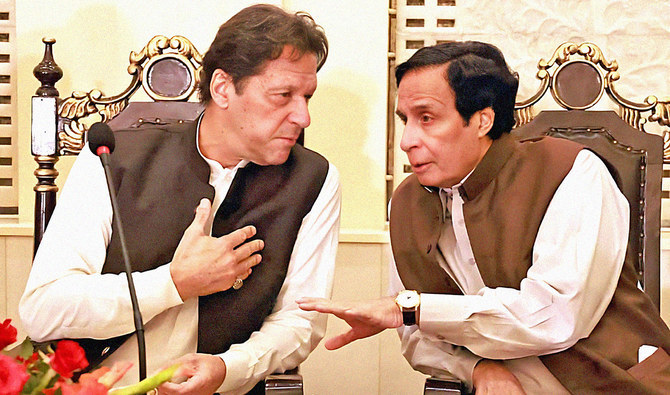
The file photo posted on July 21, 2022, shows Pakistan's former prime minister, Imran Khan (left) and Chaudhry Parvez Elahi, president of Pakistan Tehreek-e-Insaf's party, in Lahore, Pakistan. (Photo courtesy: Chaudhry Parvez Elahi/Facebook)
Short Url
Updated 15 August 2023
Follow

Pakistan anti-graft court allows questioning of deputy at Imran Khan’s party amid political turmoil 

  • The development comes a day after Pakistan’s anti-graft body arrested Pervez Elahi after his one-month detention expired 
  • Elahi was detained under a law that allows the government to arrest any suspect to ensure law and order in the country 

ISLAMABAD: An anti-graft tribunal in Pakistan’s eastern city of Lahore on Tuesday allowed authorities to interrogate the president of former premier Imran Khan’s political party in a corruption probe, prosecutors and a defense lawyer said. 

The latest development comes a day after the National Accountability Bureau arrested Pervez Elahi in the garrison city of Rawalpindi after his one-month detention expired. Elahi was detained under a law that allows the government to arrest any suspect to ensure law and order in the country. 

Elahi is the president of Pakistan Tehreek-e-Insaf, or PTI. Khan, who is imprisoned, is the chairman. 

Khan was arrested on August 6 after a court sentenced him to three years for corruption in a move that analysts say could halt his future in politics, for now. 

The court ruled that Khan, who was ousted in a no-confidence vote in April 2022 but remains the country’s leading opposition figure, had concealed assets after selling state gifts. Khan denies the charge. 

Tuesday’s development was a blow to Khan’s party as Elahi was expected to campaign for his release. It came hours after police arrested Khan’s nephew, Hassan Niazi, on charges of inciting people to violence in May when Khan’s supporters attacked government and military installations. 

At least 10 people died in the May 9 violence, which subsided only when the Supreme Court released Khan, who has been implicated in more than 150 legal cases since his ouster. Khan is also accused of inciting people to violence after his arrest. 

A court in Islamabad on Tuesday canceled Khan’s bail in three cases, meaning he could be arrested even if he is released by the Islamabad High Court, which is expected to hear his appeal against his conviction and sentencing this month. 

Khan’s party blames his successor, Shehbaz Sharif, for victimizing him. 

Sharif replaced Khan in April 2022 and relinquished his charge on Monday when caretaker premier Anwaar-ul-Haq Kakar took charge to oversee the elections, which are expected to be held in October or November under the constitution. 


Pakistan increases Reko Diq investment to $244 million as Barrick reviews project

Updated 5 sec ago
Follow

Pakistan increases Reko Diq investment to $244 million as Barrick reviews project

  • State-owned PPL injects $50.2 million more in special purpose vehicle formed to manage Islamabad’s 25 percent stake in copper-gold mine
  • Canadian operator Barrick Mining Corporation this month ordered project’s review following deadly separatist attacks in Balochistan province

KARACHI: The state-run Pakistan Petroleum Limited (PPL) has invested an additional Rs14 billion ($50.2 million) equity in the multi-billion-dollar Reko Diq copper-gold mine, the company said in its latest financial report on Thursday, as the project’s Canadian operator reviews the project following recently deadly attacks. 

Canada’s Barrick Mining Corporation owns a 50 percent share in Reko Diq in the southwestern Balochistan province, along with three Pakistani federal state-owned enterprises including PPL that own 25 percent, while the Balochistan government has the remaining 25 percent share in the project.

The Canadian company announced earlier this month it planned to “immediately” begin a comprehensive review of all aspects of the Reko Diq project following coordinated attacks in Balochistan on Jan. 30-31 that killed 36 civilians and 22 security forces personnel. 

“With respect to the Reko Diq project, the company has made further equity investment in Pakistan Minerals Private Limited (PMPL) during the period amounting to Rs14,025 million ($50.2m),” PPL told its shareholders in its financial statement for the half year ending at Dec. 31.

The additional equity has increased PPL’s total cost of investment in the PMPL to Rs68.1 billion ($243.6 million), it added. 

The PMPL is a special purpose vehicle formed to manage the federal government’s 25 percent stake in the Reko Diq project. It is a consortium of three state-owned enterprises (SOEs) namely the PPL, the Oil & Gas Development Company Limited (OGDCL) and Government Holdings (Private) Limited (GHPL) which is responsible for handling financing, equity contributions and strategic, legal or technical dealings with partners like Barrick.

“The project continued to advance site works during the period (July-December FY26),” the PPL said. “The operator (Barrick) is undertaking a review of all aspects of the project, including with respect to the project’s security arrangements, development timetable and capital budget.” 

This week, Balochistan Chief Minister Sarfraz Bugti assured investors that Pakistan has the “capacity and capability” to secure the Reko Diq project amid surging militancy. 

The PPL explores, drills, and produces oil and natural gas. Its current portfolio, together with its subsidiaries and associates, consists of 47 exploratory blocks that include one offshore Block-5 in Abu Dhabi and one onshore block in Yemen.

In December, PPL signed a strategic Deed of Assignment under which it assigned 25 percent of its participating interest (PI) and operatorship of Eastern Offshore Indus C block to Turkish Petroleum Overseas Company, a unit of state-owned Türkiye Petrolleri Anonim Ortaklığı.

Assigning 20 percent PI each to OGDCL and Mari Energies Limited, the company has retained the remaining 35 percent PI to play a key role in the block’s development.