

Sudan army chief accuses paramilitary forces of committing war crimes

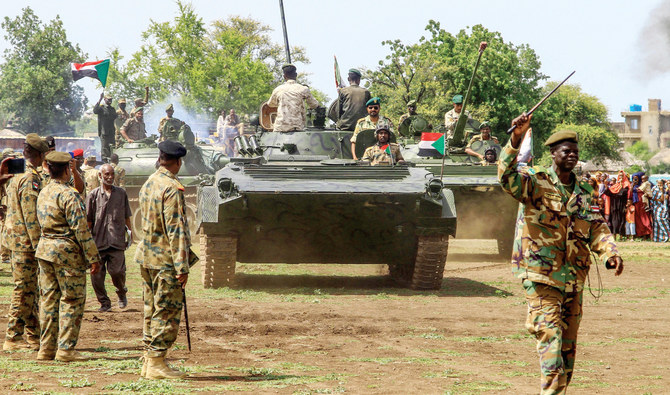
Sudanese security forces mark Army Day in the eastern Gadaref State on Monday. Fighting between the forces of rival generals has killed nearly 3,900 people. (AFP)
Short Url
Updated 14 August 2023
Follow

Sudan army chief accuses paramilitary forces of committing war crimes

  • Amnesty International has blamed both warring parties for committing deliberate killings of civilians as violence intensifies

WAD MADANI, Sudan: In a rare televised speech on Monday, the head of Sudan’s military accused the rival paramilitary force of committing war crimes as all-out civil war threatens to engulf the northeast African country.

Sudan was plunged into chaos in April when months of simmering tensions between the military, led by Gen. Abdel Fattah Al-Burhan, and the Rapid Support Forces, commanded by Mohammed Hamdan Dagalo, exploded into open fighting in Khartoum and elsewhere.

In a speech broadcast on Sudan TV, Gen. Al-Burhan accused the RSF and Dagalo of committing violations under the falsehood of promising to restore democracy.

“How can you bring about democracy by committing war crimes?” he said, in a speech celebrating Sudan’s annual armed forces day.

The rights organization Amnesty International has accused both warring parties of committing extensive war crimes, including deliberate killings of civilians and mass sexual assault. 

In its 56-page report, the group said almost all rape cases were blamed on the RSF and its allied Arab militias.

In Darfur, the scene of genocidal war in the early 2000s, the conflict has morphed into ethnic violence, with the RSF and allied Arab militias targeting African communities in the western region, UN officials say.

Last week the violence intensified in South Darfur province, killing dozens. 

The Darfur Bar Association, a Sudanese legal group focusing on human rights in the western Darfur region, said at least five civilians died in crossfire during intense clashes between the military and the RSF in Nyala, South Darfur’s capital, on Friday.

Some 50 km west of Nyala, Arab tribesmen riding RSF vehicles raided the Kubum area of South Darfur last week, burning down the local market and sacking a police station, the legal group said in a separate statement. At least 24 people were killed during the attack, it said.

Last Month, Karim Khan, a prosecutor from the International Criminal Court, told the UN that he would be investigating alleged new war crimes and crimes against humanity committed in Darfur.

The near four-month conflict has also reduced the capital, Khartoum, to an urban battlefield. 

Across the city, RSF forces have commandeered homes and turned them into operational bases, residents and doctors groups say. 

The army, in turn, has struck residential areas from the air and with artillery fire.  Over 2.15 million people have since fled Khartoum state, according to UN data.

Meanwhile, Meta confirmed that it had suspended the RSF’s account and the account belonging to Dagalo. 

Meta told the AP in an email that the group had violated its Dangerous Organizations and Individuals policy but did not provide any further details.

On its website, Meta says the policy aims to clamp down on “organizations or individuals that proclaim a violent mission or are engaged in violence.”

The RSF did not respond to AP’s request for comment. 

The paramilitary and Dagalo still have active accounts on X, the platform previously known as Twitter.

Syria’s leader set to visit Berlin with deportations in focus

Updated 2 sec ago
Follow

Syria’s leader set to visit Berlin with deportations in focus

BERLIN: Syrian President Ahmed Al-Sharaa is expected in Berlin on Tuesday for talks, as German officials seek to step up deportations of Syrians, despite unease about continued instability in their homeland.
Sharaa is scheduled to meet his counterpart Frank-Walter Steinmeier, the German president’s office said.
Chancellor Friedrich Merz’s office has yet to announce whether he would also hold talks with Sharaa during the visit.
Since ousting Syria’s longtime leader Bashar Assad in late 2024, Sharaa has made frequent overseas trips as the former Islamist rebel chief undergoes a rapid reinvention.
He has made official visits to the United States and France, and a series of international sanctions on Syria have been lifted.
The focus of next week’s visit for the German government will be on stepping up repatriations of Syrians, a priority for Merz’s conservative-led coalition since Assad was toppled.
Roughly one million Syrians fled to Germany in recent years, many of them arriving in 2015-16 to escape the civil war.
In November Merz, who fears being outflanked by the far-right AfD party on immigration, insisted there was “no longer any reason” for Syrians who fled the war to seek asylum in Germany.
“For those who refuse to return to their country, we can of course expel them,” he said.

- ‘Dramatic situation’ -

In December, Germany carried out its first deportation of a Syrian since the civil war erupted in 2011, flying a man convicted of crimes to Damascus.
But rights groups have criticized such efforts, citing continued instability in Syria and evidence of rights abuses.
Violence between the government and minority groups has repeatedly flared in multi-confessional Syria since Sharaa came to power, including recent clashes between the army and Kurdish forces.
Several NGOs, including those representing the Kurdish and Alawite Syrian communities in Germany, have urged Berlin to axe Sharaa’s planned visit, labelling it “totally unacceptable.”
“The situation in Syria is dramatic. Civilians are being persecuted solely on the basis of their ethnic or religious affiliation,” they said in a joint statement.
“It is incomprehensible to us and legally and morally unacceptable that the German government knowingly intends to receive a person suspected of being responsible for these acts at the chancellery.”
The Kurdish Community of Germany, among the signatories of that statement, also filed a complaint with German prosecutors in November, accusing Sharaa of war crimes, genocide and crimes against humanity.
There have also been voices urging caution within government.
On a trip to Damascus in October, Foreign Minister Johann Wadephul said that the potential for Syrians to return was “very limited” since the war had destroyed much of the country’s infrastructure.
But his comments triggered a backlash from his own conservative Christian Democratic Union party.